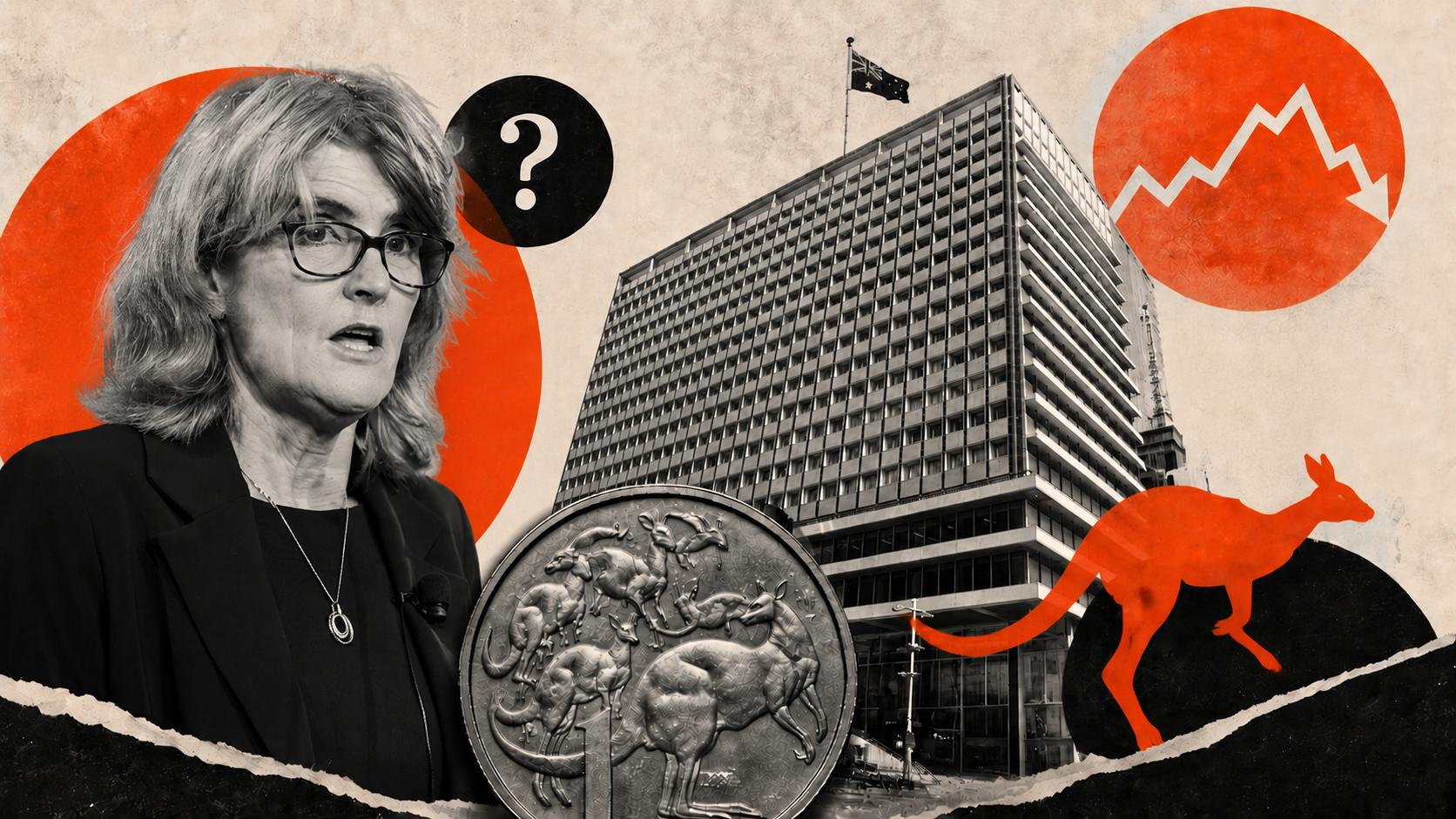
The RBA hiked and sounded hawkish. The Australian Dollar fell anyway — here’s why
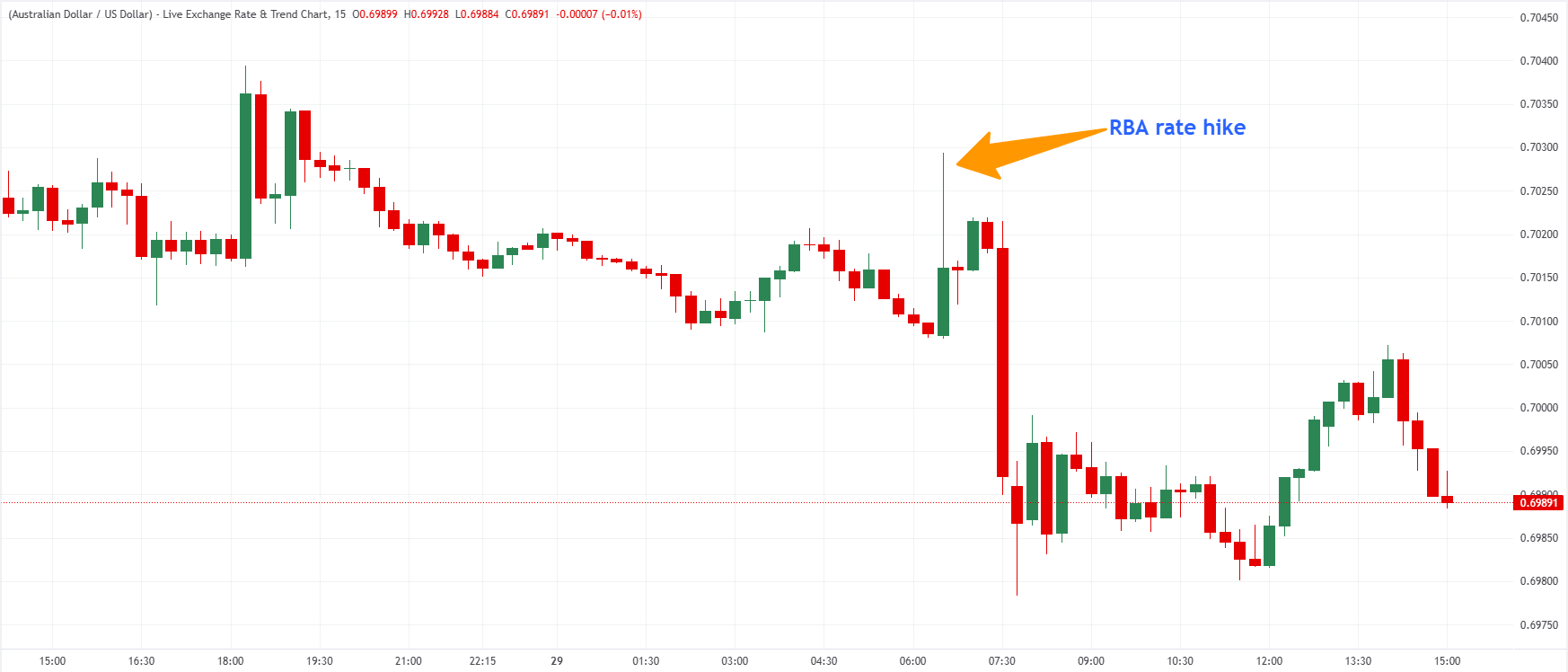
AUD/USD falls on Tuesday, erasing an initial advance to around 0.7030 despite the Reserve Bank of Australia (RBA) raising its Cash Rate by 25 basis points (bps) to 4.60%, the highest level in around 15 years.
At first glance, the Australian Dollar’s (AUD) decline appears counterintuitive. The RBA raised rates, warned that inflation remains too high and explicitly kept the possibility of additional tightening on the table. Higher interest rates would normally support a currency by increasing the return available on assets denominated in that currency.
Yet currencies rarely trade on the headline alone. Markets trade the difference between what happens and what investors had already expected to happen, as well as what a central bank’s decision says about the future path of monetary policy.
In this case, the 25-bps increase was largely priced in before the announcement. Once investors moved beyond the headline, RBA Governor Michele Bullock’s comments offered considerably less certainty that Tuesday’s hike would be followed by another one.
That distinction helps explain why the Australian Dollar rallied first and fell afterward.
The RBA delivered the hike markets were expecting
The RBA raised its benchmark rate from 4.35% to 4.60% after pausing its tightening campaign in June and August. The decision was unanimous and came as policymakers grew increasingly concerned about persistent inflationary pressures.
The central bank said some of the upside risks to inflation identified in August were materializing. It also maintained language indicating that it is prepared to increase the Cash Rate further if necessary to return inflation sustainably to target.
Governor Bullock reinforced some of that message during her press conference. She said inflation is being driven by domestic capacity pressures, that the labor market remains somewhat tight and that inflationary pressures could persist for longer than previously anticipated.
Bullock also said the Board will raise rates again if necessary and stressed that policymakers need to bring excess demand down. Taken in isolation, this is a hawkish message.
The problem for the Australian Dollar is that very little of the actual rate increase came as a surprise. Markets entered the meeting expecting a 25-bps hike, meaning that the currency needed something more than the hike itself to extend its gains.
The key question was therefore not whether the RBA would raise rates in September. It was whether the central bank would signal that another increase was likely to follow. On that question, the message becomes considerably more nuanced.
Bullock’s press conference changed the interpretation of the hike
The Australian Dollar’s reaction illustrates the difference between the RBA’s written statement and the information investors received during Bullock’s press conference. The most important revelation is that the Board considered both raising rates and leaving them unchanged.
Bullock also said she hopes the four rate increases delivered this year will prove restrictive enough to slow inflation and acknowledged that no additional hikes may be necessary if inflation declines as expected.
That does not amount to a dovish pivot. The RBA remains concerned about inflation and retains the option of tightening further. But it weakens the argument that Tuesday’s move necessarily represents the beginning of another sequence of rate increases.
Francesco Pesole, FX Strategist at ING, described the press conference as adding a “dovish taint” to an otherwise hawkish decision, pointing particularly to the fact that policymakers considered keeping rates unchanged because of risks to housing and the global economy.
This distinction matters because foreign exchange markets are forward-looking. The level of interest rates today matters, but the expected level several months from now can matter even more.
A hike to 4.60% followed by another increase would widen Australia’s prospective yield advantage. A hike to 4.60% followed by a prolonged pause is a different proposition, particularly if investors had already positioned for further tightening.
A risk-management hike, not a new tightening cycle
Another interpretation is that the RBA acted because the cost of allowing inflation risks to intensify was greater than the cost of delivering one additional rate increase, rather than because policymakers have concluded that rates need to rise substantially further.
TD Securities describes Tuesday’s decision as a “risk management hike” and maintains its expectation that the RBA will not raise rates again this year. That interpretation is consistent with several parts of Bullock’s press conference.
The Governor emphasized the lag with which monetary policy affects the economy. Previous rate increases are still passing through mortgages, household finances, consumption and broader demand, meaning that the RBA does not yet know the full impact of the tightening already delivered.
Bullock also downplayed the importance of reading too much into the upcoming monthly inflation data, arguing that monetary policy needs to be forward-looking rather than mechanically reacting to backward-looking figures.
Meanwhile, signs of softer domestic demand give the RBA another reason to proceed cautiously. Household spending data for August showed declines across six of nine categories and were flat overall on the month. Excluding transport, spending fell 0.4%. Housing and labor-market conditions are also easing, even if the RBA still considers the labor market relatively tight.
The resulting picture is therefore more complicated than the headline rate increase suggests. Inflation is uncomfortable enough to justify tighter policy, but the economy may be slowing enough to make the RBA reluctant to continue hiking aggressively.
Markets had already priced a hawkish RBA
There is also a classic market mechanism behind the Australian Dollar’s decline: expectations were already elevated before the decision. Interest-rate pricing showed investors assigned a 92% chance to a 25-basis-point hike to 4.60% on the eve of the decision, up from 78% two weeks earlier, according to the ASX RBA Rate Tracker.
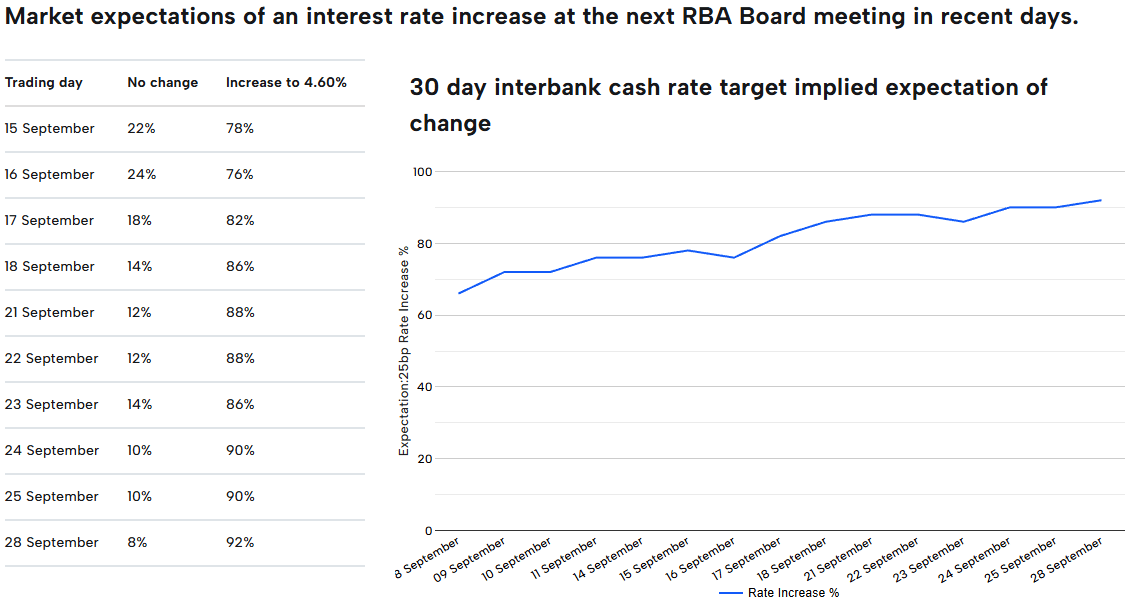
When traders broadly anticipate a central bank move, the rate decision itself has limited capacity to move the currency. What matters is whether the central bank delivers more or less than what is embedded in market pricing.
Commerzbank strategist Volkmar Baur noted that the RBA made an effort to maintain a hawkish communication, but the Australian Dollar quickly surrendered its initial gains. This can be understood as a “buy the rumor, sell the fact” dynamic.
The RBA does not merely need to be hawkish to support the Aussie when investors are already positioned for higher rates. It needs to be more hawkish than expected. Instead, Bullock gave markets several reasons to question the speed and extent of additional tightening.
This helps explain the two-stage reaction in AUD/USD. The pair initially jumped toward 0.7030 as algorithms and traders reacted to the higher Cash Rate and hawkish language in the statement. As the press conference developed and investors reassessed the probability of subsequent hikes, the rally reversed and AUD/USD fell below 0.7000.
The sequence itself tells an important story: the market liked the decision, but was less convinced by what came next.
What would make the Australian Dollar benefit from the RBA hike?
The Australian Dollar’s decline does not necessarily mean that the RBA hike is irrelevant for the currency. Rather, the decision raises the hurdle for what comes next. For the tightening story to become a stronger bullish catalyst, markets would likely need evidence that inflation remains sufficiently persistent to force the RBA into another increase despite the slowdown in parts of the domestic economy.
Conversely, softer inflation, weaker consumption or a clearer deterioration in labor-market conditions would strengthen the argument that 4.60% represents the peak of the cycle.
This is why upcoming Australian inflation figures will still matter even after Bullock cautioned against overreacting to a single monthly report. They will contribute to a broader assessment of whether Tuesday’s hike was the start of another tightening sequence or simply insurance against inflation risks.
The US side of the equation could ultimately prove just as important. ING still sees scope for AUD/USD to reach 0.7200 in December under a scenario in which the US Dollar (USD) weakens and global liquidity conditions improve. The bank nevertheless acknowledges that worsening global conditions have increased near-term downside risks.
That conditional outlook captures the broader lesson from Tuesday’s price action. A hawkish central bank is not automatically enough to produce a stronger currency. The surprise relative to expectations matters, the future path of rates matters and the policy trajectory on the other side of the currency pair matters.
The RBA delivered the hike. It did not deliver a convincing signal that another one is imminent. For AUD/USD, that difference proved more important than the 25 basis points themselves.
RBA FAQs
The Reserve Bank of Australia (RBA) sets interest rates and manages monetary policy for Australia. Decisions are made by a board of governors at 11 meetings a year and ad hoc emergency meetings as required. The RBA’s primary mandate is to maintain price stability, which means an inflation rate of 2-3%, but also “..to contribute to the stability of the currency, full employment, and the economic prosperity and welfare of the Australian people.” Its main tool for achieving this is by raising or lowering interest rates. Relatively high interest rates will strengthen the Australian Dollar (AUD) and vice versa. Other RBA tools include quantitative easing and tightening.
While inflation had always traditionally been thought of as a negative factor for currencies since it lowers the value of money in general, the opposite has actually been the case in modern times with the relaxation of cross-border capital controls. Moderately higher inflation now tends to lead central banks to put up their interest rates, which in turn has the effect of attracting more capital inflows from global investors seeking a lucrative place to keep their money. This increases demand for the local currency, which in the case of Australia is the Aussie Dollar.
Macroeconomic data gauges the health of an economy and can have an impact on the value of its currency. Investors prefer to invest their capital in economies that are safe and growing rather than precarious and shrinking. Greater capital inflows increase the aggregate demand and value of the domestic currency. Classic indicators, such as GDP, Manufacturing and Services PMIs, employment, and consumer sentiment surveys can influence AUD. A strong economy may encourage the Reserve Bank of Australia to put up interest rates, also supporting AUD.
Quantitative Easing (QE) is a tool used in extreme situations when lowering interest rates is not enough to restore the flow of credit in the economy. QE is the process by which the Reserve Bank of Australia (RBA) prints Australian Dollars (AUD) for the purpose of buying assets – usually government or corporate bonds – from financial institutions, thereby providing them with much-needed liquidity. QE usually results in a weaker AUD.
Quantitative tightening (QT) is the reverse of QE. It is undertaken after QE when an economic recovery is underway and inflation starts rising. Whilst in QE the Reserve Bank of Australia (RBA) purchases government and corporate bonds from financial institutions to provide them with liquidity, in QT the RBA stops buying more assets, and stops reinvesting the principal maturing on the bonds it already holds. It would be positive (or bullish) for the Australian Dollar.
Author

Ghiles Guezout
FXStreet
Ghiles Guezout is a Market Analyst with a strong background in stock market investments, trading, and cryptocurrencies. He combines fundamental and technical analysis skills to identify market opportunities.