The rate cut frenzy is starting to swing

Outlook: The rate cut frenzy is starting to swing! Bloomberg reports that “rate cut bets helped push Treasury yields lower as a surprise drop in UK retail sales added to the growing conviction that central banks are done with tightening.”
Got that? Economics data from another country affected US Treasuries and thus the dollar.
It’s not only cooler data that is feeding the rate cut frenzy—it’s a fresh acknowledgment that the awful geopolitical news is not a critical factor to financial market prices. We know that, hence the repeated comment that shutting down the US government, historically tended not to affect the dollar and the Ukraine war didn’t, either.
This time it looked like war in the Mideast would hit oil almost by definition, but look at the chart—oil is retreating on its own supply and demand factors, plus the crazy gene the traders all seem to have. Reuters’ Dolan notes “After a brief jump following the attacks on Israel last month, crude oil prices have already reversed all of their gains and are plumbing their lowest levels since July - down 23% in six weeks and tracking year-on-year declines of 14%.”
Apparently the relative unimportance of geopolitical events is something that has to be learned repeatedly. They are a “known unknown,” as Reuters’ Dolan puts it, or as the BoA investment manager survey puts it, tail risk.
The horse has the bit in its mouth and is running away. All the sane and reasonable talk about those bumps in the road and inflation surprises has gone to nought. This horse will jump right over them. Once this kind of move gets going, it’s irrelevant whether it’s commensurate with the data.
Our other favorite writer, John Authers at Bloomberg, has a cute story on the number of times “soft landing” has been appearing in its own stories plus others. It had been fading a bit but has come back now. More interesting, the incidence of gloomster hard-landing stories never took off. Sorry, Mr. Summers.
We know this kind of excitement is never long-lasting. Reality will bite at some point. But it’s a Big One. We know it’s Big because we got blindsided by the dollar/yen, crashing down to 149.50 when it looked like 152 would be the next test—and 152+ is the realistic way of looking at the rate differential, not to mention growth.
Forecast: Yesterday we wrote that the dollar pushback was exceptionally early after the giant breakout move—but not the real-deal comeback. Short-lived, but the same rules apply—wait for the prove-it criteria to be met. That includes match-and-surpass the previous high, the safe bet, hard as it may be to wait around for it. Another choice is hitting a Fib level, or a moving average, or a previous low if visibly notable enough.
And then there is the horror show of none of these “normal” things happening. Prices simply refuse to move in straight lines or tidy waves. We face an interesting set of conditions today because it’s Friday and because next week is a holiday week in the US. The test will be whether the euro/USD matches-and-surpasses the previous high at 1.0896 into the 1.09’s. We wouldn’t bet against it. If we get that higher high, Monday will be a dollar bloodbath as the rest of the world jumps on the bandwagon.
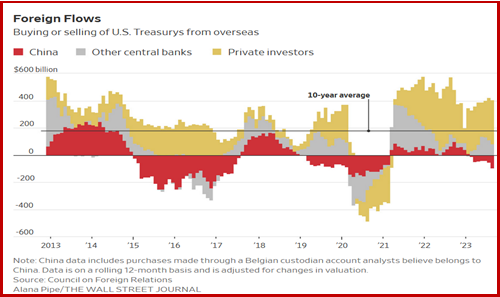
Tidbit: Every once in a while, the Treasury International Capital report gets a headline. Usually it’s a scare story about how the US and dollar are falling out of favor. At some point there really will be a wolf. The WSJ thinks that time is now, and has a front-page story about a shift in supply (higher) and demand (lower, especially from China and Japan).
“Foreigners, including private investors and central banks, now own about 30% of all outstanding U.S. Treasury securities, down from roughly 43% a decade ago, according to data from the Securities Industry and Financial Markets Association.
“Overseas investors sold a net $2.4 billion in long-term Treasurys in September, bringing their holdings to $6.5 trillion, according to data from the U.S. Treasury released Thursday. On a rolling 12-month basis, which helps to smooth out volatility in monthly data, the pace of foreign buying has eased to around $300 billion in recent months from levels above $400 billion for much of last year, according to data from the Council on Foreign Relations that also adjusts for changes in valuation.”
Goldman says the shift is not structural. Old buyers (China) are being replaced by new buyers (Middle East). Still, as Bloomberg reports, it’s the first outflow since 2021 and that might scare some folks. Congress, maybe.
This is an excerpt from “The Rockefeller Morning Briefing,” which is far larger (about 10 pages). The Briefing has been published every day for over 25 years and represents experienced analysis and insight. The report offers deep background and is not intended to guide FX trading. Rockefeller produces other reports (in spot and futures) for trading purposes.
To get a two-week trial of the full reports plus traders advice for only $3.95. Click here!
This is an excerpt from “The Rockefeller Morning Briefing,” which is far larger (about 10 pages). The Briefing has been published every day for over 25 years and represents experienced analysis and insight. The report offers deep background and is not intended to guide FX trading. Rockefeller produces other reports (in spot and futures) for trading purposes.
To get a two-week trial of the full reports plus traders advice for only $3.95. Click here!
Author

Barbara Rockefeller
Rockefeller Treasury Services, Inc.
Experience Before founding Rockefeller Treasury, Barbara worked at Citibank and other banks as a risk manager, new product developer (Cititrend), FX trader, advisor and loan officer. Miss Rockefeller is engaged to perform FX-relat














