The Japanese Yen's Friday hinges on one press conference
The Japanese Yen (JPY) remains under pressure against the US Dollar (USD) after a weak start to the week, stabilizing near recent lows as investors focus on the Bank of Japan's (BoJ) monetary policy decision on Friday.
While the central bank is widely expected to keep its benchmark interest rate unchanged at 1.25%, market attention is increasingly shifting toward the message BoJ Governor Kazuo Ueda will deliver during his post-meeting press conference. After raising interest rates in September, the BoJ could formally acknowledge that underlying inflation is now consistent with its 2% target, marking a shift in monetary policy from pushing inflation higher to keeping it sustainably anchored around that level.
The question is therefore no longer simply whether the BoJ will raise interest rates again, but when it will take the next step. A sufficiently hawkish message could reinforce expectations of a December rate hike and support the Japanese Yen. Conversely, cautious communication could revive selling pressure on the Japanese currency.
Bank of Japan prepares to pause, but monetary tightening is far from over
The Bank of Japan is expected to maintain its benchmark interest rate at 1.25% on Friday, after raising it in September to its highest level in 31 years. Such a pause would allow policymakers to assess the impact of previous rate increases on the economy and financial conditions. According to a CNBC survey conducted among 16 economists and analysts between October 14 and 26, all respondents expect the central bank to leave rates unchanged this week. However, they also anticipate another rate hike in December or January.
The upcoming meeting could nevertheless mark an important shift in Japan's monetary policy strategy. The BoJ could formally acknowledge that underlying inflation has reached 2%, following years of efforts to stimulate price growth. The central bank's objective would then shift toward sustainably stabilizing inflation around that level rather than continuing to encourage its acceleration. Such a transition could justify further interest rate increases, even without an immediate acceleration in inflation.
Japanese inflation strengthens the case for a December rate hike
The latest economic data support further monetary tightening. Japan's National Consumer Price Index (CPI) rose 2.1% YoY in September, up from 1.9% previously. Inflation excluding fresh food also reached 2.1%, while the measure excluding fresh food and energy climbed to 2.4%, compared with 2% in August.
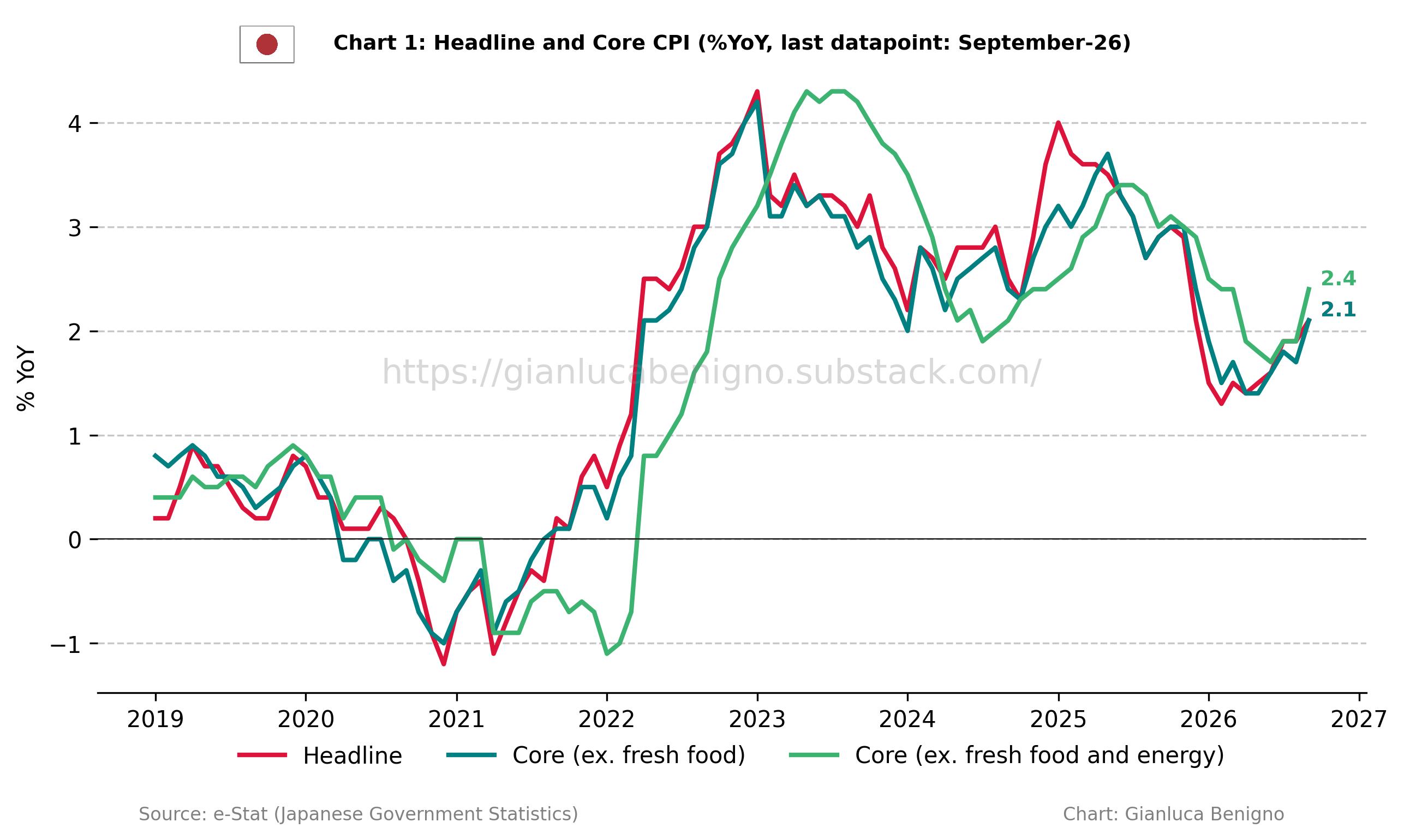
These figures suggest that inflationary pressures are gradually spreading beyond fluctuations in energy prices.
Wage growth is another important factor. According to government data cited by CNBC, Japan's inflation-adjusted wages increased 1.5% YoY in August, marking their eighth consecutive month of growth. This development could support inflation increasingly driven by domestic demand, strengthening the case for further monetary policy normalization.
Danske Bank analysts highlight this trend, noting that "Inflationary pressures are starting to put more pressure on Bank of Japan to hike rates again." They added: "A solid growth picture points towards another BoJ rate hike in December, as we see it."
However, the BoJ must also consider the economic consequences of rising energy prices, particularly their impact on household consumption and corporate profit margins. In its semiannual Financial System Report released on Friday, the central bank emphasized that Japan's financial system remains broadly stable, while highlighting the pressure exerted by energy and raw material costs on small and medium-sized enterprises.
These considerations help explain why policymakers may favor gradual normalization rather than an abrupt acceleration in interest rate increases.
Kazuo Ueda holds the key to December rate expectations
Governor Kazuo Ueda's press conference could prove to be the real catalyst for Friday's trading session. According to Daiwa Securities, three elements will be particularly important: the formal recognition that underlying inflation has reached about 2%, indications of a potential December rate hike, and the assessment of financial conditions.
The choice of words could make all the difference. In its report, Daiwa highlights that investors will closely monitor whether Ueda continues to say policy decisions will be made "at every meeting", or adopts more explicit language such as "discussed at the next meeting or later". The latter wording could be interpreted as a more direct signal that another rate hike may come as soon as December.
The BoJ's quarterly economic projections will also come under scrutiny. Reuters reported that the central bank could slightly raise its inflation forecasts for fiscal year 2027, reflecting higher Oil prices.
Nevertheless, overly cautious communication could disappoint investors. MUFG noted that Kazuo Ueda's communication style could limit the Japanese Yen's appreciation potential in the near term: "While we expect the BoJ to signal more rate hikes are necessary, Ueda’s style of communication suggests he may not provide a strong message on a move in December that remains 80% priced."
This contrast between a monetary policy outlook supportive of the Japanese Yen and the risk of cautious communication makes the market's reaction particularly uncertain.
Japanese Yen: Two scenarios for Friday's market reaction
Ultimately, the Japanese Yen next move could depend more on Kazuo Ueda's tone than on the monetary policy decision itself. In a Yen-positive scenario, the BoJ confirms that underlying inflation has reached its target, maintains that financial conditions remain accommodative, and clearly leaves the door open to a December rate hike. Such a combination could strengthen monetary tightening expectations and support the Japanese currency.
Conversely, if Ueda emphasizes the need to examine additional economic data, highlights risks to economic growth, or avoids providing guidance on December, investors could scale back their rate hike expectations. The JPY could then weaken.
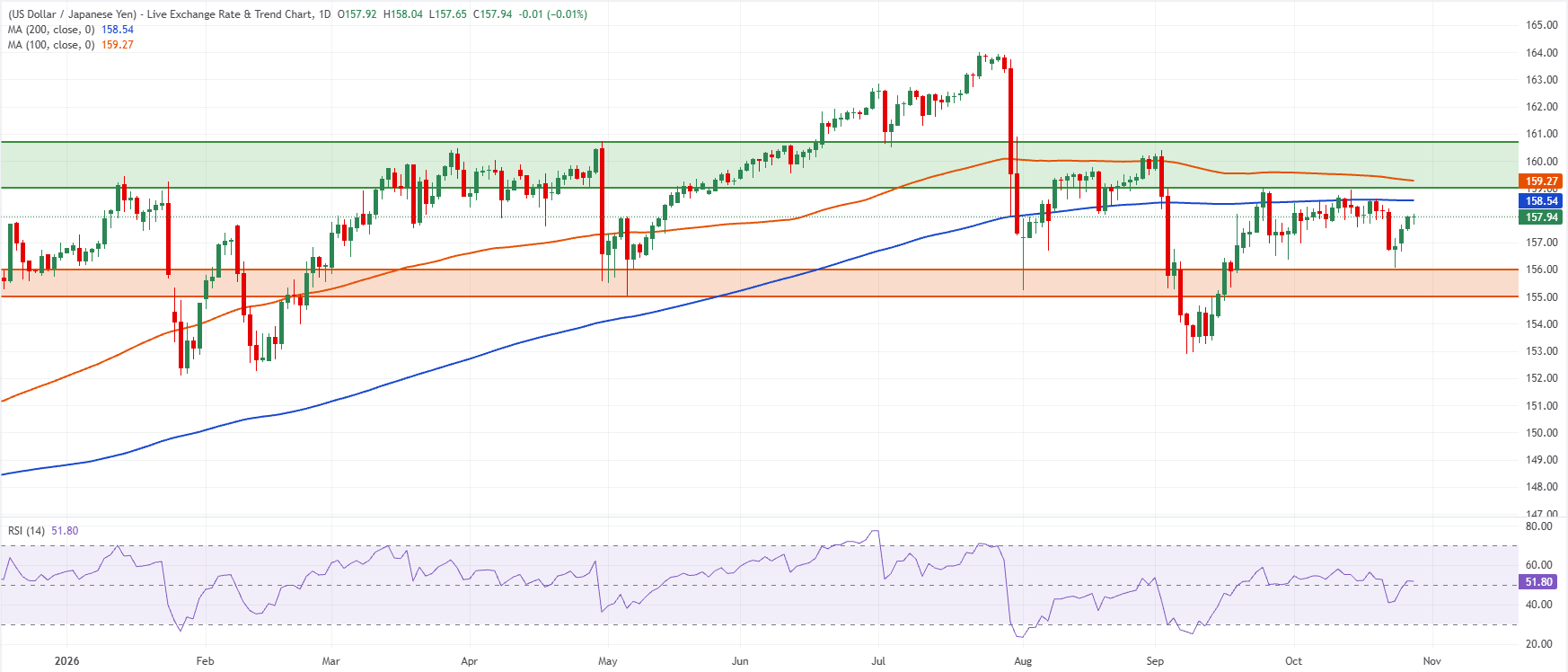
On the daily chart, USD/JPY trades slightly below the 200-day Simple Moving Average (SMA) at 158.54 and the 100-day SMA near 159.27. The pair remains confined between a major support zone at 155.00-156.00 and a resistance area at 159.00-160.70. The Relative Strength Index (RSI), hovering around 52, indicates relatively neutral momentum.
A hawkish message from the BoJ could trigger another decline toward 156.00, followed by 155.00. A break below this support zone would increase the risk of a deeper correction.
Conversely, cautious remarks from Kazuo Ueda could encourage a recovery toward 159.00-160.70. A sustained breakout above this resistance zone would open the door to a more significant USD/JPY advance.
Friday's widely anticipated rate hold therefore appears largely priced in. Kazuo Ueda's ability to convince investors that another rate hike is coming could ultimately determine the Japanese Yen's next direction.
Bank of Japan FAQs
The Bank of Japan (BoJ) is the Japanese central bank, which sets monetary policy in the country. Its mandate is to issue banknotes and carry out currency and monetary control to ensure price stability, which means an inflation target of around 2%.
The Bank of Japan embarked in an ultra-loose monetary policy in 2013 in order to stimulate the economy and fuel inflation amid a low-inflationary environment. The bank’s policy is based on Quantitative and Qualitative Easing (QQE), or printing notes to buy assets such as government or corporate bonds to provide liquidity. In 2016, the bank doubled down on its strategy and further loosened policy by first introducing negative interest rates and then directly controlling the yield of its 10-year government bonds. In March 2024, the BoJ lifted interest rates, effectively retreating from the ultra-loose monetary policy stance.
The Bank’s massive stimulus caused the Yen to depreciate against its main currency peers. This process exacerbated in 2022 and 2023 due to an increasing policy divergence between the Bank of Japan and other main central banks, which opted to increase interest rates sharply to fight decades-high levels of inflation. The BoJ’s policy led to a widening differential with other currencies, dragging down the value of the Yen. This trend partly reversed in 2024, when the BoJ decided to abandon its ultra-loose policy stance.
A weaker Yen and the spike in global energy prices led to an increase in Japanese inflation, which exceeded the BoJ’s 2% target. The prospect of rising salaries in the country – a key element fuelling inflation – also contributed to the move.
Author

Ghiles Guezout
FXStreet
Ghiles Guezout is a Market Analyst with a strong background in stock market investments, trading, and cryptocurrencies. He combines fundamental and technical analysis skills to identify market opportunities.