The Japanese Yen's 160 line is back — and this time the setup is different

USD/JPY is approaching the psychologically important 160.00 round mark again, its highest level since early September, bringing the Japanese Yen (JPY) dangerously close to levels that have previously triggered intervention by Japanese authorities.
The return toward 160.00 is particularly significant because Japan has already intervened twice this year to defend its currency, including a coordinated operation with the United States (US) during the summer. However, the current situation presents a new challenge: the US Dollar (USD) is strengthening as investors increasingly anticipate a prolonged interest-rate-hiking cycle by the Federal Reserve (Fed), potentially limiting the effectiveness of Japanese intervention.
Why the 160.00 level matters more than ever
The 160.00 level has become a critical reference point for currency traders following Japan's repeated interventions earlier this year. Japanese authorities first stepped into the Foreign Exchange market in late April and early May after USD/JPY moved above 160.00. A second wave of intervention followed between July 30 and August 3, including a rare coordinated operation with the US Treasury.
These interventions demonstrate Tokyo's willingness to counter excessive currency depreciation, although they have not prevented USD/JPY from returning to the same critical level. On Thursday, Japan's Vice Finance Minister for International Affairs and top currency diplomat Atsushi Mimura delivered a fresh warning as the pair approached 160.00, telling reporters that"It's still too early to forget what happened this summer," according to Reuters.
His remarks suggest that Japanese authorities are increasingly uncomfortable with the pace of the Japanese Yen's depreciation, even if they have not explicitly identified 160.00 as a level that would automatically trigger intervention.
MUFG Strategist Lee Hardman believes the latest warnings carry significant weight. "It sends a strong signal that Japan is prepared to intervene again to support the yen, which should help to limit further upside for USD/JPY beyond 160.00," notes Hardman.
However, intervention risks alone may not be enough to reverse the broader trend, especially while US monetary policy expectations continue to favor the US Dollar.
Hawkish Fed expectations are changing the equation
Unlike previous episodes of Japanese Yen weakness, the latest USD/JPY rally coincides with a sharp repricing of Fed interest rate expectations, following hawkish comments from policymakers and stronger-than-expected US inflation figures. Tuesday's Consumer Price Index (CPI) report showed headline inflation rising 0.4% MoM in October, exceeding the 0.3% forecast. Core inflation increased 0.3% over the same period, also beating expectations of 0.2%.

The figures reinforced warnings from Fed Governor Christopher Waller, who indicated that a larger 50-basis-point interest rate increase could be necessary in December if core inflation remained elevated.
According to the CME FedWatch Tool, investors now assign a 90% chance to a 25-basis-point rate hike in December and a 10% chance of a larger 50-basis-point increase. This means markets fully price in at least a quarter-point increase at the next meeting. More importantly, expectations extend well beyond December. Markets assign nearly a 62% chance to another 25-basis-point increase in January. A third consecutive increase in March is also becoming a realistic possibility, although far from certain; investors assign approximately a 41% chance to another quarter-point hike that month, compared with 43% for unchanged rates.
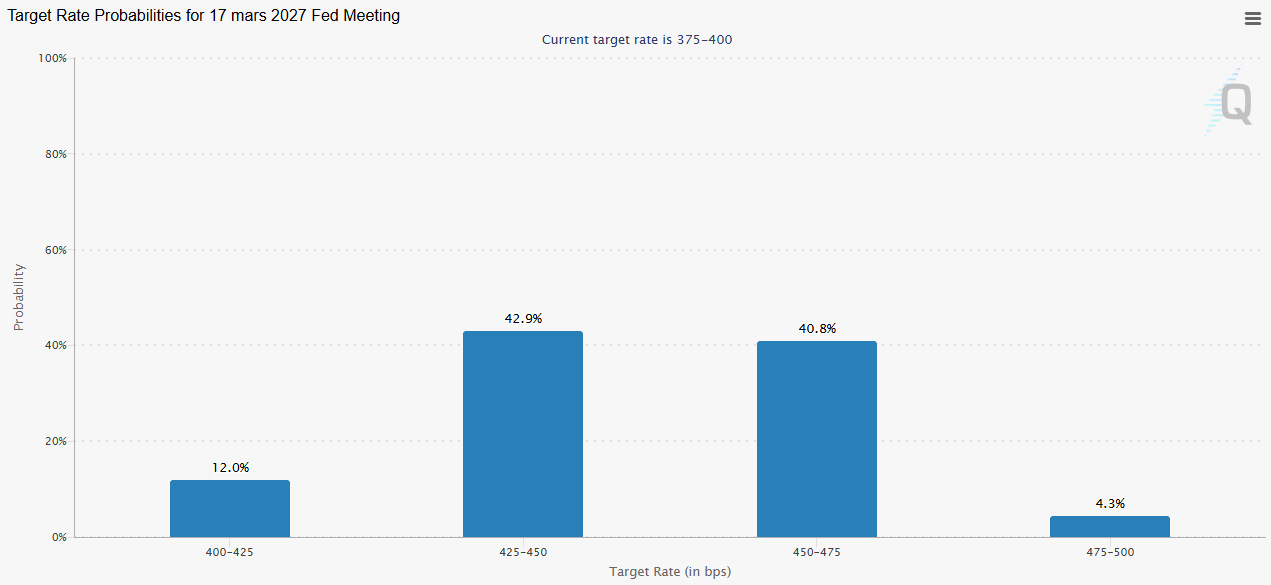
This evolving outlook suggests that the Fed could maintain its tightening cycle into early 2027, keeping US Treasury yields elevated and reinforcing the appeal of USD-denominated assets. The challenge for Japan is that even additional tightening by the Bank of Japan (BoJ) may not significantly narrow the interest rate differential between the two economies.
Japan faces a policy dilemma as inflation accelerates
Japan's domestic economic conditions provide further reasons for the BoJ to consider raising interest rates. Data released on Thursday showed that the Japanese Producer Price Index (PPI) accelerated to 7.1% YoY in October, exceeding expectations of 6.5% and September's 6.8% increase. Meanwhile, import prices denominated in Yen surged 24.8% from a year earlier, illustrating how currency depreciation is increasing costs for Japanese businesses and households.
However, BoJ officials remain divided over the appropriate pace of monetary tightening. Board member Toichiro Asada warned on Thursday that further rate hikes could weaken underlying inflation by putting additional pressure on already fragile domestic consumption. His cautious stance contrasts with growing expectations of another BoJ rate increase in December, creating uncertainty over the central bank's ability to support the Japanese currency through monetary policy.
The resulting policy divergence leaves the Japanese Yen caught between two opposing forces: the prospect of currency intervention and domestic monetary tightening on one side, and an increasingly hawkish Fed on the other.
Can 160.00 stop the USD/JPY rally again?
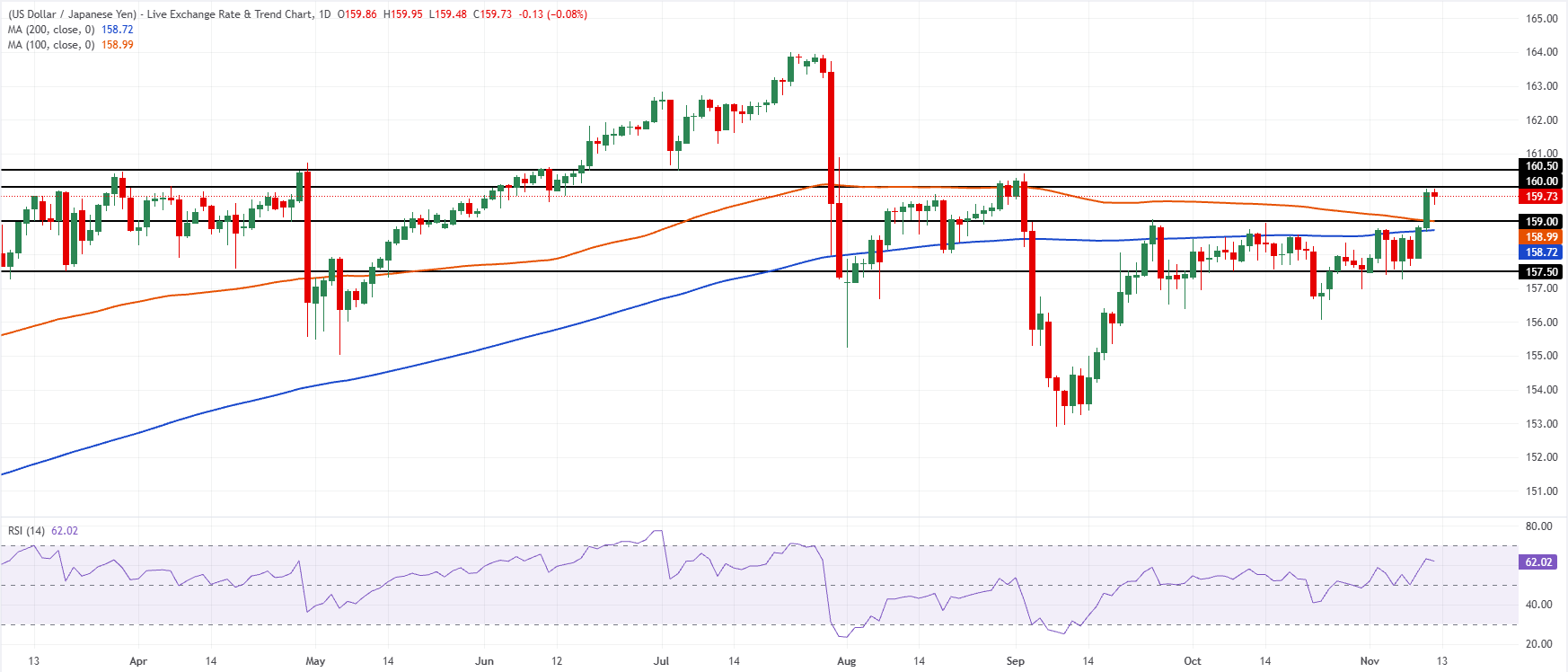
USD/JPY maintains a bullish technical bias on the daily chart after breaking above the 159.00 resistance level, which had repeatedly limited upside attempts since September. The pair now consolidates after approaching the psychological 160.00 barrier on Wednesday, with intervention warnings triggering a modest pullback on Thursday.
The bullish breakout is reinforced by the pair trading above both the 100-day Simple Moving Average (SMA), currently near 158.99, and the 200-day SMA at 158.72. Meanwhile, the Relative Strength Index (RSI) stands around 62, suggesting positive momentum without entering overbought territory.
A sustained break above 160.00 would expose the next resistance at 160.50, potentially opening the door to a broader advance toward 161.00. However, intervention concerns could make any move beyond this level particularly volatile.
Conversely, failure to overcome 160.00 could encourage profit-taking, with initial support at 159.00, reinforced by the 100-day SMA. A break below this area would weaken the immediate bullish outlook and expose the 200-day SMA around 158.72, followed by the horizontal support at 157.50.
For now, the technical momentum favors further upside, but the proximity of 160.00 creates an unusually delicate situation. The question is no longer simply whether the US Dollar can break higher, but whether Japanese authorities will allow it to do so without responding.
Author

Ghiles Guezout
FXStreet
Ghiles Guezout is a Market Analyst with a strong background in stock market investments, trading, and cryptocurrencies. He combines fundamental and technical analysis skills to identify market opportunities.