The German stock market collapse

According to a report from the International Monetary Fund, Germany might be the only major economy to experience contraction in 2023, lagging behind the growth of the United States, United Kingdom, Spain, and France over the next five years.
This instability is attributed to several factors
-
A lack of investment in new technologies, reliance on cheaper Russian gas, and bureaucratic conservatism limited business development. Moreover, Geopolitical tensions and carbon emissions issues worsened the situation.
-
Transitioning to green energy also faces challenges. With high energy consumption and weak infrastructure, Germany has fallen behind in energy transformation, potentially losing competitiveness.
-
The labor market situation is equally concerning. Shortages in qualified workforce are intensifying, with over 40% of German companies reporting skilled labor deficits. Moreover, two million Germans are set to retire within the next five years.
-
High inflation of 6.2% despite the key rate of 4.25% continues to require hawkish action from the ECB. Further rate hikes will continue to put pressure on the economy.
-
Capital outflows have surpassed $630 billion since 2013, with over 40% occurring in the last two years.
Whether new technologies can thrive in Germany and whether there are sufficient resources is a rhetorical question. The nation faces a complex challenge requiring concerted efforts and innovative solutions to regain its economic momentum. However, these solutions won’t be found shortly, and the German stock market will experience a significant decline. Moreover, since Germany is the largest European Union economy, its problems will affect the neighboring countries. As a result, the Union may keep losing attractiveness to foreign investors, weakening the EUR.
DAX (DE30) technical analysis
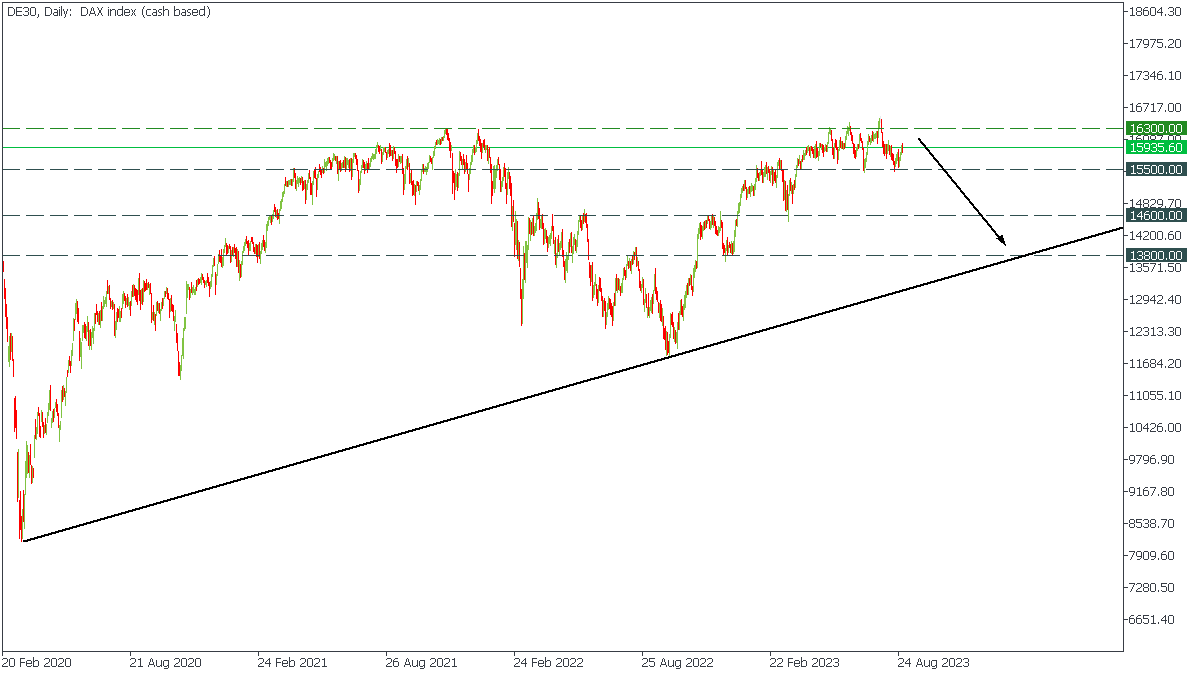
The DAX stock market index is trading near its all-time high (ATH), displaying a rounding reversal pattern indicative of major players redistributing their positions. This pattern was replicated in the autumn of 2021, leading to a 26% index drop by the following fall in 2022. Anticipating a similar situation, traders may foresee a potential price decline to the support decline in the fall of 2023.
Before the massive plunge, the price could surge toward the 16 300-resistance level, providing opportunities for sell trades around this point. In such a scenario, the following levels might serve as targets:
-
Short-term speculative targets: 15 500.
-
Medium-term: 14 600, 13 800.
EUR/USD technical analysis
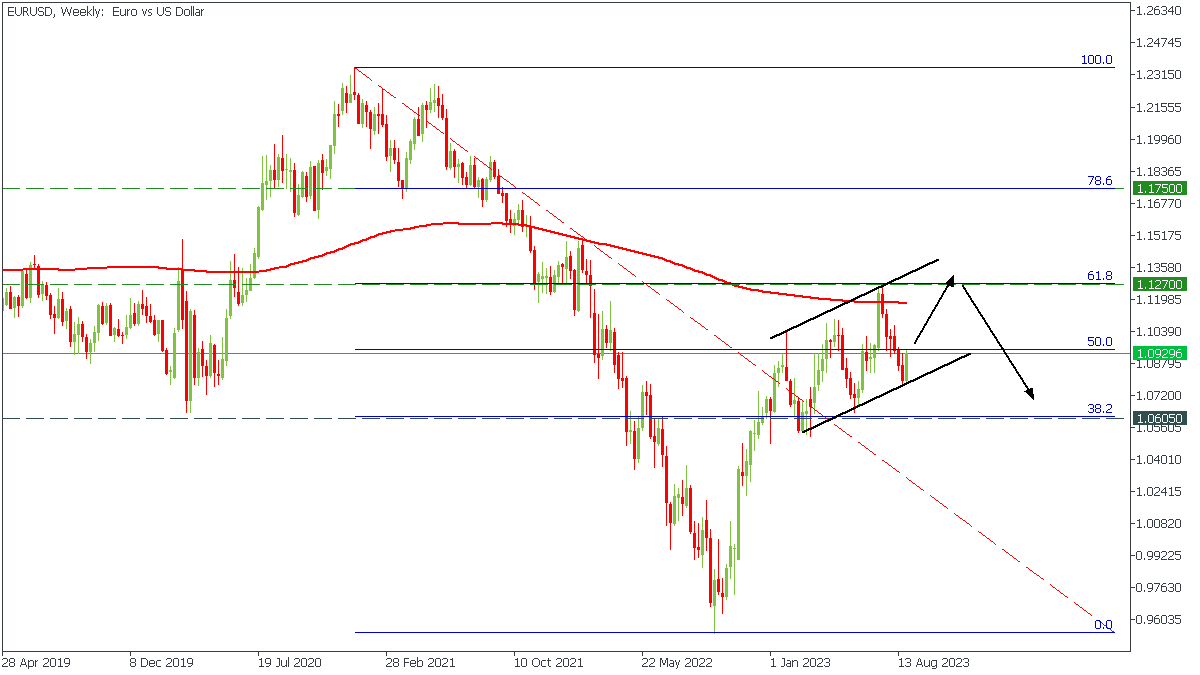
Recently, the EURUSD pair experienced a rebound from the support trendline, with a projected trajectory towards the 200-week Moving Average (MA). Notably, in July, the price could not breach the 61.8 level, a significant bearish signal, as this level commonly serves as a key determinant, distinguishing between trend corrections and reversals. As a result, as long as the pair stays below 1.1270, this level continues to be a significant resistance, marking a prevailing downtrend for the EURUSD pair. Traders may look for sell opportunities around this level with targets at 1.0930 and 1.0605, respectively, and 50.0 and 38.2 Fibonacci levels
This article is sponsored content
Author

FBS Team
FBS
FBS team is a group of professional analysts focused on Forex, stock, and commodity markets. Each expert possesses a years-long experience in fundamental and technical analysis.

















