The Federal Reserve is bleeding red ink and you're on the hook
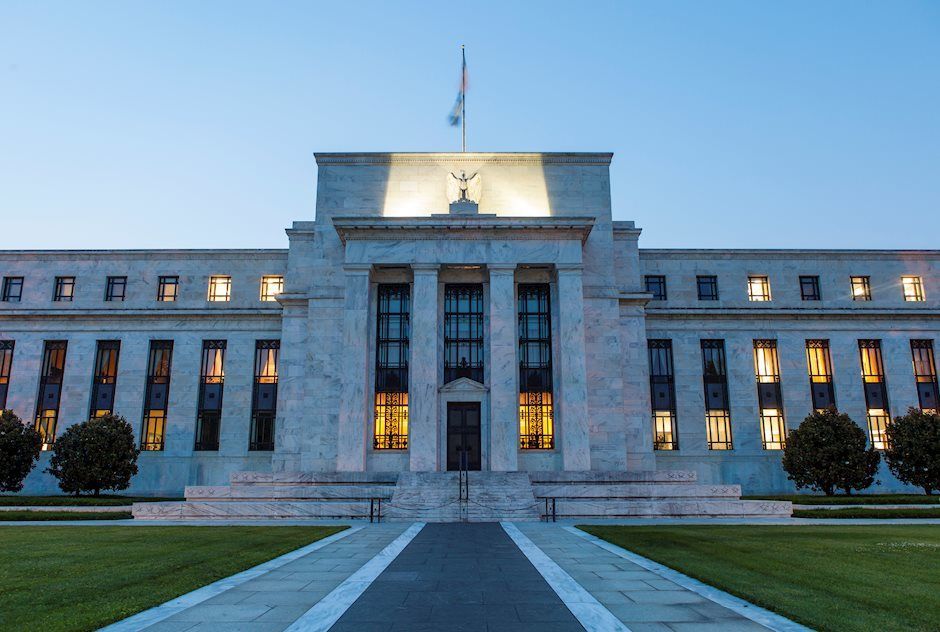

The Federal Reserve is losing over $1 billion every week and you're on the hook.
Since September 2022, the central bank has reported losses of around $176.4 billion. If it was a real company, it would be considered bankrupt.
Fortunately for the Fed, it gets to make up its own accounting rules. Unfortunately for you the taxpayer, you're going to pay for the central bank's losses.
Why is the Fed losing so much money?
It's a function of interest rates.
Since the Fed hiked rates to battle price inflation, it has been paying commercial banks more for the reserves it holds on their behalf. Meanwhile, earnings on the assets held on its balance sheets have decreased.
Wall Street on Parade reported that commercial banks have been earning 5.4 percent on their reserves at the Fed for nearly a year.
"A significant part of that generous payout has been going to megabanks like JPMorgan Chase and Bank of America. ... These megabanks aren’t passing along that generosity to their customers’ savings accounts, since those savings accounts continue to pay the preposterously low rate of 0.01 percent interest, despite 11 rate hikes by the Fed since 2022."
The other part of the problem is the bonds the Fed purchased during multiple rounds of quantitative easing (QE) were relatively low-yielding. Meanwhile, the central bank has been shrinking its balance sheet.
In effect, it's paying more and earning less.
The St. Louis Fed explained it this way:
Tightening causes the net interest rate spread to fall; that is, it causes net income to fall for a constant size of the Fed’s balance sheet. This occurs because the Fed runs a maturity mismatch: It owns long-term securities and owes short-term liabilities.
Specifically, when the Fed raises the policy rate, it is immediately paying more interest on bank reserves and reverse repos—a large portion of the Fed’s liabilities: 42.5 percent and 17.0 percent, respectively, as of Nov. 8, 2023. However, the Fed’s assets are longer-term and often pay a fixed interest rate. Therefore, when the Fed raises the policy rate, its net interest rate spread falls.
Paying more and earning less isn't exactly a sustainable business model -- at least not in the real world.
So, how is this your problem?
It's a trickle-down effect.
Under the Federal Reserve charter, the central bank remits net operating profits to the U.S. Treasury. This serves as an income source for the federal government and lowers the budget deficit. But there is no operating profit. That means the Treasury lost its payday. That results in even bigger budget deficits.
And who pays for budget deficits?
Ultimately, you do.
Bigger deficits mean Congress either has to raise taxes, or the Treasury must borrow even more money. Either way, taxpayers pay. They either get a bigger tax bill, or they pay for the borrowing via the inflation tax when the Fed prints money to monetize the debt.
Meanwhile, it’s business as usual over at the Eccles Building.
For a normal business, bleeding red ink is bad news. Big losses force managers must take drastic measures. They have to slash costs. Sometimes they lay off employees.
If losses mount high enough, they might have to borrow money or sell assets. If they can’t stop the business from bleeding red ink, the company will ultimately face bankruptcy.
But when the Fed loses money, the central bankers don’t have to do anything other than some creative accounting.
We live in a world where the Fed makes its own rules. In Fed accounting, a net loss magically transforms into a “deferred asset.”
You read that right. Losses become an “asset” on the Federal Reserve's balance sheet.
The Fed explained the “deferred asset” like this:
[I]n the unlikely scenario in which realized losses were sufficiently large enough to result in an overall net income loss for the Reserve Banks, the Federal Reserve would still meet its financial obligations to cover operating expenses. In that case, remittances to the Treasury would be suspended and a deferred asset would be recorded on the Federal Reserve’s balance sheet.
Under Generally Accepted Accounting Principles, operating losses reduce a business’s reported capital or surplus. But in Fed accounting, the central bank simply creates an “asset” on its balance sheet out of thin air equal to the loss. Business goes on as usual. If losses mount, the size of this “asset” grows.
Don’t you wish the IRS would let you use “innovative” accounting on your tax returns?
It’s important to note that there is no limit to the size of a “deferred asset,” and it could theoretically exist forever.
Once the Fed starts making money again, it will reduce the amount of this imaginary asset with its profits. That means the U.S. Treasury won’t see another dime from the Fed until this “asset” is zeroed out.
According to an analysis by the St. Louis Fed, the deferred asset won't be paid off until late 2027 or early 2028.
This means as long as the Fed continues to lose money and during the time it pays down its “deferred asset,” the federal government will experience a reduction in revenue resulting in budget deficits higher than they otherwise would have been.
And you will be footing the bill.
To receive free commentary and analysis on the gold and silver markets, click here to be added to the Money Metals news service.
Author
Mike Maharrey
Money Metals Exchange
Mike Maharrey is a journalist and market analyst for MoneyMetals.com with over a decade of experience in precious metals. He holds a BS in accounting from the University of Kentucky and a BA in journalism from the University of South Florida.