The ES is climbing higher as the bears get squeezed out.


Few believe in the stock rally, which is why it continues to run.
Ironically, it is probably the bears themselves who are forcing stock prices higher. In the futures markets, speculators are holding one of the largest net short positions we have seen in a 12-month rolling calendar. To be fair, the position is somewhat moderate at far less than 100,000 contracts but it is worth noting that most traders are playing the downside.
This is important for a few reasons; first, most of the speculative selling has likely already taken place (leaving the path of least resistance higher). Also, a bearish market composition adds fuel to the fire as those short the market are forced to cover positions at higher prices due to a lack of money, margin, or conviction. Keep in mind, if the masses are expecting one thing the markets usually do the opposite.
Treasury Futures Markets

30-year Treasury Bond Futures
We literally have NOTHING to say about Treasuries.
It doesn't happen often, but we don't have an opinion either way in bonds and notes..and haven't for weeks. The market is trading in a tight sideways pattern until it breaks out we don't see much of an edge.
Treasury futures market consensus:
We are neutral and hoping for a clue.
Technical Support: ZB : 143'17, 142'30 and 141'28 ZN: 121'21, 121'10 and 120'02
Technical Resistance: ZB: 146'22 and 148'0 ZN: 123'05 and 123'20
Stock Index Futures
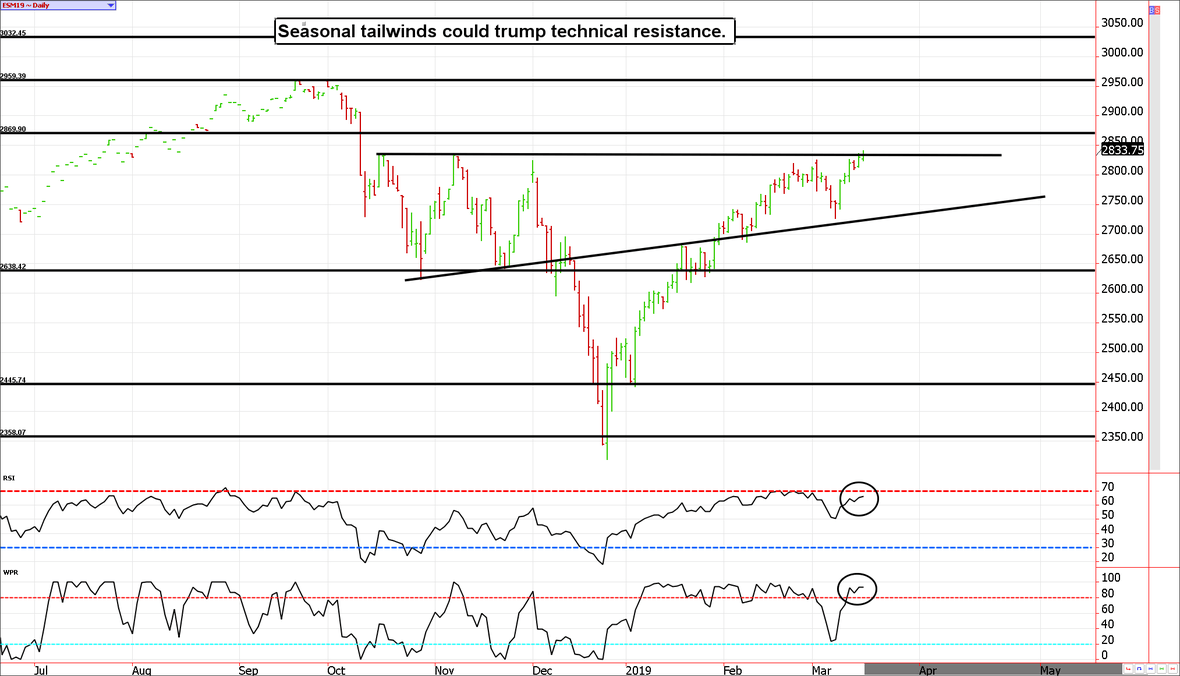
The ES is on the verge of a breakout, and it feels like it will do just that.
We are generally most comfortable being contrarians; this often means being bearish when prices are relatively lofty and bullish on large dips. After all, the market tends to jump on the bandwagon after most of the move has taken place. However, despite conventional wisdom pointing toward an overheated equity market market (saturated technical oscillators and overhead resistance), we find ourselves in a situation in which being a contrarian means being bullish in a relatively high-priced market.
This is an odd scenario; in more normal markets conditions traders are mostly positioned on the bearish side of the market as prices are nearing a low (not a high). Conversely, market peaks are often associated with an overly bullish speculative crowd. Either the current environment is an accident waiting to happen, or the bull run has a significant amount of room to run. We are siding with the latter at this time.
We are looking for the June E-mini S&P 500 to run toward 2870 this week and, in the coming weeks, we believe 2960 will be seen. On the flip side, the market is pressing up against resistance, so there is a legitimate argument for playing the downside. That said, any speculative bearish places should be very well-hedged; it is rare for the majority to be accurate in direction.
Stock index futures market consensus:
Last week's correction was likely a reload before moving higher. We think 2870ish could be seen within the week.
Technical Support: 2756, 2715, 2638, 2445, and 2358
Technical Resistance: 2840 and 2870
E-mini S&P Futures Day Trading Ideas
These are counter-trend entry ideas, the more distant the level the more reliable but the less likely to get filled
ES Day Trade Sell Levels: 2842 and 2870
ES Day Trade Buy Levels: 2823 (minor), 2808, 2780, and 2727
In other commodity futures and options markets...
June 21 - Go long the Bloomberg Commodity Index futures contract near 87.00.
September 12 - Roll the September Bloomberg Commodity Index into the December contract.
December 13 - Roll the December Bloomberg Commodity Index into March.
December 27 - Sell July corn 390 put and purchase the July 350 put for insurance.
December 28 - Go long July soybean meal, sell a July 320 call and buy a March 290 put for insurance.
January 2 - Buy the July coffee 115/125 call spread, and sell the July 95 put. Then buy the March 90 put for insurance.
January 23 - Go long the June euro currency future near $1.1520, then sell the May $1.15 call option and purchase a March $1.11 put for protection.
February 7 - Sell the May natural gas 2.55/2.30 put spread near $550.
February 9 - Buy back the July 95 coffee put to lock in gain, then sell the July 102.50 put and purchase the April 100 put for insurance.
February 19 - Buy back July coffee 125 call and sell the April 100 put to lock in gains. Purchase an April 95 put to replace the insurance.
February 20 - Sell diagonal put spreads in wheat using the May 475 put and the April 460 put (about 11 cents).
February 21 - Exit half of the Bloomberg Commodity Index futures position (we added on a dip in January).
February 25 - Buy back the May natural gas 2.55/2.30 put spread to lock in a profit.
March 1 - Sell April wheat $4.60 put to lock in gain and replace it with an April $4.35 put.
March 7 - Roll short May euro $1.15 call into June euro $1.15 call to collect more premium and better our hedge. Purchase an April $1.1150 put for insurance.
March 8 - Sell another June euro $1.15 call to bring in another 65 ticks in premium and provide a better downside hedge.
March 8 - Purchase May coffee 90 put replace expiring April put.
March 15 - Roll March BCI into June.
Author
Carley Garner
DeCarley Trading
Carley Garner is an experienced commodity broker with DeCarley Trading, a division of Zaner, in Las Vegas, Nevada. She is also the author of multiple books including, “Higher Probability Commodity Trading” and “A Trader's First Book on Commodities”.