The effects of the labour-market reforms in Spain are clearly visible

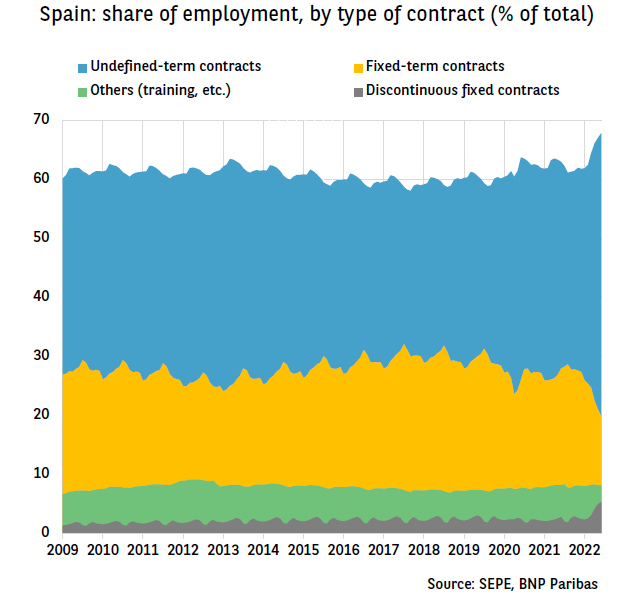
Spain’s labour market is still delivering pleasant surprises, with a net job creation rate of almost 263,000 during the first half of 20221. However, beyond these rising numbers, the major change on the labour market was in recruitment processes in February as a result of employment law reforms, which most notably set out to tighten the conditions for using precarious short-term contracts.
These reforms have produced immediate results, with a leap of more than 1,130,000 in the number of permanent contracts since the beginning of the year, which is an increase of 12%. These increases have been particularly large in the accommodation/restaurant (+32.5% over the last six months), construction (+30.8%) and arts and leisure activity (+18.9%) sectors, which have traditionally been the main users of these precarious short-term contracts. By contrast, the number of fixed-term contract jobs has fallen by 1,083,000 (-26%) during the first half-year. « Discontinuous fixed contracts » also grew very strongly (+118%), with this type of contract offering more flexibility around organising working time than permanent contracts. Against the current challenging economic backdrop, tightening recruitment conditions could have been an obstacle to recruitment. However, this has not happened and shows how well the Spanish economy is holding up against the economic shocks so far.
Author

BNP Paribas Team
BNP Paribas
BNP Paribas Economic Research Department is a worldwide function, part of Corporate and Investment Banking, at the service of both the Bank and its customers.

















