The clock is ticking for France


France was one of the dark horses in 2024 for political risk. There was the snap election in June, and it’s not over yet. The technocratic government led by Michael Barnier, after June’s election failed to deliver a clear winner, has until 21st December to pass a Budget.
The French parliament has been debating the government’s Budget proposal for weeks. It contains EUR 40bn of spending cuts and EUR 20bn of tax rises, which, as expected, are unpopular. There is now a no-confidence motion being tabled to overthrow the government in the wake of the Budget debates. Whether or not Barnier will remain as PM depends on the Far-Right National Rally, led by Marine Le Pen. She is no fan of President Macron and has campaigned on a platform of change. Thus, Barnier cannot depend on her support if there is a no confidence vote, and Le Pen has not indicated how she would vote.
A political problem turns into a financial problem
A French political problem is turning into a problem for financial markets. The budget deficit in France is 6% of GDP, if the planned reforms are not enacted, then the deficit could rise to 7% of GDP next year. This is the level when bond vigilantes start to sniff around.
The French – German 10-year yield spread has surged to a fresh 12 year high on Wednesday at 86bps. This wider than the peak in June, when the French bond market sold off on the back of election fears. This suggests that the bond market’s concerns are now focused solely on the budget and the size of the deficit. If Barnier’s technocratic government does collapse, this will likely spell the end for his radical, cost cutting budget. If he does manage to stay in office, then he can use special parliamentary measures next month to force the Budget through.
French and German 10-year yield spread
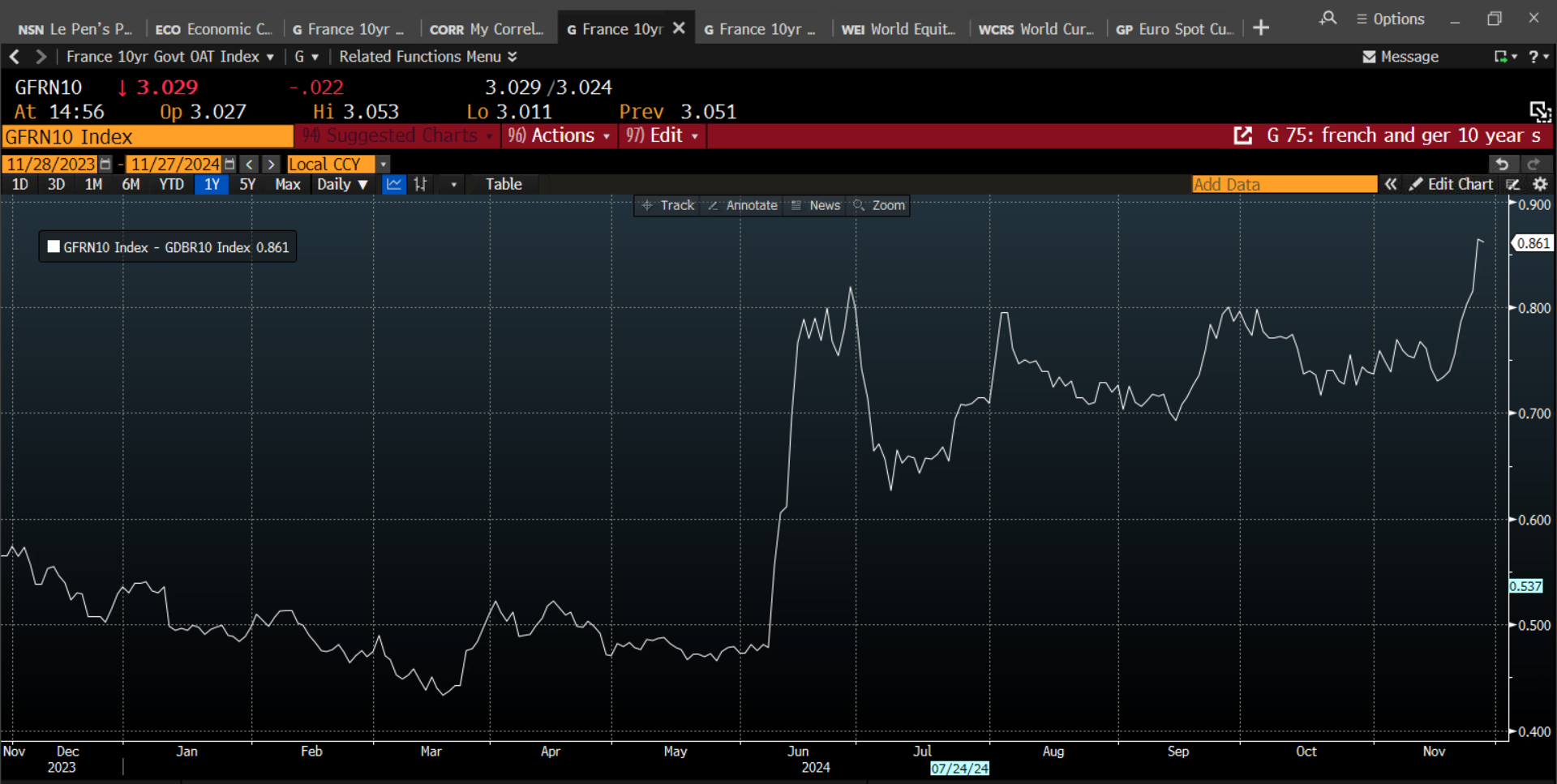
Source: XTB and Bloomberg
The outcome of the no-confidence vote is binary. If Barnier wins, then the French bond market could rally. If he loses, then the French- German yield spread could widen beyond 100bps. French 10-year yields are only 40bps below the Italian 10-year yield, which is another sign that there has been a recalibration of sovereign debt risks in the currency bloc.
CAC traders need to watch French bonds
The Cac 40 is also under pressure today and is underperforming other European indices. The CAC 40 has historically had a negligible relationship with French 10 -year bond yields, however, it has strengthened in recent weeks. As the Budget debate has escalated, the correlation between the Cac 40 and the 10-year French bond yield is now -0.34. This is still statistically insignificant; however, it does mean that every time French bond yields rise, the Cac 40 declines 30% of the time. This relationship could strengthen further if Barnier loses a no-confidence vote in the coming days.
EUR/USD at risk if French government turmoil escalates
The euro is in recovery mode on Wednesday, as the dollar falters. EUR/USD has backed away from the parity danger zone and is back above $1.05 at the time of writing. However, we think that the euro could be impacted by a bout of heightened political risk if the French government collapses and there is a sell-off in the French bond market. If this happens then we think that EUR/USD could fall back below $1.05 towards the $1.0450 level from earlier this month.
Author
Kathleen Brooks
XTB UK
Kathleen has nearly 15 years’ experience working with some of the leading retail trading and investment companies in the City of London.