The Barrel gambit: OPEC+ swings for market share while Brent is about to teeter

OPEC+ just lit the fuse on round three of its production hike bonanza, upping output by another 411,000 barrels per day in July. It’s not quite the Saudi armada redux of 2020, but the message is clear: Riyadh isn’t playing defense anymore—it’s swinging the bat. The cartel, once laser-focused on price defense, has veered into volume-first territory, weaponizing barrels to discipline quota cheats, squeeze US shale, and curry favor with Washington, all while dancing on the edge of its own fiscal cliff.
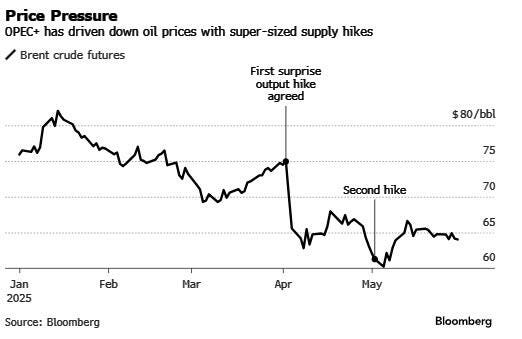
This isn’t subtle. After a cautious May and a deliberate June, July is a megaphone moment—OPEC+ is no longer trying to manage prices; it’s trying to reshape the scoreboard. The problem? Not every player’s reading from the same playbook. Russia, Algeria, and Oman pushed back hard, hoping to hit pause before the entire dance floor collapses. But Riyadh bulldozed through, laser-focused on regaining market share—even if it means breaching the cartel’s own breakeven pain thresholds.
Kazakhstan remains the cartel’s rogue state—pumping above quota, brushing off warnings, and daring anyone to do something about it. Riyadh’s quiet retaliation? Turn up the spigot until the Caspian's pipes sweat. There’s only so long you can let a spoiler profit from cartel discipline before the knives come out.
And yet, the real casualty may be stateside. U.S. shale, once propped up by MAGA-era swagger and ultra-low borrowing costs, is wilting under the weight of lower prices and investor fatigue. Diamondback and its Permian peers aren’t drilling—they’re ducking. So much for “drill, baby, drill.” The shale boom is being outflanked not just by OPEC+ volume but by its own capital discipline.
Brent clawing back to $64 might look like a recovery, but let’s not kid ourselves: Saudi fiscal math needs $90+. And while summer demand and air-conditioned Middle Eastern megacities will mop up some of the oversupply, nonetheless, Brent in the high $50s later this year rings ominously loud for oil market bulls
This isn’t a supply tweak—it’s a regime change. OPEC+ is frontloading a multi-year re-entry of 2.2 million bpd into a market that still doesn’t know how much China plans to stimulate or how long the US can hold the global demand side together. If Riyadh’s playing the long game, they’re betting the price dip today is the cost of cartel control tomorrow.
But make no mistake: this is high-stakes poker with a leaking barrel as the pot. And Riyadh’s betting big with a pair of deuces, hoping the table folds.
Author

Stephen Innes
SPI Asset Management
With more than 25 years of experience, Stephen has a deep-seated knowledge of G10 and Asian currency markets as well as precious metal and oil markets.