The anatomy of a Silver bull run and other Silver news

Silver surged to record highs last year, peaking at $84 in December, before climbing as high as $110 early this year.
What caused this extraordinary bull run?
As the Silver Institute explains in its latest edition of silver news, it was a combination of factors, including tight liquidity and growing investor interest.
“Exceptionally strong physical demand, tight inventories, and robust industrial metal prices, copper in particular, fueled silver’s outperformance of gold during that period. This trend eventually became self-fulfilling, as investors that had previously favored gold shifted their attention to the white metal.”
More fundamentally, it was a shortage of physical metal.
“Silver’s deficit finally caught up with it, as lower inventories and metal being pulled out of London or tied up in exchange-traded products (ETPs) created explosive conditions for lease rates and prices.”
The shortage of physical metal, along with the displacement of silver due to tariff worries last year, set the stage for two silver squeezes.
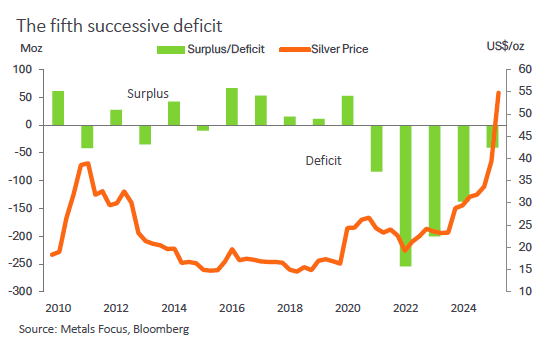
The silver demand has outstripped supply for five straight years. The 5-year market deficit amounted to 716 million ounces. To put that into perspective, total silver mining output last year was 846 million ounces. Metals Focus forecasts a 46.3-million-ounce supply deficit this year.
We can see the trajectory of the silver rally in the movement of the gold-silver ratio. This ratio tells you how many ounces of silver it takes to buy one ounce of gold, given the current spot price of both metals.
In the modern era, the gold-silver ratio has averaged between 40:1 and 60:1. Through the first 10 months of 2025, the gold-silver ratio was historically high, averaging 91:1. The ratio peaked in April at 107:1. By the end of the year, the ratio had plunged to 61:1 before falling into the sub-50s early this year. It was the narrowest gold-silver ratio since March 2013, indicating a significant correction in the silver price.
Even with the recent correction, the Silver Institute remains bullish moving forward, warning that despite some easing in the market, the environment remains favorable for additional squeezes.
“Policy uncertainty remains unusually high, sovereign debt fears are, if anything, worsening in the face of war-related fiscal pressures, and concerns about the future role of the U.S. currency also remain relevant. The Iran war has complicated the short-term outlook, but in our view, on balance, strengthens the longer-term case for precious metals. Our base case is that the situation will be contained, and that the recent pressure that rising U.S. rate expectations have placed on precious metals prices will be temporary.”
The most recent edition of Silver News also highlighted some interesting technological advances using silver.
Just when you thought that silver nanowires could not be more versatile, a group of Korean scientists has developed a new insulating layer to encase the wires that results in greater electrical conductivity and more durability.
While most people are trying to figure out how to minimize CO2, it is an important input in some industrial applications, and there are scientists working to produce it more efficiently. Carbon dioxide is generally considered a waste product, but it has many uses, particularly as a precursor to other chemicals and products such as fertilizers and for making methanol, which is used in paints, plastics, and adhesives. Carbon dioxide is also used in the production of pharmaceuticals such as aspirin.
A research team at the Korea Advanced Institute of Science & Technology (KAIST) has developed a silver nanowire network that looks like a bird’s nest to more efficiently produce CO2 for industrial use. The team noted that they achieved 86 percent efficiency in producing carbon dioxide with their silver nanowire configuration, compared to 33 to 60 percent in similar non-silver nanowire-based systems (such as copper).
Silver may help efficiently produce hydrogen for use as a power source. Not only is hydrogen clean-burning – leaving only water – but it is easier to store and transport than petroleum-based fuels. Conventional methods of producing hydrogen, such as steam methane reforming (SMR) or water electrolysis, have disadvantages that silver may help to overcome.
One up-and-coming method is known as dehydrogenation – literally, removing hydrogen. This process can be performed at low temperature and pressure, without requiring large amounts of electrical power. The process uses formic acid – a chemical released by ants – and a catalyst of silver-nickel. While scientists have experimented with catalysts composed of nickel alone, the addition of silver enhances the amount of hydrogen gas produced.
Vanadium oxide batteries are an alternative to lithium-ion batteries. However, they have a drawback. They are subject to crystal growth that can cause failures. Researchers have found that adding silver to the batteries can prevent this phenomenon, leading to a safer, longer-lasting battery.
To receive free commentary and analysis on the gold and silver markets, click here to be added to the Money Metals news service.
Author

Mike Maharrey
Money Metals Exchange
Mike Maharrey is a journalist and market analyst for MoneyMetals.com with over a decade of experience in precious metals. He holds a BS in accounting from the University of Kentucky and a BA in journalism from the University of South Florida.