GBP/USD at three-month high: Outlook hinges on economic data

GBP/USD surged to 1.3613 on Wednesday, reaching a three-month high. Investors are digesting fresh UK inflation and labour market data.
Consumer inflation accelerated to 2.9% in July, up from 2.6% in June and in line with forecasts. Core inflation held steady at 2.6%. Following the release, markets slightly scaled back expectations of a Bank of England rate hike before year-end.
Earlier labour market data showed unemployment holding at 4.9%, above expectations, while the number of payrolled employees fell by 86,000 year-on-year. Meanwhile, growth in regular pay remained fairly stable at 3.5%.
Additional support for the pound is coming from a weaker dollar. Soft US economic data have led investors to reduce expectations of further Federal Reserve tightening. At the same time, elevated oil prices and uncertainty surrounding the US–Iran conflict continue to pose inflation risks for the UK.
Technical analysis
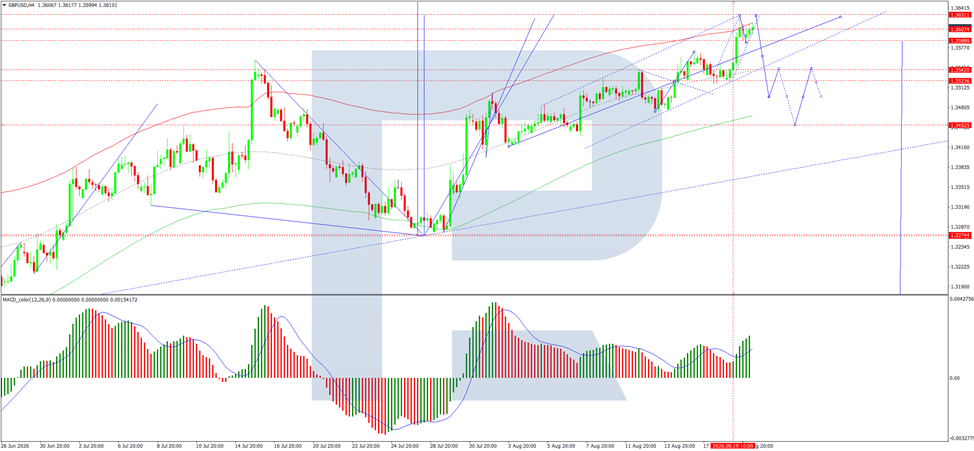
On the H4 GBP/USD chart, a wide consolidation range is forming around the 1.3523 level. The market has moved towards its upper boundary. A new compact consolidation range is expected to form below 1.3631. A downside breakout from this range would open the way for a move lower towards 1.3500. The MACD supports this scenario, with its signal line above zero and beginning to turn downwards.
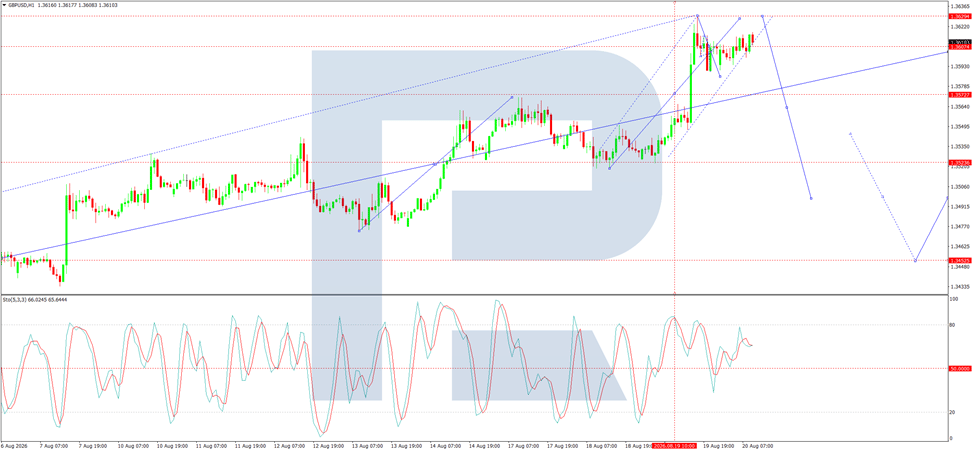
On the H1 chart, the market has formed a compact consolidation range around the 1.3607 level, currently extending between 1.3588 and 1.3618. A move lower towards 1.3572 is expected, followed by a move higher to 1.3600. The Stochastic oscillator confirms this scenario, with its signal line below 80 and trending downward towards 20, indicating short-term downside pressure.
Conclusion
GBP/USD has climbed to a three-month high, supported by a weaker dollar and UK economic data that largely met expectations. Inflation accelerated to 2.9% in July, while core inflation held steady, prompting markets to slightly lower BoE rate hike expectations. Labour market data showed unemployment above forecasts and a decline in payroll employment, though wage growth remained stable. The dollar remains under pressure from soft US data, which has reduced Fed tightening expectations. However, elevated oil prices and geopolitical uncertainty continue to pose inflation risks for the UK. Technically, the pair may see a short-term pullback towards 1.3572, with potential for a further decline to 1.3500. The near-term direction will depend on upcoming economic releases and central bank signals.
Author

RoboForex Analysis Department
RoboForex
RoboForex Analysis Department provides timely market insights, expert technical analysis, and actionable forecasts across forex, commodities, indices, and equities.