The $10 trillion blind spot: Pricing Taiwan like a risk manager
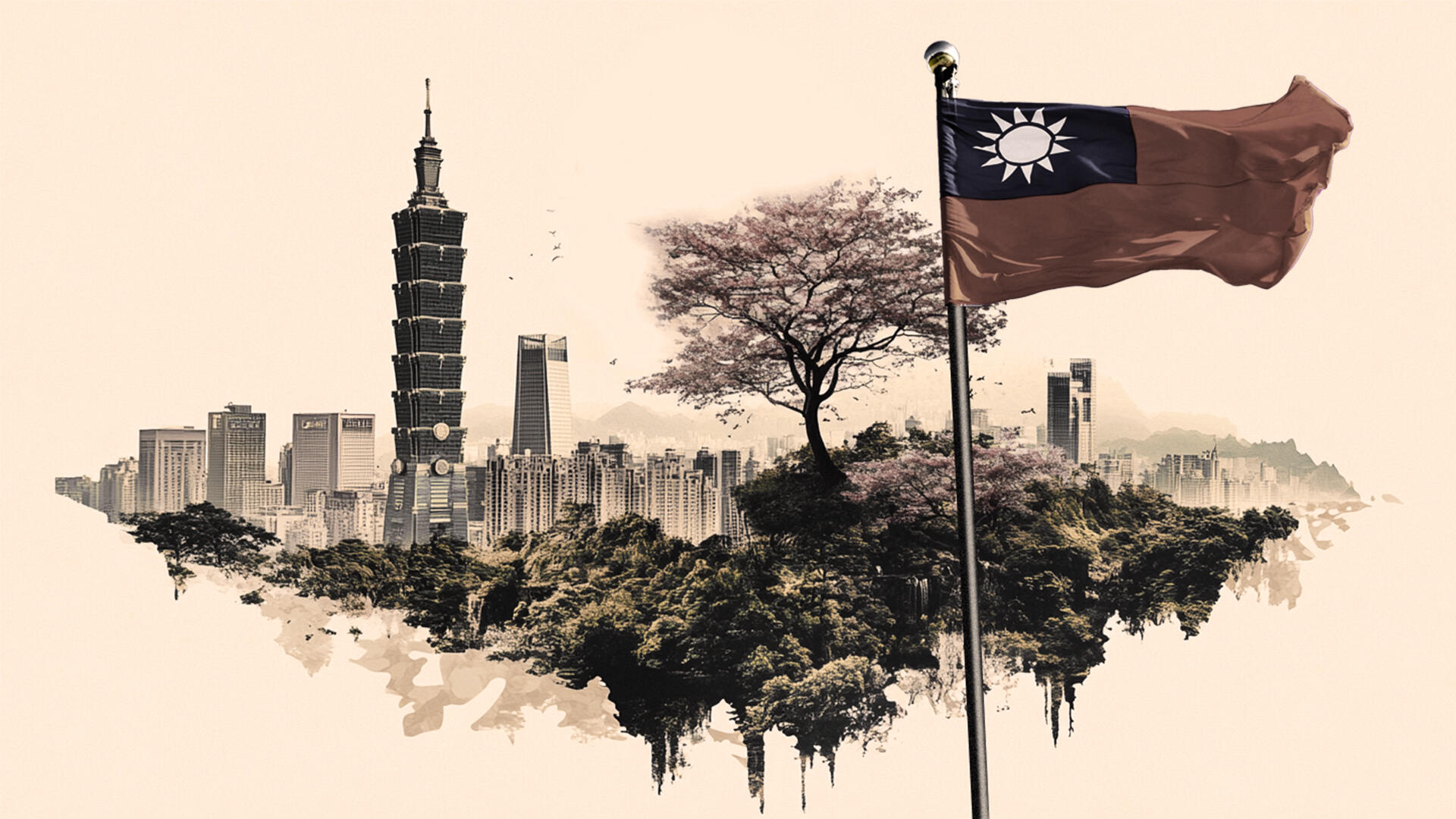
Markets are obsessed with oil and interest rates. The largest single point of failure in the world economy sits across a strait barely 130 kilometres wide at its narrowest, and almost nobody is pricing it.
Every risk management meeting I sat on with Minister of Finance in the Middle east began with the same three questions. What are we exposed to? What happens in the worst case? And what are we doing today to avoid the risk? Applied to Taiwan, those questions produce an uncomfortable answer. The global economy has built its most important industry on a single island, stress tests show losses larger than the Covid pandemic and the financial crisis, and the insurance premium the world is paying is a fraction of the expected loss.
This matters now. Last week Xi Jinping used his state visit to Washington to press President Donald Trump on Taiwan. According to Chinese state media, he asked the US to adhere to "the correct position of opposing" Taiwan independence. The White House published no account of the conversation. A $14 billion US arms package for the island has been frozen since May, and in November a Taiwanese envoy will attend the APEC summit in Shenzhen, on mainland soil. Meanwhile, markets are trading oil and Treasury yields. Taiwan barely registers.
Step one: Map the exposure
Risk management starts with concentration. In any bank, a single counterparty accounting for 70 percent of an exposure would trigger an emergency meeting. In semiconductors, it is simply the market structure.
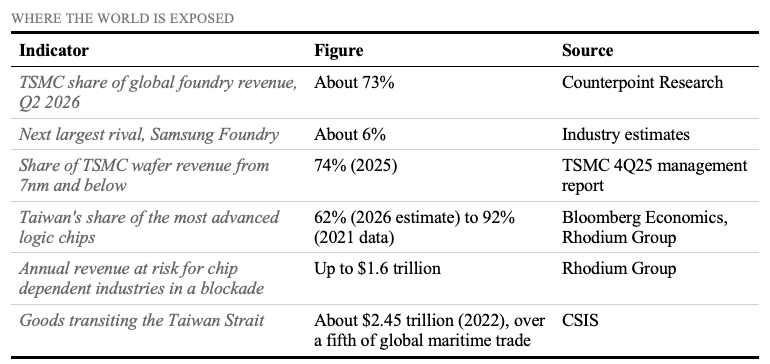
Two features make this exposure unusual. The first is substitutability. When one oil field goes offline, another can pump more within months. When the world's leading edge fabs go offline, there is no spare capacity anywhere, because building a fab takes years and the know how is concentrated in a few thousand engineers. The second is reach. Advanced chips are not one industry. They are an input to every industry, from AI data centres and phones to cars, medical devices, power grids and weapons systems.
Step two: Stress test the scenarios
Bloomberg Economics updated its Taiwan modelling this year. The results read like a stress test that went too far, except that the scenarios are plausible.
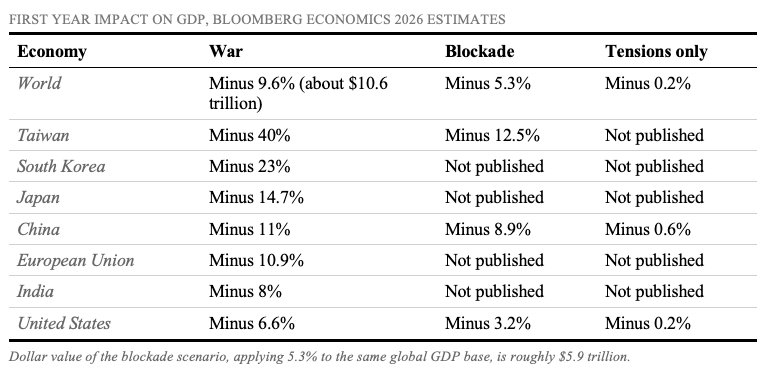
Three details deserve attention. First, the blockade scenario alone would cost the world more than half of a full war. You do not need a single shot fired for the damage to be massive. Second, America's own loss is the smallest on the list, which may explain why Washington feels able to treat arms sales as a bargaining chip. Third, the European Union loses almost as much as China in proportional terms. Brussels is debating overcapacity with Beijing this autumn, but its larger exposure sits in the Taiwan Strait.
For the Gulf, the numbers are a warning of a different kind. Its largest customers, China, Japan, South Korea and India, all take heavy losses. A Taiwan shock would arrive in the Gulf as a collapse in Asian energy demand.
Step three: calibrate against history
Stress tests are only credible if history supports them. The closest precedent is not a war but a shortage. In 2021, a squeeze in chip supply with no conflict at all cost the global auto industry an estimated $210 billion in lost revenue and 7.7 million vehicles, according to AlixPartners. That was a problem of timing and demand, not of access.
Scale that up. The 2021 shortage hit mostly mature, cheaper chips, in one sector. A Taiwan disruption would hit the most advanced chips, across every sector, with no alternative supplier. The Bloomberg figure of 9.6 percent of world output would exceed both the Covid collapse and the 2007 to 2009 financial crisis. The history does not make the scenarios alarmist. It makes them conservative.
Step four: estimate the expected loss
Risk managers do not ask whether something will happen. They multiply what it would cost by how likely it is, and compare the result with what they are spending to prevent it. The probabilities below are illustrative assumptions, not forecasts. They are chosen to be low on purpose.
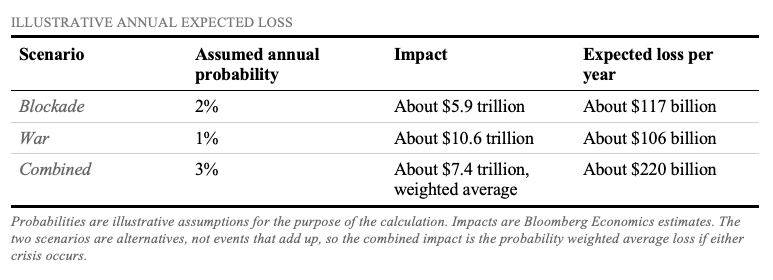
Even at these deliberately modest odds, the world carries an expected loss of around $220 billion every year. Now compare the premium. The US CHIPS Act committed about $52.7 billion in total. TSMC has now announced $265 billion of investment in the US, spread over many years. On any reasonable annualised basis, the world is spending a small fraction of the expected loss on reducing it. In my old job, that gap would have been called underinsured.
Step five: Why markets underprice it
If the numbers are this large, why does the risk barely register in prices? Four reasons, all familiar to anyone who has managed tail risk.
It has never happened. Markets price what they can measure. There is no historical return series for a Taiwan blockade, so models default to zero. It is binary. The risk does not build gradually like inflation. It sits dormant and then arrives in full, which makes it easy to ignore until the day it cannot be. Everything else is louder. This month the 10 year Treasury yield passed 5.1 percent for the first time since 2007 and Brent traded above $100. Visible risks crowd out invisible ones. The signals are ambiguous. When Washington chooses silence and Beijing chooses its words carefully, investors read calm. A risk manager reads uncertainty.
Step six: The hedges
For governments, the priority is time. Every year that passes without a crisis is a year to build capacity elsewhere. TrendForce expects the US to hold 22 percent of advanced capacity by 2030, while Taiwan's share falls from 71 percent to 58 percent. That is progress, but it means Taiwan will remain the dominant supplier for the rest of this decade. Deterrence buys the time that reshoring needs. Treating deterrence as a negotiating chip spends it.
For companies, the lesson of 2021 still applies. Map chip exposure beyond the first tier of suppliers, hold strategic inventory for the components that cannot be replaced, qualify second sources where they exist, and run a formal blockade scenario at board level. Very few boards have done this.
For investors, the exercise is to ask how a portfolio behaves if the most concentrated input in the world stops flowing for six months. Chip designers, AI infrastructure, carmakers, Asian exporters and the currencies of Taiwan, South Korea and Japan are all exposed to the same event. Correlation in a crisis goes to one.
Five signals to watch
Tail risks rarely announce themselves, but they leave tracks. First, the decision on the frozen $14 billion arms package, now expected after APEC. Second, how Beijing treats Taiwan's envoy in Shenzhen on 18 and 19 November, from name cards to seating. Third, the scale and duration of military exercises around the island, which have become the rehearsal space for a quarantine. Fourth, war risk insurance premiums for vessels in the Strait, the market's most honest price of danger. Fifth, the Taiwan dollar and South Korean won against the dollar, the currencies most directly exposed to a disruption.
The takeaway
Taiwan is the ultimate concentration risk. It is a single point of failure for an industry that powers every other industry, valued by stress tests at up to 10 percent of global output and insured at a fraction of its expected cost. The world does not need to believe a conflict is likely to take it seriously. It only needs to accept a principle every risk manager learns early. The most dangerous risks are not the most probable. They are the ones that are catastrophic, correlated and ignored.
This autumn, all eyes are on oil, yields and the 10 January trade deadline. The largest risk on the map is the one nobody is watching.
Author

Andrea Zanon
Empower Capital
Andrea Zanon has 20 years of professional experience as a disaster risk management, sustainability, and entrepreneurship specialist. Mr. Zanon has advised international institutions and countries across the Middle East and North Africa. Mr.











