|

Telltale sign

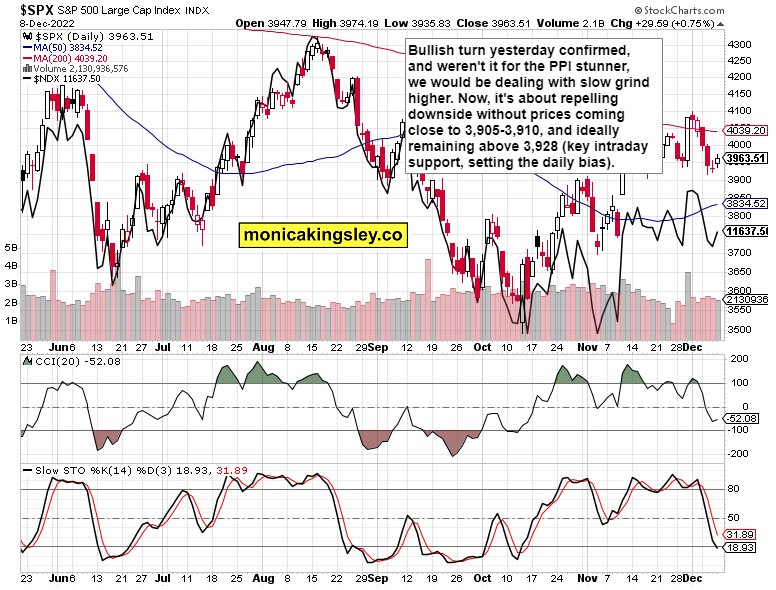
PPI and core PPI came above expectations, fuelling a sharp S&P 500 decline upon the data release. Similarly to yesterday though, the market reaction isn‘t unequivocal as neither USD nor yields are correspondingly up. Real assets aren‘t tanking either, not even the 3m Treasury yield has moved much. And that leads me to think the bearish gap on the news release, will be taken on at least to the 3,965 level degree, after an otherwise positive, bullish turn in paper assets yesterday, which was accompanied by a not at all contradictory real assets message.

Summing up, the (especially the one that Fed is looking at – the core) PPI figure has spooked the markets, but there is no deleveraging panic kicking in. Gold and silver are up – and so is oil, with copper likely to improve later today as well. The dollar isn‘t barking (remember yesterday‘s article featuring similar theme), and that‘s a telltale sign that a sharp selling spree isn‘t likely to kick in after today‘s opening bell. Being ready for all eventualities, watch for the opening selling pressure to ideally dissipate within dozens of minutes after the bell, and for solid bid lifting prices above 3,965 to materialize next.

Failing that, 3,905-3,910 is the support next, which I however don‘t see as likely to be jeopardized – chop would be more probable instead of a fall, as the seasonal tendencies counter the sellers still. Similarly, precious metals and commodities are likely to weather today‘s volatility fine, with the former outperforming the latter (headwinds are to be more lasting in commodities as opposed to gold and silver, which benefit from signs of inflation being as sticky as I‘ve been telling you about for months it would be.
SPX

Author

Monica Kingsley

Monica Kingsley

Monicakingsley

Monica Kingsley is a trader and financial analyst serving countless investors and traders since Feb 2020.


More from Monica Kingsley
Share:

Editor's Picks

AUD/USD drops to two-week low, further below 0.7000 after RBA's less hawkish rate hike

AUD/USD drifts lower for the second straight day on Tuesday, hitting a fresh two-week low during the Asian session after the Reserve Bank of Australia's (RBA) widely expected 25 bps rate hike. The decision was far from unanimous, with three members preferring to hold rates at 4.60%. This tempers expectations of further tightening, which, along with modest US Dollar strength, weighs on the currency pair.


USD/JPY fails near 159.00 amid weak USD, intervention risks

USD/JPY edges lower during Tuesday’s Asian session, reversing part of the previous day's gains to 158.00 as the US Dollar remains depressed amid hopes for Iran diplomacy and ahead of US midterm elections. Meanwhile, intervention risks support the Japanese Yen, though the uncertainty over the timing of the next BoJ rate hike caps gains. This keeps the pair confined within a familiar range and warrants caution before placing directional bets.


Gold holds Monday’s gains near $3,950 on US-Iran deal hopes

Gold clings to previous day’s recovery around $3,945 in the Asian trade on Tuesday, as hopes of a deal between the United States and Iran have kept oil prices under pressure. Still, the Gold price is close to its yearly low of $3,870.23 posted on Friday.

XRP and XLM slide as bearish signal grows
Ripple (XRP) and Stellar (XLM) remain under pressure on Tuesday, with bearish momentum capping recovery attempts. XRP trades around $1.25 as sellers maintain control, while XLM extends its decline below $0.162, raising the risk of a deeper correction. Meanwhile, mixed derivatives data, bearish on-chain metrics and weakening technical indicators all hint at continued downside risk for both altcoins.
What a split Congress means for the US Dollar

The United States is going to the polls on Tuesday, and much is at stake. The mid-term elections mean the renovation of roughly one-third of the Senate and all 435 of the House seats. Additionally, special elections in Florida and Ohio will be held to fill the seats vacated by US Secretary of State Marco Rubio and Vice President JD Vance.

The 2% inflation target came from a throwaway remark. It now moves trillions
The Federal Reserve's 2% inflation goal grew out of an off-the-cuff remark by a New Zealand politician in 1988. Bond investors still price long-term US debt as if 2% holds, so a change in how the Fed measures inflation would move markets.