Sweden’s Riksbank to match ECB’s 75bp rate hike on Tuesday
With only two meetings left this year, and facing higher-than-expected inflation and a tight jobs market, we expect the Riksbank to hike rates by at least 75 basis-points on Tuesday. We expect a repeat move in November.
75bp at a minimum from the Riksbank
The 75 basis-point (bp) rate hike from the European Central Bank all but guarantees the same sized move from Sweden’s Riksbank on Tuesday – and if anything it could go even more aggressively. Partly that’s because the Riksbank has only one scheduled meeting left this year after this month, which is one less than most central banks. In that sense, it’s got to make each one count, especially given expectations for further aggressive ECB tightening in the near term.
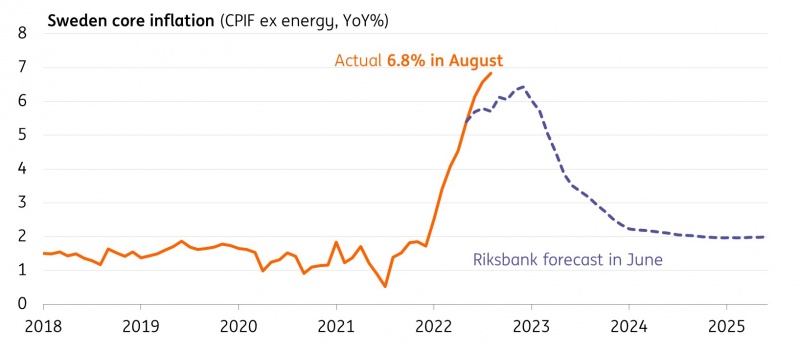
But more importantly, core inflation has once again exceeded the Riksbank’s forecast. Core inflation came in over a percentage-point higher in August than policymakers had projected back in June.
This is coinciding with a jobs market that looks unusually tight. With low unemployment and wage growth at 3%, policymakers are focusing increasingly on the upcoming wage negotiations, which are due to lock in pay growth for the next three years. All the signs currently point to a more generous outcome for workers than the last set of negotiations in 2020.
Core inflation has once again exceeded the Riksbank’s forecast
Source: Riksbank, ING
All of that means another 75bp hike in November also looks highly likely. Most members of the committee have been vocal about the need to get inflation lower, and indeed at least one member signalled they were willing to vote for 75bp in June had there been consensus for it.
For now, the bank also seems unperturbed by signs of weakness in the Swedish housing market, with Deputy Governor Martin Floden signalling in June that the fall in retail sales and house prices is a “necessary development”. Nevertheless, the housing market is highly sensitive to interest rate hikes and it’s a key risk to the economic outlook, not least given households’ record debt-to-income ratios. The Riksbank’s last monetary policy report accepted there was a risk of an abrupt fall in prices.
That – and the fact that we expect less ECB tightening than the market – suggests there is only so far the Riksbank can hike rates this cycle. We wouldn’t be surprised if, after a 75bp rate hike both this month and in November, the central bank stops there. That suggests a peak in the region of 2.25%, something we suspect the Riksbank’s new rate projection due on Tuesday will probably agree with.
SEK: Riksbank impact still contained
We recently published an update on our SEK view (Sweden: The krona’s recovery is delayed again), where we highlighted how downside risks for the krona were set to remain relatively high, and that a recovery will likely have to wait until next year given the challenges to the European economic outlook (among other reasons).
This remains our core view for the krona, regardless of our expectations for a 75bp rate hike by the Riksbank next week. This is because firstly, central bank decisions and policy messages have had a rather limited impact on EUR/SEK of late, and secondly because SEK’s high beta to global risk sentiment and Europe’s economic woes may keep appetite towards the krona limited for now.
Incidentally, markets are fully pricing in a 75bp rate hike by the Riksbank and this means that even on the day of the release, there may not be much room for a SEK rally. We expect EUR/SEK to stay around 10.70 in the coming weeks, with risks of retesting the 10.78 July high or even the 10.86 March high if the external environment continues to deteriorate.
Read the original analysis: Sweden’s Riksbank to match ECB’s 75bp rate hike on Tuesday
Author

ING Global Economics Team
ING Economic and Financial Analysis
From Trump to trade, FX to Brexit, ING’s global economists have it covered. Go to ING.com/THINK to stay a step ahead.
















