Stock Market 10% Plunge is the Worst Since 1987

Worst Single Day Since 1987
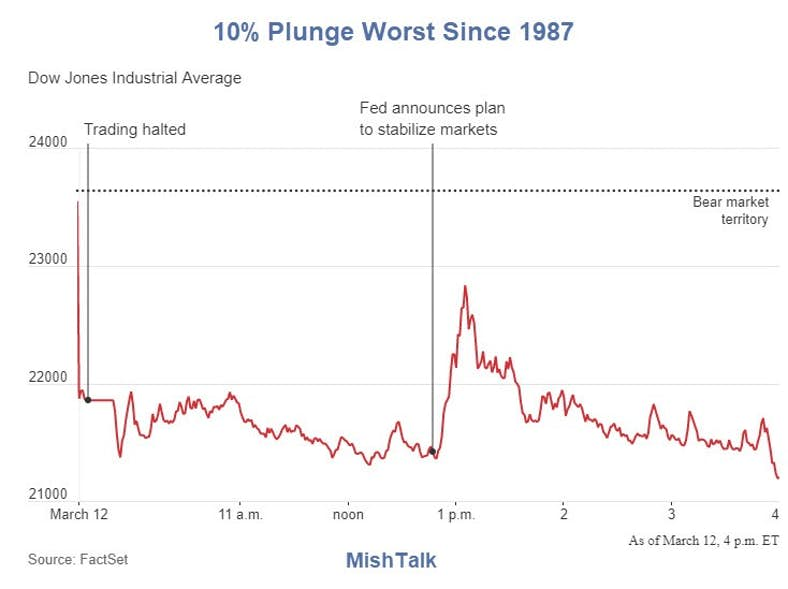
Despite emergency liquidity move by the Fed, today's Stock Plunge is Worst Single Day Since 1987.
The furious falls in share prices on rising fears of a global slowdown due to the rapid spread of coronavirus occurred despite a $1.5 trillion intervention in short-term funding markets by the Federal Reserve.
For the day, the Dow industrials shed 2,352.6 points, or 10% to 21,200.62. The S&P 500 sank 260.74 points, or 9.5%, to 2,480.64. And the Nasdaq Composite slid 750.25 points, or 9.4% to 7,201.80.
Companies most exposed to the coronavirus outbreak were particularly hard hit, and airline and cruise shares helped lead the tumble. United Airlines Holdings dropped 25%, Delta Air Lines fell 21%, and Spirit Airlines tumbled 33%. Royal Caribbean Cruises plummeted 32%. On Thursday, Princess Cruises canceled all voyages for the next two months after two of its ships suffered coronavirus outbreaks.
But few parts of the market were immune. All 11 sectors of the S&P 500 tumbled, with losses led by the real estate and industrial sectors. Even companies that investors thought would reap the benefits of the virus tumbled. Clorox ended the day down 6.3%. Gilead Sciences, which has started testing a virus treatment, fell 6.1%.
Illogical Comments of the Day
“We are beyond the logical, mathematical approach to things,” said Steven Dudash, president of Chicago-based IHT Wealth Management. “We’ve got complete overreactions going on because of the fear of the unknown.”
“When you see that, you can’t expect to see a logical response to interventions,” he said.
If you do not know what is going to happen, how many people will die, or how long this will last, how the hell can anyone say the market reaction is illogical?
Who's to Blame?
A friend of mine commented today that you cannot blame the Fed for the coronavirus.
That's true enough.
But you can blame the Fed for blowing three massive bubbles in succession, each bigger than the prior one, in the nonsensical idea that something must be done about deflation.
Economic Challenge to Keynesians
Of all the widely believed but patently false economic beliefs is the absurd notion that falling consumer prices are bad for the economy and something must be done about them.
My Challenge to Keynesians “Prove Rising Prices Provide an Overall Economic Benefit” has gone unanswered.
BIS Deflation Study
The BIS did a historical study and found routine deflation was not any problem at all.
“Deflation may actually boost output. Lower prices increase real incomes and wealth. And they may also make export goods more competitive,” stated the BIS study.
Deflationary Outcome
Central banks’ seriously misguided attempts to defeat routine consumer price deflation is what fuels the destructive asset bubbles that eventually collapse.
Deflation is not really about prices. It's about the value of debt on the books of banks that cannot be paid back by zombie corporations and individuals.
That is what the Fed fears. It takes lower and lower yields to prevent a debt crash. But it is entirely counterproductive and it does not help the consumer, only the asset holders. Fed (global central bank) policy is to blame.

Assessing the Blame
I don't blame the Fed for the coronavirus.
However, I do blame the Fed for its erroneous inflationary tactics that blew three of the biggest economic bubble in succession: 2000, 2007, 2020.
Fiscal policies helped as well. Trump's stimulus that went to corporations and the wealthy also fueled the stock market.
So if you want another tinger to point, that's the one. But it is secondary to cheap money.
Author
Mike “Mish” Shedlock's
Sitka Pacific Capital Management,Llc