Silver pricing compresses as industrial momentum cools ahead of US PCE

Key takeaways
- Silver remains in deep compression as industrial momentum cools and softer inflation signals shift metals positioning ahead of Thursday’s US PCE.
- Industrial divergence intensifies: copper maintains structural leadership while silver stays trapped in a low‑conviction regime.
- Real yields and growth sensitivity continue limiting upside participation despite resilient logistics and selective industrial continuity.
- The active pivot sits at 75.6–76.0, with broader participation still constrained until macro alignment improves.
Silver enters a transitional industrial pricing phase
Silver enters the May 27 session inside a market increasingly shaped by industrial divergence, softer inflation expectations and uneven participation across the broader metals complex.
The latest Australia CPI figures reinforced the idea that global inflation pressure is gradually moderating. Headline CPI slowed to 4.2% from 4.6%, while monthly inflation also softened, contributing to a broader repricing process across rates and commodity markets.
This matters for silver because the metal remains highly sensitive to the interaction between:
- Industrial growth expectations.
- Real yields.
- Macro liquidity.
- Manufacturing momentum.
Markets are now reassessing how much industrial demand can continue supporting metals participation if global growth conditions become progressively less synchronized.
Copper still remains the structural industrial leader across the commodity complex. The latest EcoModities™ Multi-Timeframe Scanner continues classifying Copper as the strongest aligned continuation regime across both daily and H4 structures, with industrial beta remaining firmly positive.
Silver, however, continues trading inside a lower conviction framework.
The scanner currently classifies silver as:
Low conviction
With weaker structural participation despite ongoing macro support from industrial metals.
This divergence remains the dominant narrative surrounding silver pricing.
Industrial participation remains selective
The broader commodity system still shows active industrial continuity.
Shipping flows remain operationally resilient, dry bulk strength continues improving and freight indicators still point toward active logistical demand across multiple corridors. The Shipping Radar currently maintains an:
Extreme stress
Classification across the global transportation environment.
Dry bulk equities continue outperforming several shipping-linked sectors, while freight proxies preserve positive momentum despite broader energy weakness.
This confirms that the industrial system itself has not entered contraction territory.
At the same time, the distribution of participation remains highly selective.
Markets continue favoring:
- Copper.
- Fertilizers.
- Industrial mining exposure.
- Dry bulk logistics.
While broader cyclical participation remains uneven.
The latest EcoModities™ integrated reports reinforce this view. Fertilizer and mining leadership continue outperforming weaker downstream sectors, while industrial transmission across grains and manufacturing inputs remains only partially confirmed.
Silver therefore continues operating in an environment where industrial demand exists, though participation breadth remains insufficient to trigger a full expansion phase.
Yields and growth sensitivity continue shaping metals flows
The current macro backdrop also continues influencing silver behavior.
US10Y yields remain structurally elevated despite recent tactical cooling, while markets continue preparing for Thursday’s:
- Core PCE.
- Preliminary GDP.
These releases now represent the next major macro catalyst for precious and industrial metals positioning.
The Dollar remains softer on a structural basis according to the scanner framework, though the broader rates environment still limits aggressive upside participation across silver.
This creates a more fragmented market structure where silver reacts positively to:
- Softer inflation impulses.
- Weaker Dollar conditions.
- Industrial continuity.
While simultaneously remaining constrained by:
- Elevated real yields.
- Slower manufacturing breadth.
- Selective institutional participation.
The result is a market that continues rotating rather than expanding.
Copper leadership continues defining the metals hierarchy
One of the clearest developments across the current commodity landscape is the persistence of copper leadership relative to silver.
The scanner continues identifying:
Copper and AUD aligned – Industrial metals beta confirmed
as one of the dominant intermarket relationships.
This relationship matters because copper currently functions as the market’s preferred industrial transmission asset.
Investors continue favoring assets directly exposed to:
- Electrification.
- Infrastructure investment.
- Industrial scarcity.
- Manufacturing throughput.
Silver still benefits from these themes, though participation remains less aggressive because the metal continues carrying stronger macro and precious-metals sensitivity.
This creates a layered pricing environment where silver participates in industrial momentum without fully absorbing the same degree of institutional conviction visible across copper.
Technical structure: Silver rotates around the 75.6 participation pivot
Silver continues operating inside a compressed rotational structure centered around the 75.6–76.0 participation region.
This zone currently acts as the primary organizational layer of the market, where price repeatedly pauses, rotates and rebuilds positioning following short term directional moves.
The broader framework remains neutral-to-defensive.
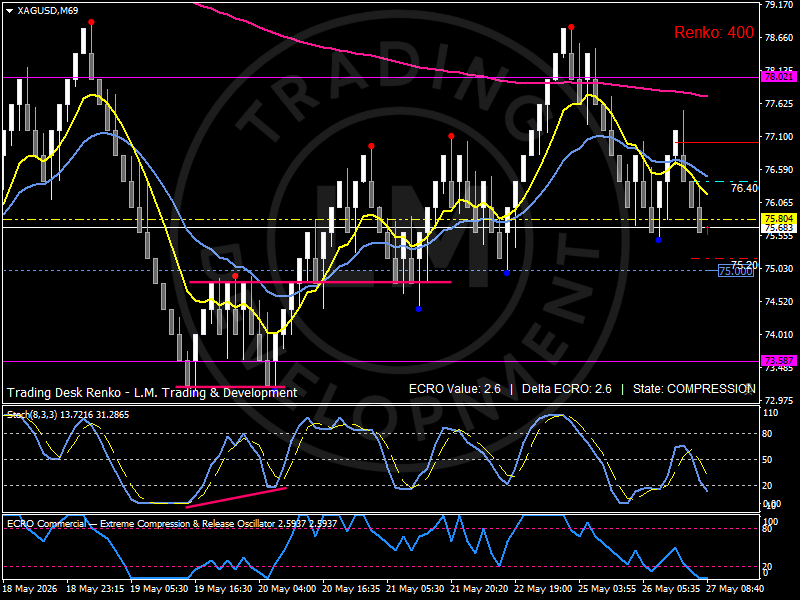
Resistance develops near 76.4–77.1, where previous upward extensions lost continuity and generated renewed selling pressure. The upper participation ceiling near 78.0 continues functioning as the dominant long term structural barrier.
Support remains concentrated around 75.6, followed by the deeper stabilization layer near 75.0. This region continues attracting tactical re-engagement after downside extensions.
The EMA configuration still reflects gradual momentum cooling. Short term averages continue rotating beneath the broader long term structure while directional participation progressively compresses after the previous recovery phase.
The Renko sequence shows alternating recovery attempts and controlled pullbacks while maintaining coherent rotational behavior inside the broader range.
The ECRO indicator currently stands near 2.6 with a slightly positive delta, reflecting a deeply compressed state where directional momentum remains weak but downside pressure is no longer accelerating.
This structure remains consistent with a market waiting for stronger macro alignment before attempting a broader expansion phase.
Bird’s eye view: Silver market map
Silver currently operates inside a fragmented industrial framework shaped by selective participation, softer inflation expectations and ongoing macro sensitivity ahead of Thursday’s US PCE release.
The primary regime pivot remains concentrated around 75.6–76.0, while broader participation resistance continues developing between 76.4 and 78.0.
Acceptance above the upper participation zone would strengthen the probability of renewed industrial continuation, particularly if softer inflation data begin reducing pressure from real yields.
On the downside, sustained movement below 75.0 would expose deeper corrective conditions as markets reassess industrial demand expectations and positioning breadth.
The key systemic variables remain:
- Copper leadership.
- Real yields.
- Manufacturing participation.
- Industrial logistics continuity.
- Dollar positioning.
- US inflation expectations.
Outlook
Silver continues trading inside a market shaped by selective industrial participation and gradual macro repricing ahead of the next major US inflation releases.
Copper remains the dominant industrial leader across the metals complex, while silver continues operating inside a lower conviction framework where participation remains fragmented despite resilient logistical and industrial conditions.
Softer inflation signals from Australia helped stabilize the broader macro backdrop, though yields and growth sensitivity continue limiting aggressive expansion across silver positioning.
The next directional phase now depends on whether Thursday’s US PCE data can further reduce pressure from real yields and broaden participation across industrial metals beyond the current copper-led structure.
Author

Luca Mattei
LM Trading & Development
Luca Mattei is a market analyst focusing on FX, metals, and macroeconomic trends. He develops trading tools for retail and professional traders, coding indicators and EAs for MT4/MT5 and strategies in Pine Script for TradingView.