Private credit books a Fed hike as income until borrowers stop paying
Seven of the largest publicly traded business development companies (BDCs) state in their June quarter filings what a rise in the base rate is worth to them. Across the seven, 100 basis points adds $677.1 million of annualised interest and dividend income and $367.2 million of net income. The Federal Open Market Committee (FOMC) meets on September 15 and 16, and the curve carries more than one of those over the next year. None of it is new money. It comes out of companies that, on the most-cited measure of their health, are already not generating any.
That is the whole argument. A floating-rate loan book reprices within a quarter of a hike and the borrower's ability to service it does not, so the same quarter point arrives as income on one side and as a bill on the other. The income books this quarter. The bill takes two to four quarters to surface as a default, and years to surface as a maturity nobody will refinance.
Every stress model was built for the other direction
The FOMC has held the target range at 3.50%-3.75% since December 2025. In July it held again, 9-3, with the Cleveland, Minneapolis and Dallas presidents all dissenting for a quarter-point rise, the most unified hawkish split since September 2016. August payrolls then landed at 162K against a 56K consensus. Chair Kevin Warsh has said the underlying inflation trend has not meaningfully improved, and Governor Christopher Waller, the closest thing the board has to a swing vote, has tied his decision to the August Consumer Price Index (CPI). The committee has not moved a rate in nine months and has spent the last three meetings arguing about which way it would move if it did.
Two years of private credit stress work asked what a cutting Fed would do to this book. The filings answer the other question in the same table, one column across.
What a quarter point buys, and who it is billed to
Ares Capital (ARCC) puts 100 basis points at $212 million of additional income and $94 million of additional net income, the largest of the seven. These are not projections. They are the filers' own answers to a required disclosure, computed off their own balance sheets, and they point the same way at every one of them.
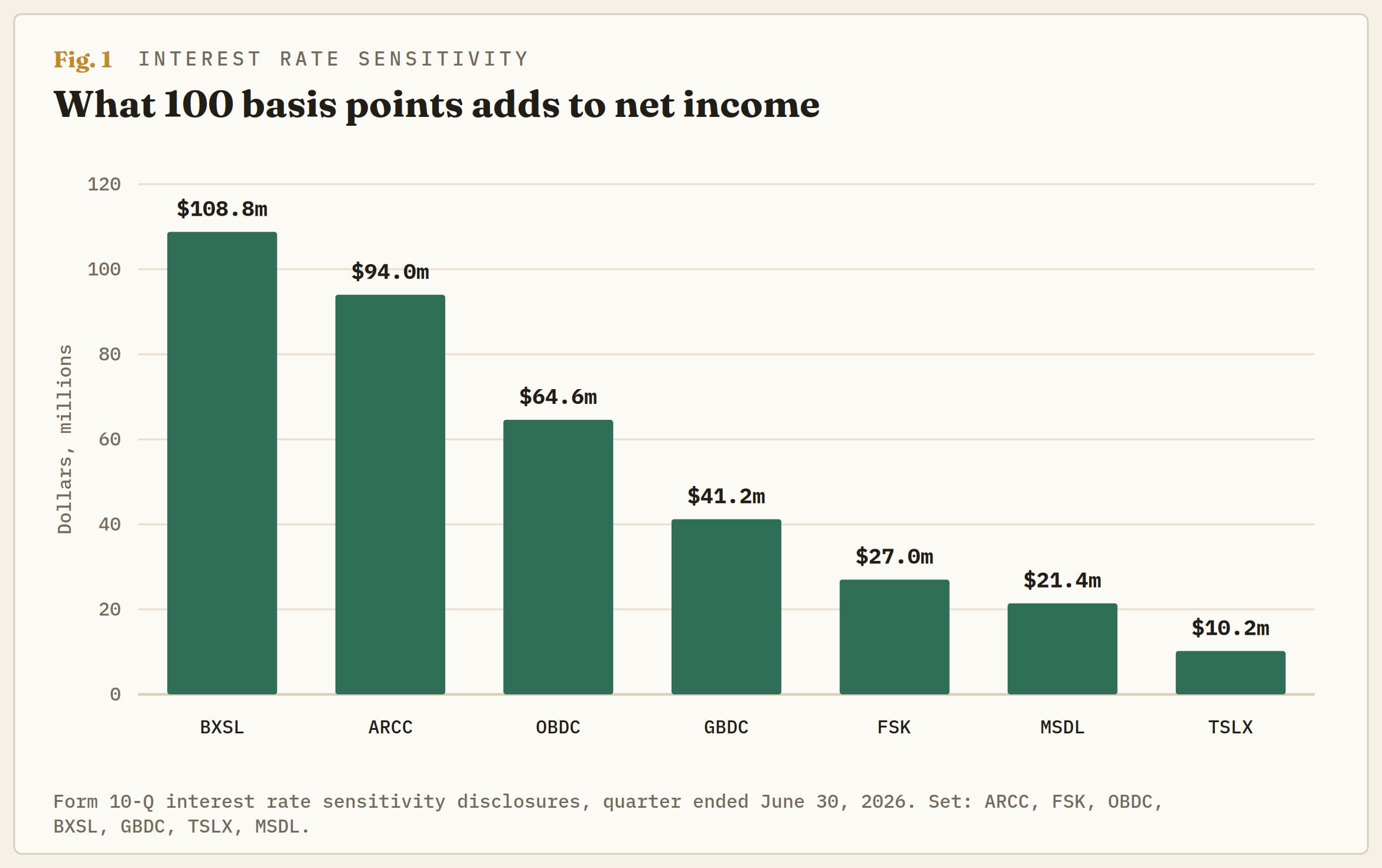
Blackstone Secured Lending (BXSL) and Morgan Stanley Direct Lending (MSDL) do better still, because both disclose that a rise in the base rate reduces their interest expense, their own borrowing being fixed or swapped to fixed. Blackstone Secured Lending holds 99.3% of its performing debt investments at floating rates and takes the increase on all of them. A hike raises what its borrowers pay and lowers what it pays. The table has a column for each.
The curve is not pricing one hike
Market pricing on Wednesday put September 16 at a 63.6% chance of a rise. That is the small number. The curve carries 66.9bp over twelve months, which is two or three hikes, lifting the implied midpoint to 4.29% by July 2027 from an effective rate of 3.63% now. The Secured Overnight Financing Rate (SOFR) these loans reference is 3.65%.
Run that path through the same disclosures and the seven collect roughly $246 million of additional net income a year from here. September alone is worth about $108 million of income at the priced probability. The borrowers do not get a probability-weighted bill.
The borrowers were already deferring before the rate turned
Payment-in-kind (PIK) interest is interest the borrower does not hand over, added to the loan balance instead. It books as income, it funds the distribution, and it is a wager that the borrower eventually pays. It also means the migration from performing to distressed was running before the rate direction changed, which is the part that makes a hike compound rather than initiate.
PIK interest ran 14.5% of FS KKR Capital's (FSK) investment income in the June quarter and 5.5% of Morgan Stanley Direct Lending's, and not one of the seven printed a lower share than it did a year earlier.
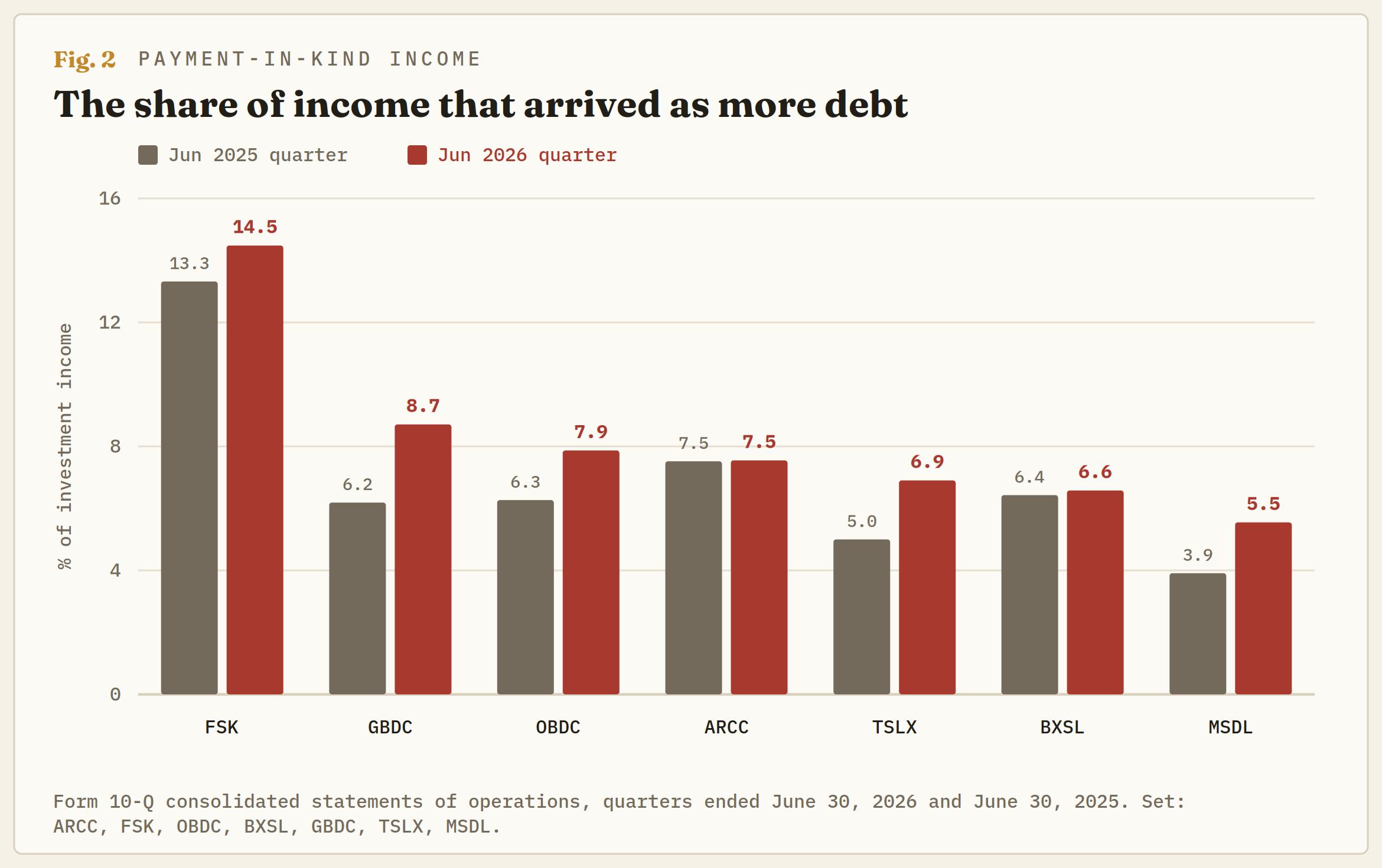
The Boston Fed put the PIK share of BDC loans near 10% in early 2026 against around 6% in early 2022, spread across industries rather than confined to software. A hike raises the coupon on a PIK loan as well. The borrower who could not pay the old rate now does not pay a higher one.
The measure that improves as the loan gets worse
Non-accrual is the end of that migration, where the lender stops booking the interest because it has stopped expecting to collect it. Ares Capital reports non-accruals at 2.4% of investments at amortised cost and 1.4% at fair value, against 1.8% and 1.2% at the end of December.
The fair value figure is always the lower one, and the mechanism is arithmetic rather than judgement. A distressed loan gets marked down, and a marked-down loan is a smaller share of the portfolio it is spoiling. The measure that flatters the book is the one that improves as the loans deteriorate, which is why the reported number will be the last place this shows.
A higher coupon is survivable; a refinancing is not
Everything above is about the coupon, and a coupon can be absorbed, deferred, PIK-ed or renegotiated with a sponsor. Principal cannot. The seven schedules of investments carry 4,207 debt positions with a maturity attached and $73.9 billion of principal behind them, and they say when each loan has to be refinanced by somebody at whatever the base rate is on the day.
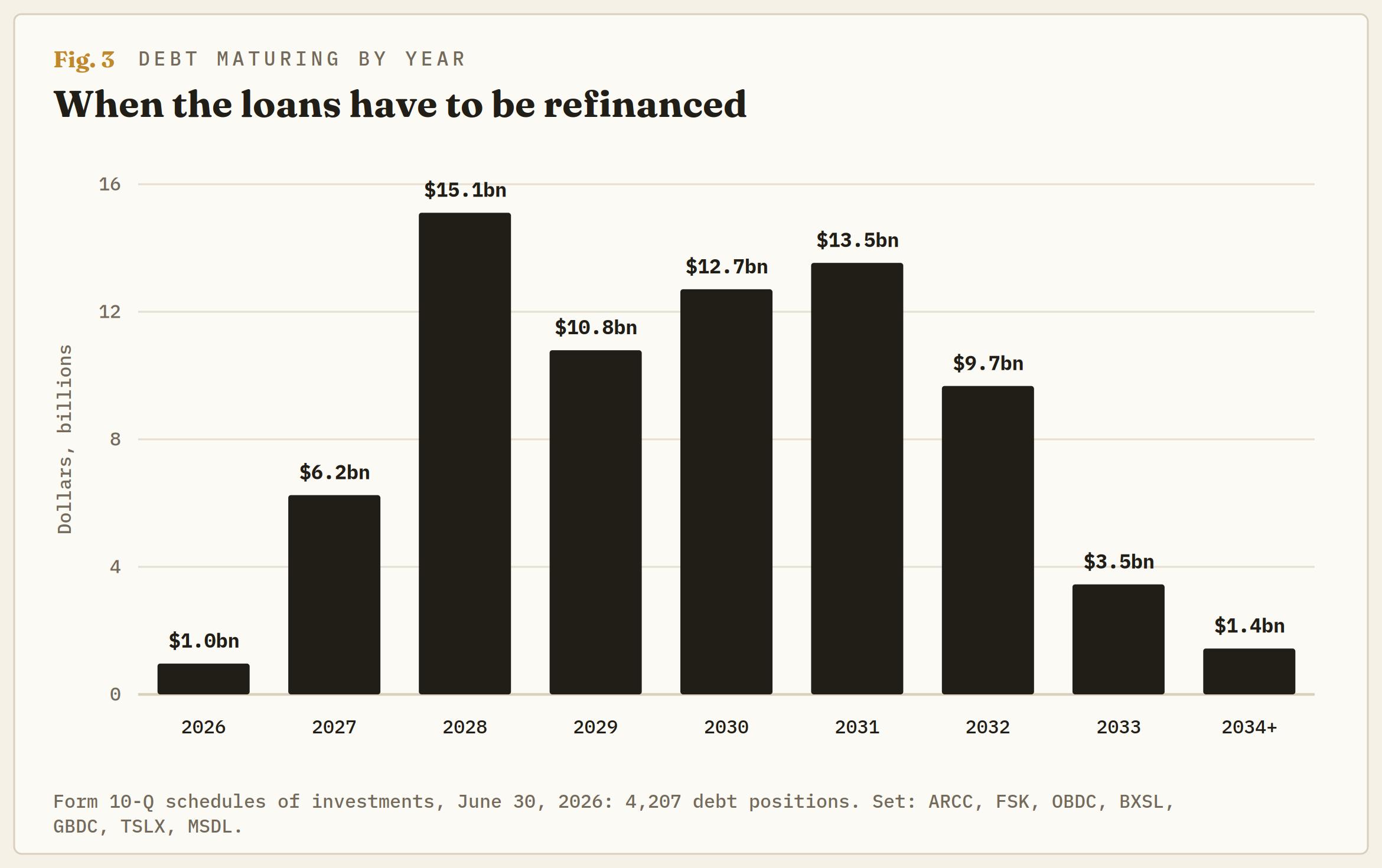
The near years are quiet and then they are not. Under $1 billion comes due through the end of this year, but 2028 alone carries $15.1 billion, and 30.2% of the book has to be refinanced by the end of it. That is the point where deferral stops working, because a sponsor can restructure a coupon in an afternoon and cannot conjure a lender for a company that has been capitalising its interest for three years.
The wall is not evenly owned. Golub Capital BDC (GBDC) has 45% of its book due by the end of 2028 and Ares 15.2%, a three-fold spread between two lenders the market prices as the same asset class.
The fork is on September 11, not September 16
The decision that matters is five days ahead of the decision everyone has diarised. August CPI publishes on September 11, and the swing voter on the board has said in advance which way each outcome moves him. A hot print hands the three dissenters a fourth vote and probably several more. A soft one buys the borrower base one meeting, and the curve still carries the rest of the path behind it.
Neither branch reverses the arithmetic, because reversing it requires a cut and nobody on the committee is arguing for one. The third-quarter filings in early November are where the first part resolves, and two lines carry it: PIK as a share of investment income, and non-accruals at amortised cost rather than at fair value. If both hold flat across the seven after a September rise, the borrower base absorbed the increase and this is wrong. If PIK climbs while the fair value figure sits still, the migration is running. The 2028 stack resolves later and more slowly, in maturity dates that quietly move out a year at a time.
The lenders book the income either way.
Author

Joshua Gibson
FXStreet
Joshua joins the FXStreet team as an Economics and Finance double major from Vancouver Island University with twelve years' experience as an independent trader focusing on technical analysis.

















