Prediction markets are changing how traders read breaking news
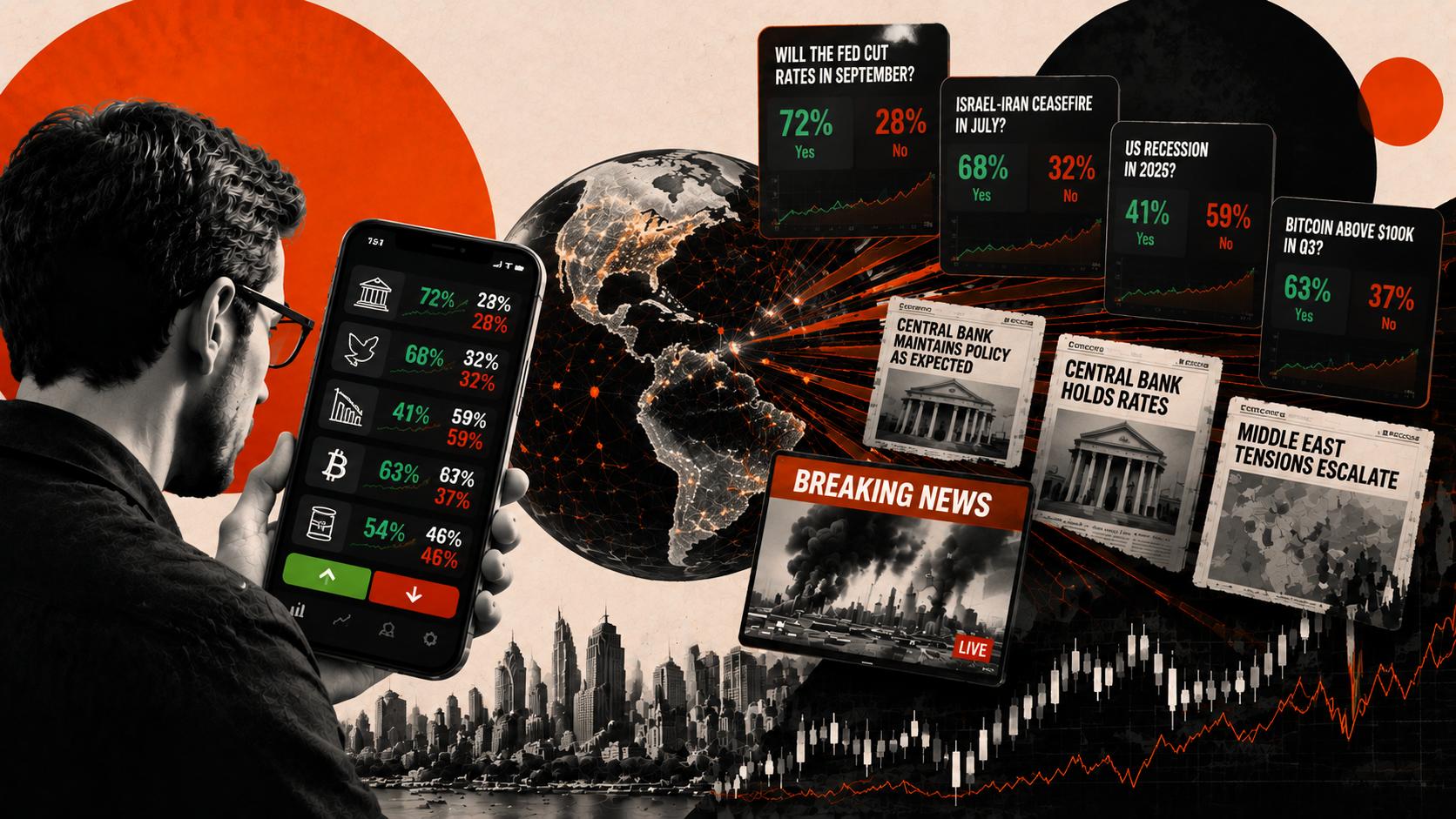
When a major macroeconomic release hits the wires, traders instinctively turn to Treasury yields, the US Dollar (USD), Equity futures or the CME FedWatch Tool to gauge the market's reaction. Increasingly, however, another screen is attracting attention: Prediction markets.
Platforms such as Polymarket and Kalshi are no longer confined to election betting or niche political forecasts. They have become real-time indicators of how market participants interpret breaking news, whether it is a surprise inflation report, a Federal Reserve (Fed) speech, an escalation in the Middle East or a new tariff announcement.
In many cases, these markets appear to react within seconds, displaying an implied probability for a future event before more traditional financial indicators have fully adjusted. This growing speed has led some traders to wonder whether prediction markets are becoming one of the earliest signals available in modern financial markets.
The answer may increasingly be yes. But that speed comes with important caveats.
Why prediction markets react so quickly
Prediction markets differ fundamentally from traditional financial markets because they price a single question rather than an asset.
A Treasury future reflects a complex combination of interest rate expectations, inflation forecasts, liquidity conditions, positioning and risk premiums. By contrast, a prediction market contract simply asks a binary question.
- Will the Federal Reserve cut interest rates in September?
- Will inflation exceed 3%?
- Will Congress approve a spending bill before Friday?
Each contract generally pays one dollar if the event occurs and zero if it does not. A contract trading at $0.68 therefore implies that the market assigns roughly a 68% probability to that outcome.
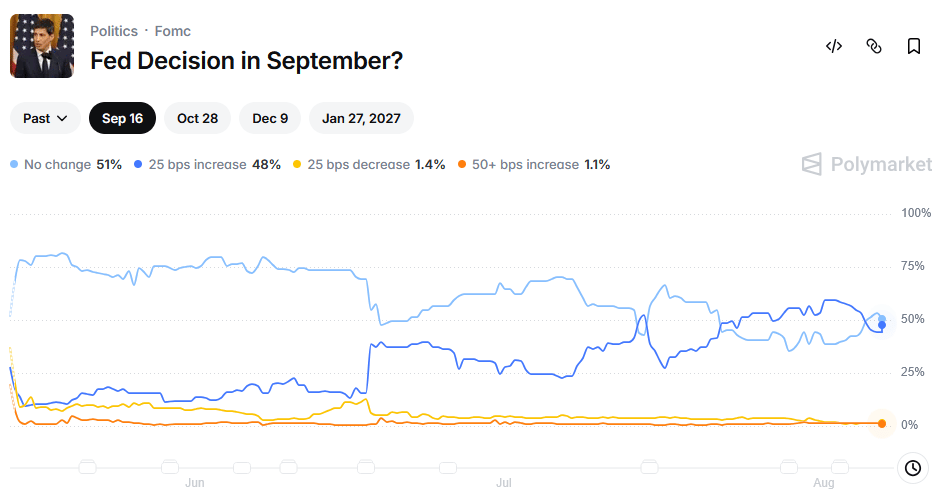
Because participants only need to reassess the probability of one specific event, new information can be incorporated almost immediately. There is no need to estimate discounted cash flows, earnings revisions or fair value models. Traders simply decide whether the probability should move higher or lower and execute their orders.
This structural simplicity explains why prediction markets often appear to digest breaking news faster than many traditional asset classes.
Markets don't just report the news; they interpret it
Perhaps the biggest advantage of prediction markets is that they transform headlines into probabilities. A stronger-than-expected inflation report, for example, tells investors that price pressures remain elevated. But it does not immediately answer the question every trader is asking: What does this mean for the next Fed meeting?
Prediction markets attempt to answer that question in real time. Instead of reading dozens of analyst reactions or waiting for economists to update their forecasts, traders can simply observe how the implied probability of a rate cut changes almost immediately after the data release.
The same mechanism applies to elections, geopolitical crises or trade policy announcements. A military strike, an unexpected resignation or a surprise tariff announcement is immediately translated into changing odds that reflect the collective judgment of thousands of market participants.
Rather than replacing traditional news coverage, prediction markets add a quantitative layer that attempts to measure how important a new development actually is.
Are prediction markets becoming an earlier signal than the FedWatch Tool?
One common comparison is with the CME FedWatch tool, which has become the standard reference for estimating future Fed policy decisions. Although many traders treat FedWatch as a forecasting model, it is important to understand what it actually does.
The FedWatch tool does not generate forecasts on its own. Instead, it converts prices from Fed Funds Futures into implied probabilities for future interest-rate decisions.
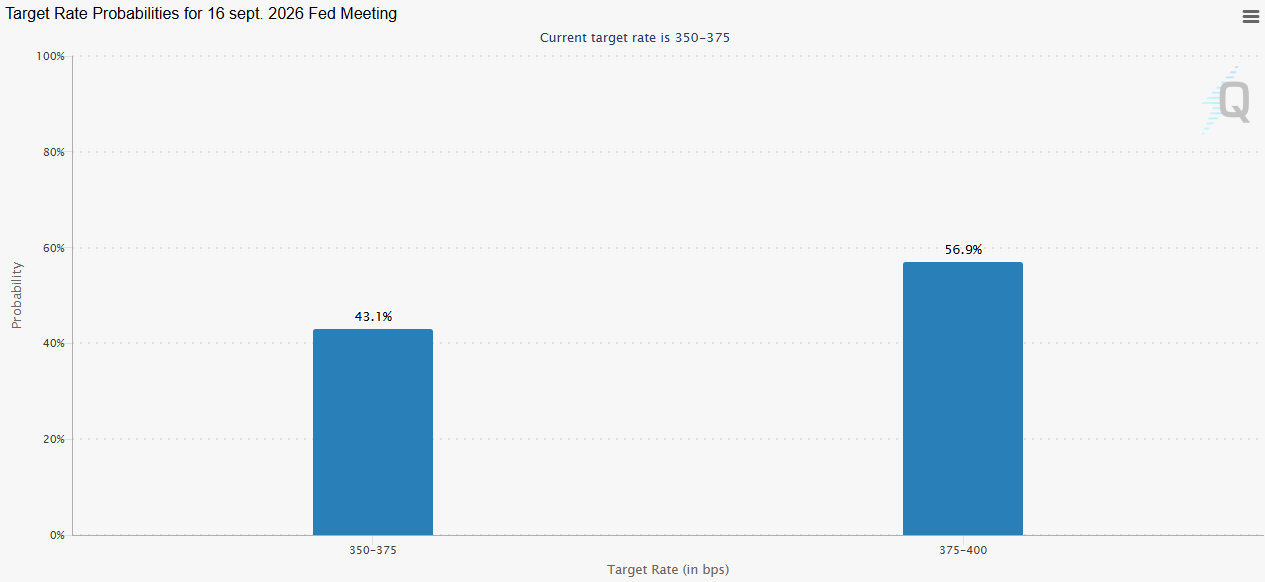
Prediction markets remove one layer from this process. Instead of pricing an interest-rate future and then translating that price into probabilities, participants directly trade the probability itself.
That does not mean prediction markets always lead traditional markets. Treasury markets remain vastly deeper and more liquid, while institutional investors continue to dominate interest-rate pricing. But for highly event-driven developments, prediction markets can offer one of the earliest readings of how traders collectively interpret new information.
For traders trying to understand not just what happened, but what the market believes will happen next, prediction markets have become an increasingly valuable complement to traditional indicators.
Why Wall Street is paying attention
Only a few years ago, prediction markets were largely viewed as niche platforms focused on politics and entertainment. That perception is changing rapidly.
Trading volumes have surged as platforms expanded beyond election contracts into macroeconomic releases, monetary policy, inflation, geopolitics, weather events and corporate developments. According to a Pew Research Center analysis, combined monthly global trading volume on Polymarket and Kalshi has risen from less than $5 billion in September 2025 to about $24 billion in April 2026.
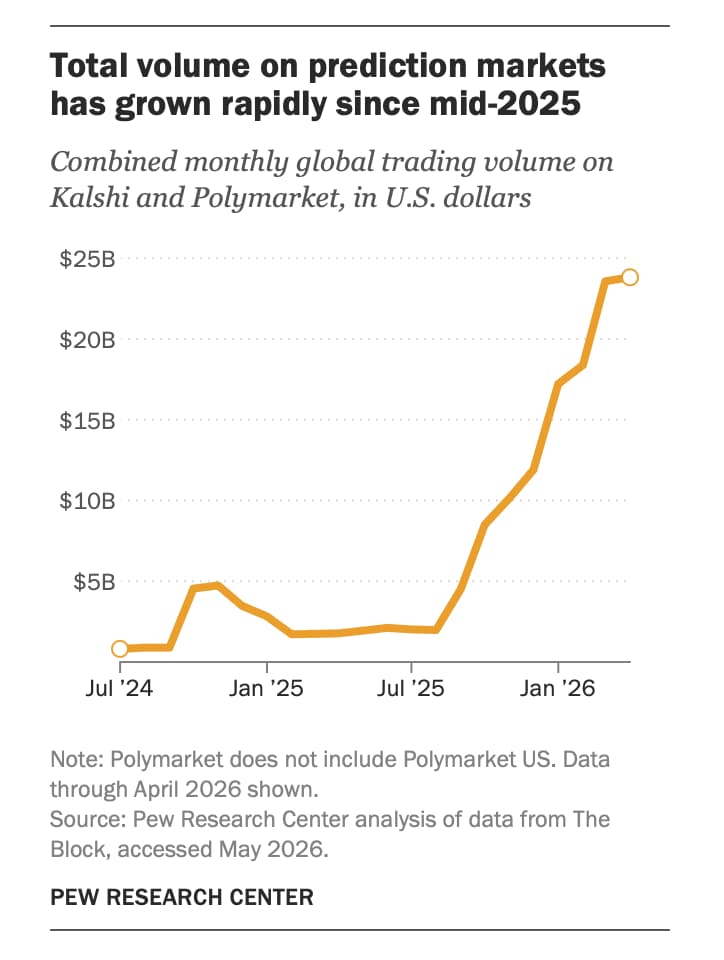
Their growing relevance has not gone unnoticed across financial markets. Institutional investors increasingly monitor prediction market prices alongside traditional indicators to gauge market sentiment surrounding Fed meetings, elections and geopolitical risks. Research firms have noted that hedge funds and asset managers are beginning to incorporate these probabilities into scenario analysis, portfolio construction and volatility management.
Retail brokerages are moving in the same direction. Robinhood, Coinbase and Webull have all expanded into event contracts, reflecting growing demand from traders looking to express views on economic and political events as easily as they trade stocks or cryptocurrencies.
Prediction markets are gradually evolving from speculative platforms into another layer of market intelligence.
Faster doesn't always mean better
The speed of prediction markets is also their greatest weakness. Unlike the US Treasury market or major currency pairs, many prediction contracts still trade with relatively limited liquidity. In some markets, a relatively modest order can move prices significantly, creating the impression that probabilities have changed dramatically when only a handful of participants have traded.
Morgan Stanley recently highlighted this distinction, noting that prediction markets tend to be well calibrated when liquidity is deep, but their accuracy can deteriorate in thinner markets where prices are easier to influence.
This creates an important difference between speed and reliability. A rapidly changing probability is not necessarily a better signal if only a small amount of capital is behind the move.
Prediction markets also remain particularly vulnerable to informed trading. Unlike broad financial markets, where moving prices often requires enormous amounts of capital, many event contracts revolve around information known by only a handful of people before it becomes public.
A study by Columbia Law School’s Professor Joshua Mitts recently identified more than 210,000 suspicious trades on Polymarket over two years. The statistical analysis revealed that these trades achieved a nearly 70% success rate and generated an estimated $143 million in profits, suggesting that informed trading may be far more prevalent than many participants realize.
Several high-profile cases illustrate the concern. One widely reported investigation involved a US military officer accused of placing profitable trades linked to the anticipated removal of Venezuelan President Nicolas Maduro before the operation became public. In another case, French authorities investigated alleged manipulation of a weather station near Charles de Gaulle Airport after unusually accurate temperature bets generated significant profits on Polymarket.
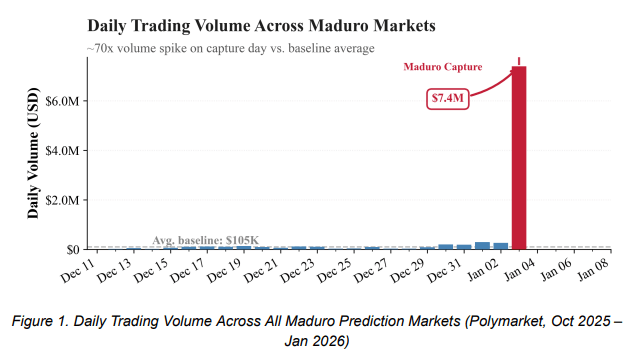
Whether these cases ultimately result in convictions is less important than what they reveal: a potential weakness in prediction markets. If traders begin reacting to prices influenced by insider information or manipulation, prediction markets risk transmitting distorted signals into much larger financial markets.
A powerful tool, but not a source of truth
Prediction markets are changing the way traders process information. Rather than waiting for economists to update forecasts or analysts to publish research notes, investors can now watch probabilities adjust in real time as markets digest new information. For event-driven trading, they have become one of the fastest sentiment indicators available.
That does not make them infallible. Like every market, prediction markets reflect the incentives, biases and information available to their participants. Their prices are not objective facts, nor official forecasts. They are simply the collective opinion of traders willing to put money behind a particular outcome.
For traders, that distinction matters. Prediction markets deserve a place alongside Treasury yields, Fed Funds Futures, the US Dollar and other traditional macro indicators. They can provide valuable early insight into how the market is interpreting breaking news, especially around elections, monetary policy and geopolitical developments.
But they should remain exactly what they are: one signal among many. The traders who benefit the most from prediction markets are unlikely to be those who blindly follow every probability change. Instead, they will be the ones who understand both the extraordinary speed of these markets and the limitations that come with that speed.
Author

Ghiles Guezout
FXStreet
Ghiles Guezout is a Market Analyst with a strong background in stock market investments, trading, and cryptocurrencies. He combines fundamental and technical analysis skills to identify market opportunities.














