|

Paraguay's stable growth

For 35 years until 1989 Paraguay was governed by the dictator Stroessener. Constitutionalism was restored in 1992. Paraguay has two official languages, Spanish and Guarani, and the latter is spoken by 60% of the population - the highest indigenous participation on the Continent. Under Stroessener the Paraguayean economy grew steadily under the import substitution model and the development of infrastructure for hydroelectric dams.

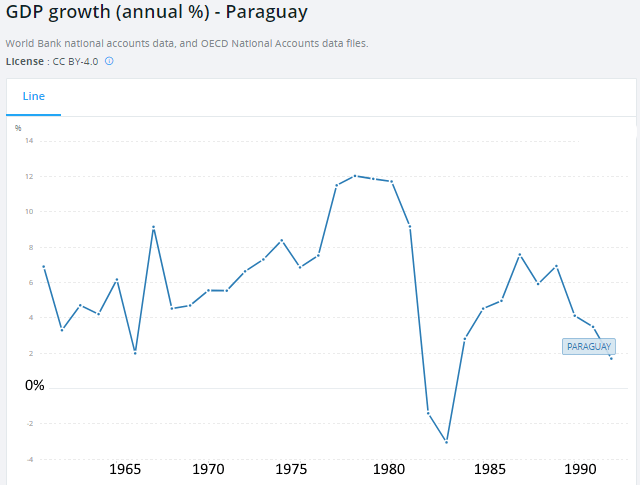
It can be seen from the chart below that for the period up to the 1992 Constitution economic growth averaged about 7% a year. There was a contraction around 1982/83 coinciding with the Latin American debt crisis but growth quickly resumed. In fact, although Paraguay, like it’s neighbours, borrowed internationally after 1974 it invested the loans in infrastructure and particularly dams for electricity generation for export. Thus it was comfortably able to meet it’s repayments and didn’t have recourse to the IMF.
GDP

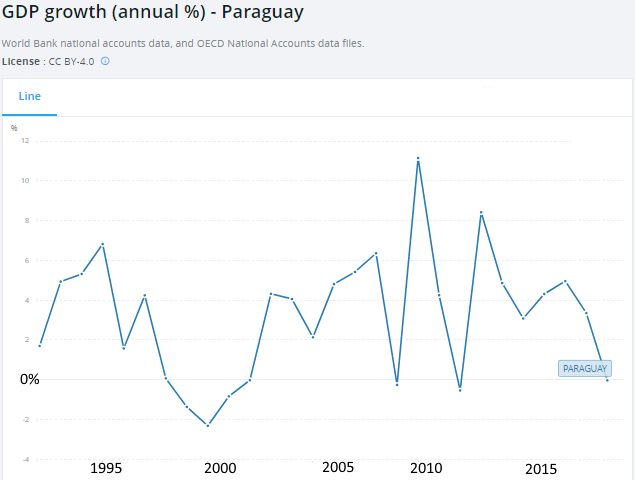
For the period since the return of Constitutionalism it can be seen from the chart below that growth has averaged about 5% a year. There was a dip at the turn of the Millennium coinciding with contractions in both Brazil and Argentina and there was also a minor dip coinciding with the world financial crisis around 2010. Thus it can be said that Paraguay has been one of the most consistent growth countries in Latin America over many decades. It also has low inflation and a negligible Government deficit. Some 45% of the working age population are in insured employment.
GDP

Apart from electricity it exports are mostly primary produce and it’s three largest export markets are Brazil, Argentina and Chile. That means it will be affected by the recent slowdowns in Brazil and Argentina in particular. For economic growth to continue Paraguay must diversify it’s exports by type and destination by looking for new markets in Asia, Europe and beyond.

Author

Paul Dixon

Paul Dixon

Latin Report

Paul Dixon’s focus is economics from a long term perspective.

More from Paul Dixon
Share:

Markets move fast. We move first.

Orange Juice Newsletter brings you expert driven insights - not headlines. Every day on your inbox.

By subscribing you agree to our Terms and conditions.

Editor's Picks

EUR/USD gathers recovery momentum, trades near 1.1750

Following the correction seen in the second half of the previous week, EUR/USD gathers bullish momentum and trades in positive territory near 1.1750. The US Dollar (USD) struggles to attract buyers and supports the pair as investors await Tuesday's GDP data ahead of the Christmas holiday. 

GBP/USD rises toward 1.3450 on renewed USD weakness

GBP/USD turns north on Monday and avances to the 1.3450 region. The US Dollar (USD) stays on the back foot to begin the new week as investors adjust their positions before tomorrow's third-quarter growth data, helping the pair stretch higher.

Gold not done with record highs

Gold extends its rally in the American session on Monday and trades at a new all-time-high above $4,420, gaining nearly 2% on a daily basis. The potential for a re-escalation of the tensions in the Middle East on news of Israel planning to attack Iran allows Gold to capitalize on safe-haven flows.

Top 10 crypto predictions for 2026: Institutional demand and big banks could lift Bitcoin

Bitcoin could hit record highs in 2026, according to Grayscale and top crypto asset managers. Institutional demand and digital-asset treasury companies set to catalyze gains in Bitcoin.

Ten questions that matter going into 2026

2026 may be less about a neat “base case” and more about a regime shift—the market can reprice what matters most (growth, inflation, fiscal, geopolitics, concentration). The biggest trap is false comfort: the same trades can look defensive… right up until they become crowded.

XRP steadies above $1.90 support as fund inflows and retail demand rise

Ripple (XRP) is stable above support at $1.90 at the time of writing on Monday, after several attempts to break above the $2.00 hurdle failed to materialize last week. Meanwhile, institutional interest in the cross-border remittance token has remained steady.













