Oil outlook: US considering a strike against Iran

Since our last report, oil prices have moved higher for a third week in a row. In today’s report, we are to have a look at some key issues that tend to tantalise oil traders, primarily related to the recent geopolitical developments in the Middle East and Fed’s recent interest rate decision and to conclude we discuss the recent reports by the IEA and OPEC. We are to complement the fundamentals with a technical analysis of WTI’s daily chart.
US on the verge of attacking Iran?
In our last report, we correctly noted that Israel was more likely to strike Iran rather than the US, with Israel and Iran now engaged in a war that has lasted for over 6 days. In particular, the two nations have engaged in an “aerial-bombardment” campaign where the two have been exchanging missile and drone attacks. In turn, the military campaigns embarked by both nations have sent oil prices soaring higher and have resulted in significant volatility in the oil markets. Moreover, according to various media outlets, the US is considering a direct strike against Iran with President Trump stating that ““I may do it, I may not do it”, a move which could further destabilize the region, as US bases hosted in foreign nations may be considered as valid military targets, thus risking dragging in other nations into the war.In addition, the US has been moving strategic military assets into the region and of particular interest is the Nimitz carrier strike group and the USS Gerard R Ford carrier strike group, which are both deploying to the region. In our opinion, the deployment of carrier strike groups to the region could be in order to protect the vital oil arteries such as the Suez Canal and the Strait of Hormuz, whilst possibly providing support for military action. Furthermore, we would not be surprised to see a limited military involvement from the US, either by supplying their bunker buster munitions to Israel or using their B2 stealth bombers to destroy the Furdow nuclear facility in Iran. Nonetheless, any military action by the US could aid oil prices, as the consequences of a direct US involvement could lead to various oil supply disruptions in the region. On the other hand, there has been an ongoing diplomatic effort from various nations around the globe in an attempt to de-escalate the situation and thus should their efforts be fruitful, it may weigh on oil prices. In conclusion, the situation is ongoing and warrants close attention, as any developments could either positively or negatively impact oil prices depending on their implications.
Fed remains on hold as expected
The Fed’s interest rate decision occurred yesterday, with the bank remaining on hold as was widely expected. Moreover, the bank released its summary of economic projections, in which the bank still expects to cut two times by the end of the year. However, within the bank’s dot plot they also see fewer rate cuts ahead. In addition, during Fed Chair Powell’s press conference, he stated that “We expect a meaningful amount of inflation in the coming months”, showcasing the ongoing concerns faced by Fed officials, which could blur the bank's path moving forward. In turn, the decision may have initially weighed on oil prices, yet when looking at the longer picture the concerns over “meaningful” inflation could result in a reduction of oil demand. In conclusion, should Fed officials showcase their concerns about the possible resurgence of inflation in the near future, it may be perceived as hawkish it may curb demand and thus may aid oil prices and vice versa.
OPEC and IEA release their Oil reports
OPEC and the IEA have both released their monthly oil reports, with the IEA also releasing a longer term report up until 2030. Starting with the report by OPEC, the cartel stated that the “strong base from 1H25 is anticipated to provide support and sufficient momentum into a sound 2H25” when referring to underlying growth. In turn the implications of a “strong base” may imply that demand may remain sufficient or possibly increase during the second half of the year, which may aid oil prices. Yet they remain concerned as “some risks may persist on the tariff front, particularly given the scheduled expiration of the 90-day pause on reciprocal tariffs in July and August, including those targeting China” and thus the possible meeting between US Treasury Secretary Scot Bessent and his Chinese counterparts which may occur in about 3 weeks may be closely monitored by oil market participants. Moving to the IEA, they have stated that “ the report finds that increased output from the United States, Canada, Brazil, Guyana and Argentina is set to be more than sufficient to cover the growth in global demand in the coming years. In the absence of major supply disruptions, the latest medium-term forecast sees a comfortably supplied oil market through 2030” which could be perceived a bearish for oil prices, and supply may exceed demand in the longer run. However, they also raise their concerns over geopolitical risks and heightened trade tensions which could result in oil supply crunches and may thus aid oil’s price depending on the scope and duration of the possible supply disruptions. To summarize, the implications of a continued momentum of growth leading into the 2H25 may be perceived as bullish for oil prices, coupled with the recent geopolitical tensions it may further aid oil’s price.
Technical analysis
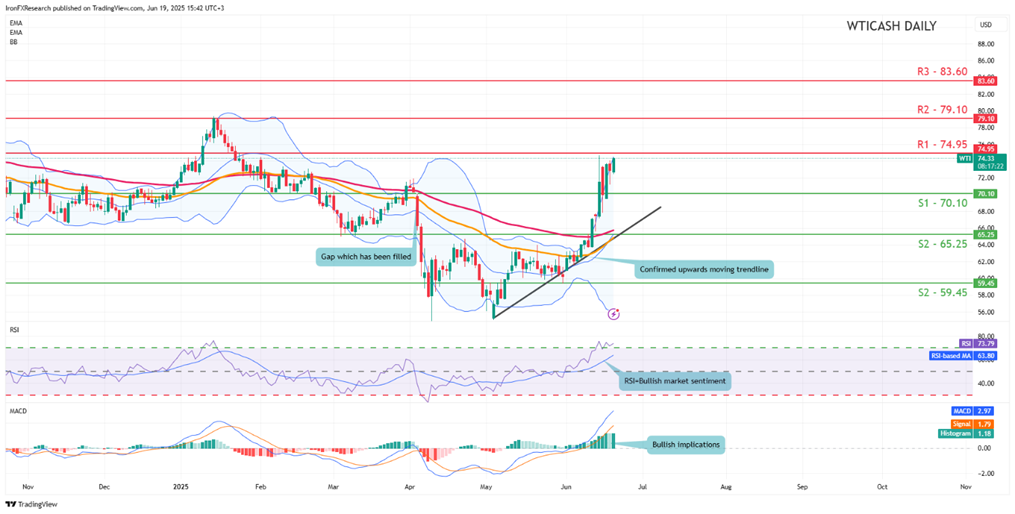
WTI cash daily chart
-
Support: 70.10 (S1), 65.25 (S2), 59.45 (S3).
-
Resistance: 74.95 (R1), 79.10 (R2), 83.60 (R3).
WTI’s price appears to be moving in a predominantly upwards fashion. We opt for a bullish outlook for the commodity’s price and supporting our case are a variety of factors, starting with the upwards moving trendline which was incepted on the 5th of May in addition to the RSI and MACD indicator below our chart. For our bullish outlook to continue we would require a clear break above the 74.95 (R1) resistance line with the next possible target for the bulls being the 79.10 (R2) resistance level. On the other hand for a sideways bias, we would require the commodity’s price to remain confined between our 70.10 (S1) support level and the 74.95 (R1) resistance line. Lastly, for a bearish outlook we would require a clear break below the 70.10 (S1) support line with the next possible target for the bears being the 65.25 (S2) support base.
Author
Phaedros Pantelides
IronFX
Mr Pantelides has graduated from the University of Reading with a degree in BSc Business Economics, where he discovered his passion for trading and analyzing global geopolitics.