Oil market faces dual challenge: From oversupply fears to declining field output
Oil traders are grappling with a paradox. Over the past week, headlines swung from warnings of oversupply and weak U.S. demand to fresh concerns about accelerating decline rates in oil and gas fields that could undermine future supply. For traders, this dual narrative complicates the outlook: bearish pressure in the short term, but bullish risks building over the longer horizon.
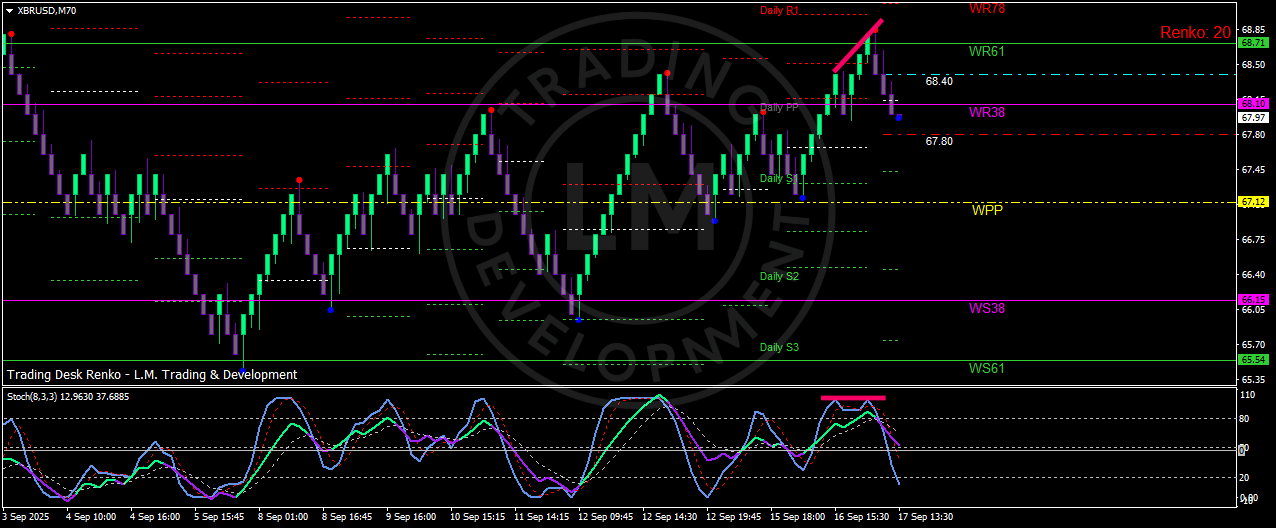
Brent (XBRUSD) Renko chart showing rejection at WR78 69,14 and bearish divergence on Stochastic (8,3,3).
| Resistance | Support |
|---|---|
| WR78 – 69,14 | 68,40 (intraday pivot) |
| Daily R1 – 68,70 | WR38 – 68,10 |
| 67,80 (local lows) | |
| WPP – 67,12 | |
| WS38 – 66,15 |
Bias: Bearish below 68,40. A clear bearish divergence on Stochastic (8,3,3) confirms fading momentum.
Short-term pressure points toward 67,80 / 67,10. Only a breakout above 69,14 would reopen upside toward 69,50–70,00.
Oversupply fears dominate early September
On September 11–12, the International Energy Agency (IEA) warned that global oil supply was set to rise faster than demand in the second half of 2025, raising the prospect of renewed surpluses. At the same time, U.S. economic data painted a softer picture of consumption. Oil prices slipped even as geopolitical tensions simmered in the Middle East, highlighting just how dominant the oversupply theme had become.
Incremental output from OPEC+ members, along with growing production in non-OPEC countries such as Brazil, Guyana and the U.S., tilted the balance back toward excess supply. Traders reacted swiftly: Brent and WTI both extended losses into the end of that week, underscoring the market’s skepticism about near-term demand.
Adding to the bearish pressure was evidence of weakening U.S. demand. Inventory reports pointed to softer refinery intake and slower gasoline consumption. Even with supply-side risks, the market’s inability to rally underscored how sensitive crude prices remain to signals of faltering U.S. consumption.
A shift in focus: Declining field output
Just a few days later, on September 16, the IEA released another report highlighting a very different concern: accelerating decline rates in global oil and gas fields. According to the agency, many producing fields are now past their peak and require significant investment simply to maintain current levels. Without sustained upstream investment, natural decline rates could reduce supply by millions of barrels per day in the coming decade.
This message stands in sharp contrast to last week’s oversupply narrative. Rather than worrying about too much oil, the industry could soon face too little if capital spending does not keep up. Declining production from legacy fields means that new projects must not only meet incremental demand but also offset the natural depletion of existing reservoirs.
For traders, the juxtaposition is striking. Short-term bearish headlines about weak demand and rising inventories sit uneasily next to longer-term warnings of underinvestment and potential supply shocks.
The market’s dual narrative
This dual narrative is not unusual in commodity markets, but it is particularly stark in today’s oil landscape. On the one hand, the near-term balance looks heavy: inventories are ample, U.S. demand has shown cracks, and OPEC+ production increases are hitting the market. On the other hand, the structural story suggests that without more investment, the industry risks a sharp drop in supply capacity over the next decade.
For price action, this creates a range-bound environment. Brent has repeatedly tested the $67–68 support zone, while WTI has traded around $63–64. Attempts to rally have been capped by macro concerns, while attempts to break lower have run into the recognition that supply risks cannot be ignored. Volatility is likely to remain elevated as traders weigh these conflicting forces.
Trading implications
For short-term traders, the oversupply narrative remains the dominant driver. Price dips have been linked to weaker U.S. retail gasoline demand and rising crude inventories, while rallies struggle to hold unless backed by geopolitical risks or sudden supply disruptions. Technical levels around WTI $63 and Brent $67 have acted as key pivot points, and momentum traders will continue to use these zones as references.
Medium-term investors, however, may find the IEA’s warnings about decline rates more compelling. If upstream investment fails to materialize, today’s oversupply could flip to undersupply within a few years. That creates an asymmetry in the risk profile: downside may be limited in the long term, while upside shocks become more likely.
From a macro perspective, the interplay between demand-side signals (U.S. consumption, Chinese growth, European industrial output) and supply-side capacity constraints will dictate whether oil remains range-bound or breaks into a new trend.
What traders should watch next
The next key data points for traders will be weekly U.S. inventory reports, which remain a high-frequency barometer of near-term demand. Any further evidence of soft gasoline and distillate consumption would reinforce the oversupply theme. At the same time, OPEC+ communications will be critical: whether the group adjusts output in response to price weakness could set the tone for Q4.
On the structural side, capex announcements from major oil companies will indicate whether the industry is responding to the IEA’s call for more investment. If spending remains subdued, traders may start to price in longer-term supply risks even as short-term balances appear heavy.
Conclusion
The oil market is facing a classic commodity dilemma. In the short run, prices are pressured by oversupply concerns and soft U.S. demand. In the long run, the very sustainability of global production is in question as decline rates accelerate.
For traders, the challenge is to navigate between these two narratives: bearish momentum in the immediate term, but a bullish undertone for those willing to look beyond the current surplus.
The coming weeks will be critical in determining which side of the narrative gains traction. For now, oil remains at a crossroads — trapped between today’s surplus and tomorrow’s potential scarcity. In the meantime, traders should brace for choppy price action as these two forces collide.
Author

Luca Mattei
LM Trading & Development
Luca Mattei is a market analyst focusing on FX, metals, and macroeconomic trends. He develops trading tools for retail and professional traders, coding indicators and EAs for MT4/MT5 and strategies in Pine Script for TradingView.