Oil and Gold: Price review for the week ahead

This preview of weekly data examines USOIL and XAUUSD, with economic data expected later this week as the primary market drivers of the near-term outlook.
Highlights of the week: RBA rate decision, EU inflation, US job report
Tuesday
The Reserve Bank of Australia interest rate decision at 4:30 AM GMT is expected to increase from 4.35% to 4.60%. If this is confirmed, it would be the fourth rate hike in 2026 and could potentially create some gains for the Aussie against its pairs.
Wednesday
NBS manufacturing PMI at 01:30 AM GMT, where expectations are for a slight increase to 50.1 points. If the expectations are correct, then it would mean that the state- owned firms might be performing better, given the actual figure is above the 50-point level,l indicating that the manufacturing sector of the NBS survey might still be expanding and probably might have some effect on production-related products like oil, natural gas, silver, etc.
RatingDog Manufacturing PMI at 01:45 AM GMT. The figure for September is expected to increase by 0.1 points, reaching 51.6. RatingDog PMI is more focused on the export sector and small and midsize enterprises (SMEs) and a reading of anything above the 50 point mark would indicate that these companies are growing and expanding which could result in affecting the prices of various manufacturing related instruments.
Preliminary German inflation rate at 12:00 PM GMT. The market consensus forSeptember is for an increase in the figure of around 0.2%, reaching 3.1%. If this is broadly accurate then it could most probably influence the European inflation figure on Friday.
US core PCE expected to be released at 12:30 GMT is anticipated to increase by 0.1% for August. The PCE index shows the changes in the price of goods and services bought by consumers for consumption, and it excludes food and energy. The PCE reading is one of the vital components taken into account by the Federal Reserve when deciding on its monetary policy.
US GDP growth for the second quarter of 2026 is expected to decline to 1.6% against the previous figure of 2.1%. If these expectations are met, it could cause minor losses for the Dollar while supporting many of its instruments traded against it.
Thursday
US manufacturing PMI at 14:00 GMT. The consensus for September is an increase from 54.6 to 54.8 points. The manufacturing sector in the States seems to be holding above the 50-basis points meaning that the sector is still expanding and holding strong, supporting the dollar.
Friday
Flash European inflation rate at 09:00 AM GMT. The rate for September is expected to increase to 3.5% up from the previous reading of 3.2%. This could have a short-term positive effect on the Euro against its pairs because it could influence a more hawkish stance by the ECB at its next meeting.
The US jobs report is at 12:30 GMT, when the non-farm payrolls and unemployment rate are going to be published. The expectation for the NFP is for a decline to 100,000, down from the previous 162,000 jobs. If these expectations are correct, the dollar could move down in various pairs in the aftermath of the release. On the other hand, the unemployment rate is expected to increase from 4.1% to 4.2%.
USOil, daily
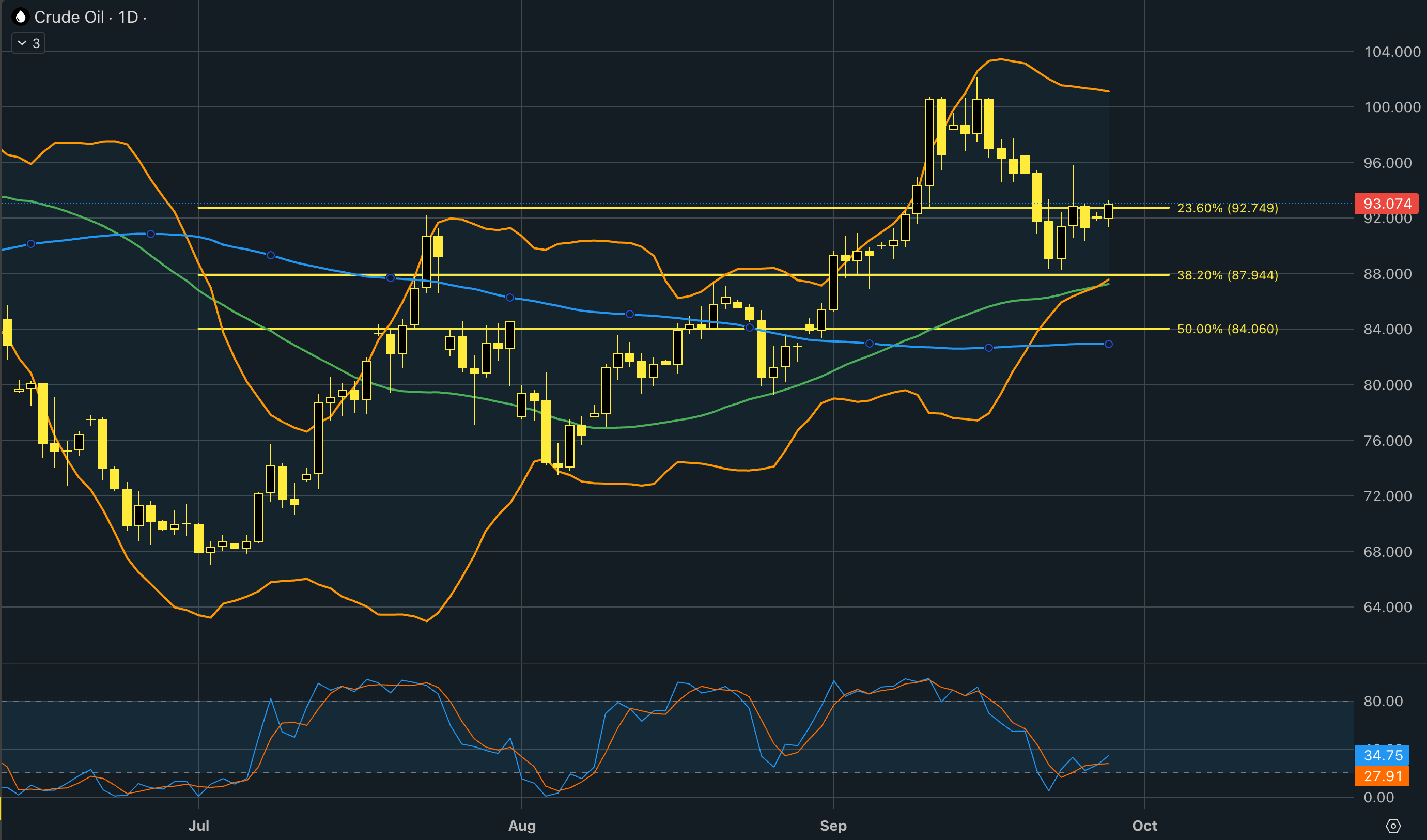
Oil prices rose as diplomatic efforts to reopen the Strait of Hormuz stalled after the US rejected Iran’s proposal, with Tehran refusing to soften its conditions. Although President Trump expects negotiations to resume this week, uncertainty over a potential agreement has increased supply concerns. The US is also considering restrictions on diesel exports to combat domestic fuel prices, while Washington claims that Iran’s oil shipments to China could soon come to an end. Meanwhile, reports of attacks on shipping and intercepted Houthi drones targeting Saudi Arabia have added to regional tensions, keeping supply disruption risks elevated.
From a technical perspective, crude oil is showing signs of stabilisation after a sharp correction, with price recovering toward $93 and testing the 23.6% Fibonacci resistance at $92.75. The recent rebound from the $88 area suggests buying interest has returned, while the Stochastic oscillator is turning higher from oversold territory, indicating improving short- term momentum. However, the broader recovery remains unconfirmed, with price still below the recent highs near $100. A sustained break above $92.75 could open the way toward $97–100, while rejection at this level could bring a retest of $88, followed by the $84 support area.
Gold-Dollar, daily
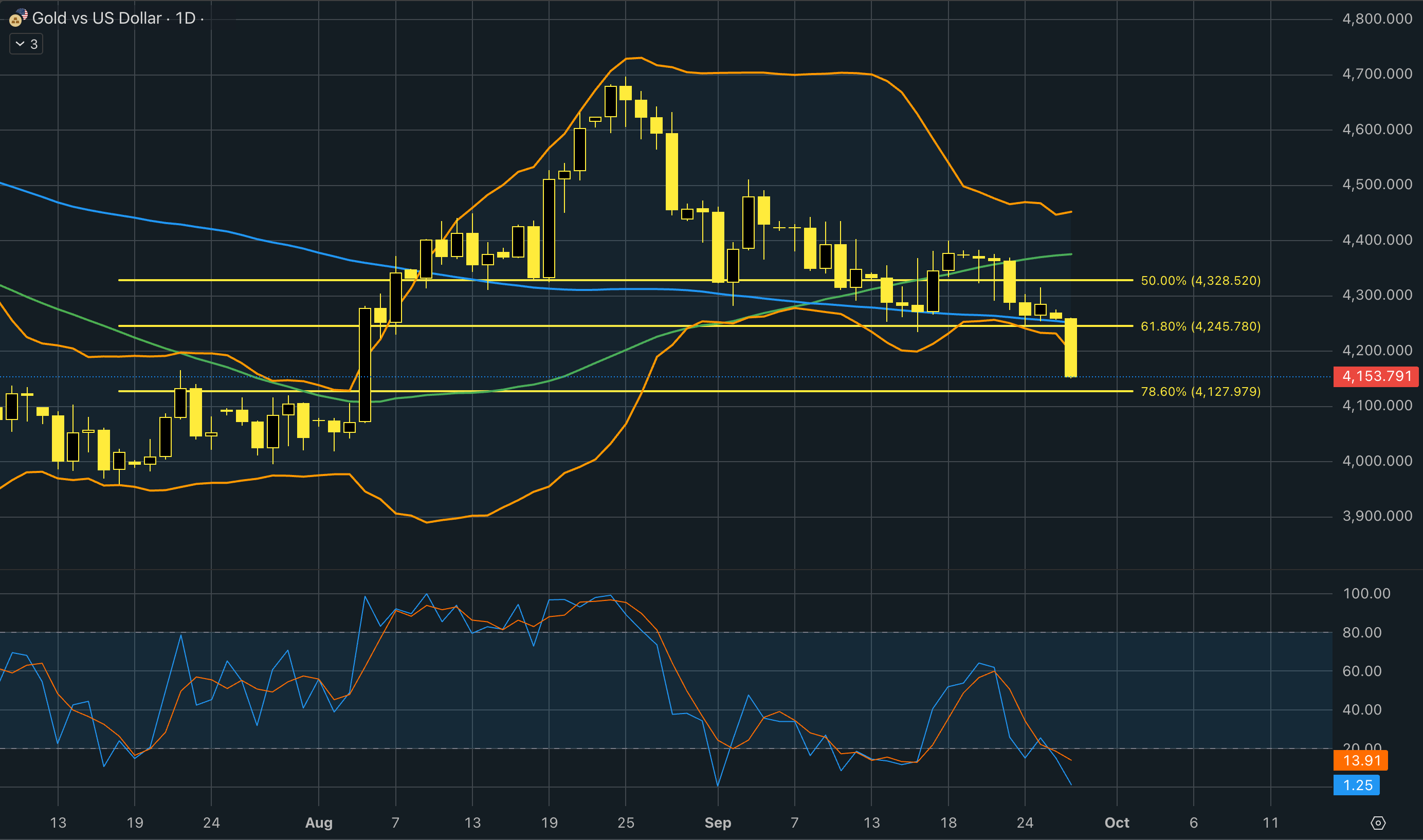
Gold plunged below $4,165 as the US-Iran stalemate over the Strait of Hormuz kept energy prices elevated and reinforced expectations of further Fed rate hikes. A stronger US dollar and rising Treasury yields added further pressure on precious metals, with gold heading for a nearly 6% monthly decline. Following the Fed’s first rate hike since 2023, markets are pricing in a 64% chance of another increase in October. Persistent inflation, higher real yields and uncertainty over a resolution to the Middle East conflict continue to weigh on gold.
From a technical point of view, gold is showing strong bearish momentum on the daily chart, with price falling sharply to around $4,154 and breaking below the 61.8% Fibonacci support at $4,245. The latest bearish candle has pushed price toward the 78.6% Fibonacci level at $4,128, while the Stochastic oscillator has dropped into deeply oversold territory, with %K near 1. This suggests that selling pressure remains strong, although a short-term rebound is possible. A hold above $4,130 could trigger a recovery toward $4,245, while a sustained break below this level would expose the $4,000 area.
Author

Antreas Themistokleous
Exness
Antreas has been trading CFDs since 2018 using a combination of fundamental and technical analysis.















