Can falling prices really ease inflation?

The global oil market may be approaching a turning point. While geopolitical tensions in the Middle East continue to create considerable uncertainty, supply conditions are showing increasing signs of improvement. For 2027, Goldman Sachs expects a growing production surplus and declining crude oil prices. For the Fed, this development could generally provide some relief. However, falling oil prices do not automatically mean that inflation will decline significantly. Energy prices depend on several factors beyond the price of crude oil alone.
Oil prices caught between geopolitical risks and rising supply
After Brent and WTI each lost more than three percent at the beginning of the week, prices recovered on Tuesday, November 17. Brent temporarily traded near $93 per barrel, while WTI rose to approximately $86.
The recovery was driven by renewed concerns about security in the Strait of Hormuz. Following fresh reports of attacks on oil tankers, uncertainty surrounding oil supplies increased. Adding to these concerns are the continued tensions between the United States and Iran.
Production in the Middle East has recovered significantly. Saudi Arabia reported production of approximately 10.5 million barrels per day in October, while other producers in the region were also able to increase their output. According to Goldman Sachs, the global oil balance shifted from a deficit of approximately 600,000 barrels per day in September to a surplus of around 1.6 million barrels per day in October.
This means that the fundamental conditions of the oil market are increasingly shifting away from supply shortages toward a potential oversupply.
Goldman Sachs expects a surplus of two million barrels per day in 2027
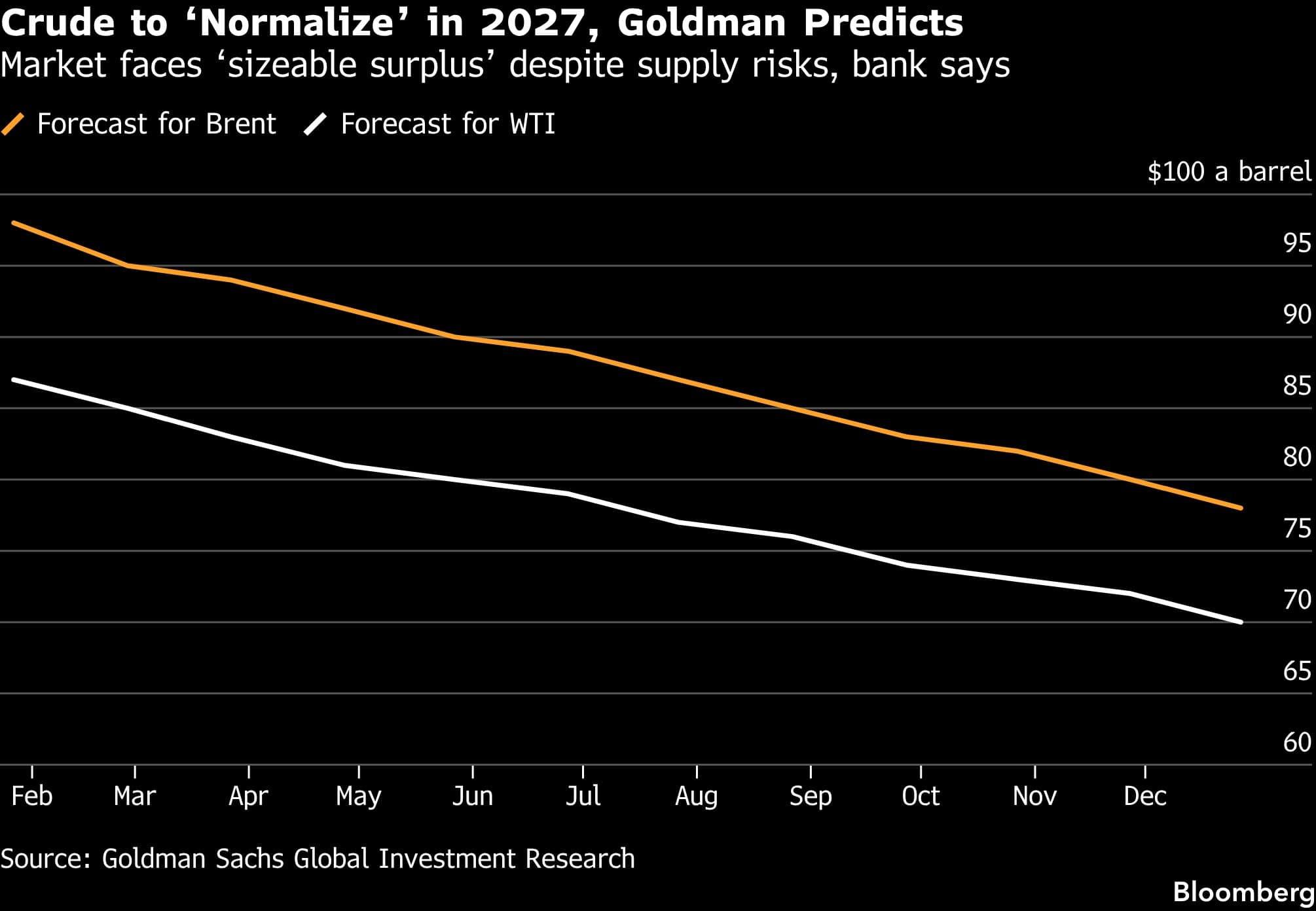
Goldman Sachs expects global crude oil production to exceed end-user demand by an average of approximately two million barrels per day next year. The investment bank forecasts an average Brent price of $88 in 2027. By December, the price could fall to $78 under its baseline scenario.
One important reason for this is that countries in the Middle East are expanding their infrastructure to make oil exports easier in the future. Several producers are investing in alternative transportation routes to reduce their dependence on the Strait of Hormuz. Goldman Sachs expects additional pipeline capacity of approximately 3.8 million barrels per day to become available over the course of next year.
This infrastructure would allow Gulf countries to export larger volumes of oil through alternative routes, thereby avoiding some of the geopolitical transportation risks. However, a distinction must be made between transportation capacity and actual production.
Weak Chinese demand could increase supply pressure
Alongside supply developments, Chinese demand plays a decisive role in the medium-term price outlook.
China remains one of the most important sources of demand in the global crude oil market. However, Goldman Sachs sees no signs of a slowdown in Chinese consumption growth.
In particular, weaker road transportation fuel demand could weigh on oil consumption by approximately 400,000 barrels per day. The analysts also consider it possible that China's total oil demand may already have peaked in 2025. If this assessment proves correct, a previously important driver of global oil demand growth would lose influence.
Combined with rising production in the Middle East, this could lead to a prolonged supply surplus. However, future price developments will also depend on whether OPEC+ adjusts its production policy. The OPEC+ meeting on November 29 could therefore provide an indication of how producing countries intend to manage their oil output next year.
Why falling Crude Oil Prices do not automatically mean lower energy inflation
To better understand the impact on inflation, it is worth looking beyond the price of crude oil itself. What also matters is how prices for gasoline, diesel, and other refined petroleum products develop.
While crude oil supplies appear to be improving, significant bottlenecks remain in parts of the refining sector, including damaged refineries, limited processing capacity, and higher transportation costs. These factors can make diesel and other refined products more expensive.
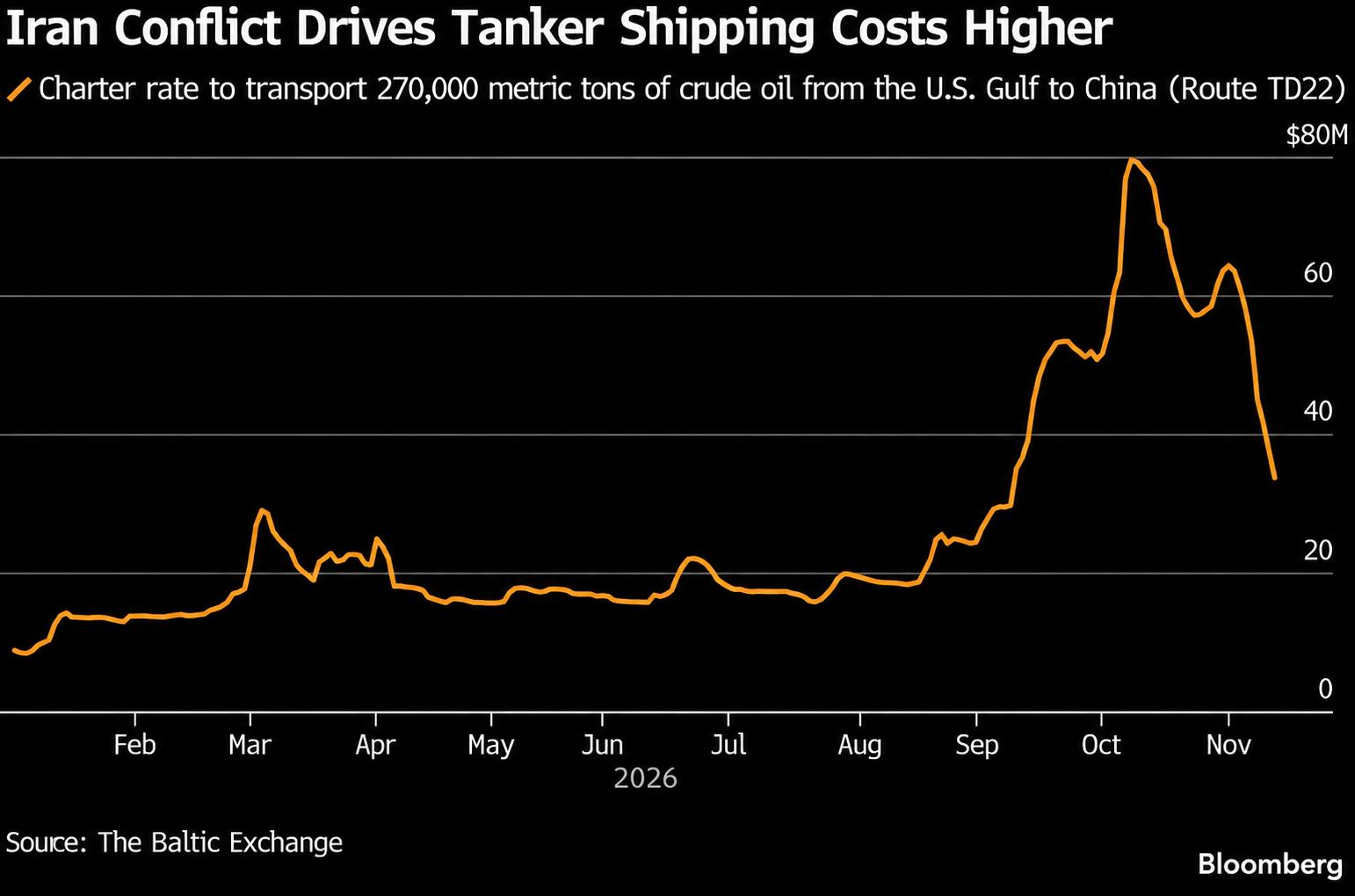
For this reason, Goldman Sachs expects prices for certain petroleum products to remain above their historical averages in 2027, even if crude oil prices decline. This creates an important macroeconomic relationship.
Even if more crude oil is produced worldwide than is needed, this does not automatically mean lower prices for consumers. As long as refineries cannot process enough oil or transportation remains expensive, the benefits of lower crude oil prices may only partially reach gasoline and diesel consumers. Diesel plays a particularly important role because it is used not only in transportation but also in industry and agriculture. If these costs remain elevated, companies may continue passing some of the price pressure on to their customers.
For inflation, this means that even if crude oil prices fall, energy and service costs do not necessarily decline at the same pace.
The Fed faces a difficult monetary policy balancing act
This development is particularly relevant for the Federal Reserve.
The latest US inflation data show that prices continue to rise significantly. In October, consumer prices increased by 0.4 percent compared with the previous month, while core inflation rose by 0.3 percent. Fed Governor Christopher Waller had already raised the possibility of a 25-basis-point rate increase in December on November 10. If inflation remains persistent, he also considers a larger increase of 50 basis points possible.
The challenge for the Fed is that higher interest rates can reduce overall economic demand but cannot provide an immediate solution to physical energy supply shortages. At the same time, higher financing costs can weigh on private consumption, business investment, and credit demand.
The Fed must therefore assess whether current inflationary pressures are mainly caused by excessive demand or by longer-lasting supply restrictions. The problem is that an overly cautious response could raise inflation expectations, while overly aggressive tightening would increase the risk of a more severe economic slowdown.
Housing market weakness and credit risks increase the pressure
The effects of restrictive financing conditions are particularly evident in the US housing market.
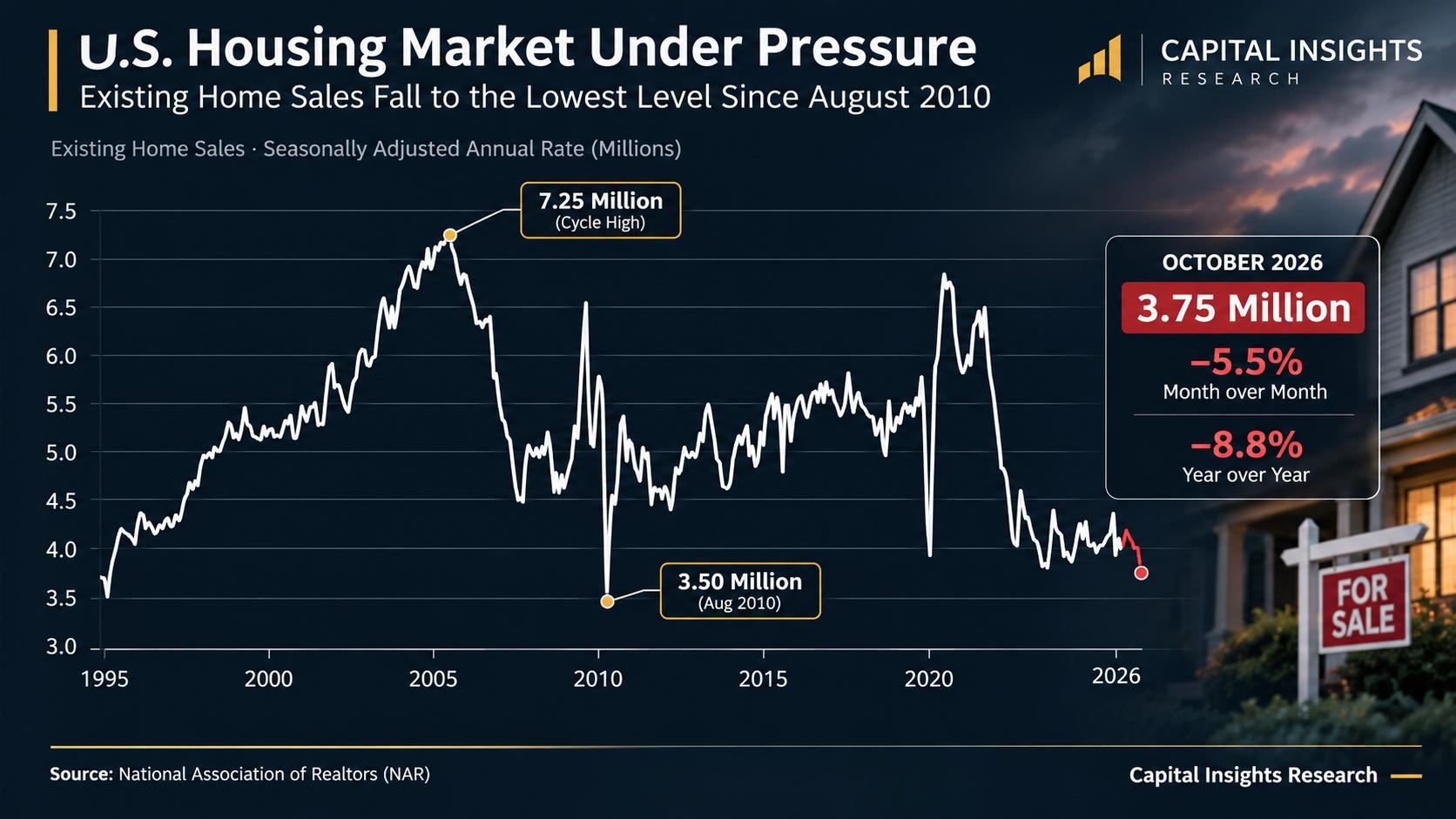
In October, existing home sales declined by 5.5 percent compared with the previous month. On a yearly basis, sales fell by 8.8 percent. The seasonally adjusted annual sales rate dropped to 3.75 million units, reaching its lowest level since August 2010. At the same time, high mortgage rates and persistently elevated home prices are making homeownership more difficult for many households.
Additional monetary tightening could reinforce this development and spread to other parts of the economy through reduced construction activity, weaker investment, and declining consumption.
For financial markets, it will therefore be crucial to determine whether rising interest rates merely reflect tighter monetary policy or whether they also lead to deteriorating credit conditions. The development of credit spreads is particularly relevant here. If corporate bond risk premiums increase alongside rising Treasury yields, this could indicate growing concerns about companies' ability to secure financing.
Outlook: The connection between Crude Oil, inflation, and credit markets will be decisive
The coming months will likely show whether the oil market is actually entering a new phase.
On one side are rising production volumes, alternative export routes, and potentially structurally weaker Chinese demand. On the other side, risks remain from geopolitical conflicts, limited refining capacity, and high transportation costs.
For the macroeconomic outlook, the decisive factor will therefore not simply be whether Brent falls to $78 in 2027.
Far more important is the extent to which a potential improvement in crude oil market conditions actually translates into lower energy prices for households and businesses.
Only if lower crude oil prices also lead to a sustained reduction in inflationary pressures could a more stable environment for US monetary policy emerge.
At the same time, developments in Treasury yields, credit spreads, and corporate financing conditions must also be considered.
Declining inflation alongside stable credit markets would generally be a constructive signal for risk assets. However, a combination of weaker demand, rising credit defaults, and falling commodity prices would point to a much more challenging macroeconomic environment.
The decisive factor for 2027 may therefore be less about the absolute level of oil prices and more about whether the global economy benefits from improving energy supply conditions before restrictive financing conditions cause more significant economic damage.
Author