Australian Dollar Price Forecast: Bottoming out?
- AUD/USD recedes to fresh lows near the 0.6700 yardstick on Tuesday.
- Fresh selling pressure on the US Dollar allows spot to recover some ground.
- The RBA Minutes reinforced the data-dependent stance.


After bottoming out in levels last seen in January near the 0.6700 region vs. the US Dollar (USD), the Australian Dollar (AUD) has managed to regain some composure, motivating AUD/USD to stage a tepid comeback to the 0.6750 region on Tuesday.
Indeed, the pair has set aside five consecutive daily declines, although it continues to navigate the fourth week in a row in the red.
Meanwhile, steady speculation of further tightening by the Federal Reserve (Fed) has been reinforcing the solid performance of the Greenback while keeping the broader risk complex under heightened pressure despite the marked correction in crude oil prices in the last few days.
Looking at the broader picture, AUD/USD remains well south of its key 200-day SMA near 0.7050, exposing it to further retracements in the short-term horizon. In the meantime, persistently high domestic inflation in combination with the ongoing cautious stance from the Reserve Bank of Australia (RBA) seems to be failing to put a solid floor to the severe depreciation of the currency in the last few weeks.
Australia's resilience faces an inflation test
Australia’s economy continues to compare favourably with many of its G10 peers, supported by domestic demand and positive economic growth. Persistent inflation also supports the RBA’s cautious, data-dependent policy stance.
However, business activity seems to have lost some momentum after preliminary data showed the Purchasing Managers’ Index (PMI) for Manufacturing improving marginally to 49.5 in September and easing to 47.8 when it comes to Services, from 49.6 and 51.9, respectively.
Trade data provided another positive signal after the September trade surplus widened to A$2.826 billion, adding to the A$0.184 billion surplus registered in the previous month (revised from A$0.495 billion).
Growth figures were less encouraging, however. Indeed, the Gross Domestic Product (GDP) expanded by 0.4% QoQ in the second quarter of 2026, up from 0.3%, while annual growth came in at 2.1%, down from the previous 2.5% yearly expansion.
The labour market, however, disappointed investors in September after the Unemployment Rate held steady at 4.7% (August’s print was revised higher to 4.7% from 4.6%), while the Employment Change shrunk by 39.3K, reversing August’s 29.3K increase (revised from 39.5K).
Inflation seems to have regained some impulse after the latest data showed the most-watched Trimmed Mean CPI came in at 3.7% over the last twelve months in Q3, while the headline CPI held steady at 3.9% from a year earlier.
The Melbourne Institute’s Consumer Inflation Expectations measure reinforced that trend after holding steady at 5.3% in November.
The figures leave the RBA’s inflation task incomplete. Policymakers expect inflation to return to target only in early 2028, keeping the emphasis on patience rather than an imminent policy pivot.
China's recovery is still missing a higher gear
China is providing stability for the Australian economy, but not the growth impulse that has underpinned the Australian Dollar during previous expansions. However, this situation appears to be gradually improving.
Indeed, the Chinese economy expanded by 4.5% YoY in the July-September period, although that trend could have lost some momentum in Q4. Indeed, according to the latest data, Industrial Production expanded by 4.8% YoY in October (from 5.5%) and 5.3% YDT. In the same direction, the latest trade data showed a surplus of $133.53 billion in September, as both imports and exports posted strong gains. Somewhat undermining this picture, consumer spending appears to have lost momentum in October, with a meagre 0.4% annual expansion and a 1.04% increase since January.
Pouring cold water over that optimism, business surveys offered a mixed picture: the National Bureau of Statistics (NBS) reported that both the Manufacturing PMI and the Services PMI returned to the contraction territory last month after easing to 49.3 (from 50.1) and 49.7 (from 50.2), respectively. In the opposite direction, although also showing some loss of momentum, private measures like RatingDog remained in expansionary territory, with Manufacturing at 52.0 (from 52.1) and Services at 50.8 (from 51.6).
Disinflationary pressures seem to have resumed in October, with the CPI gaining 0.7% from a year earlier (from 0.9%), while prices came in flat on a monthly basis (from a 0.2% gain). In addition, Producer Prices rose more than initially estimated by 5.7% over the previous twelve months from the 5.0% increase recorded in the previous month.
Back to the central banks’ space, the People’s Bank of China (PBoC) kept its Loan Prime Rates (LPR) unchanged at 3.00% for the one-year tenor and 3.50% for the five-year tenor, matching the broad consensus.
Taken together, the latest Chinese data offer some encouragement for Australia and the AUD, although the recovery has yet to develop the kind of momentum that could provide the currency with a more lasting and convincing boost.
RBA minutes show a divided board still worried about inflation
The RBA lifted its Official Cash Rate (OCR) by 25 basis points to 4.85% earlier this month, in a 6-3 vote, after dramatically boosting its inflation predictions. However, headline CPI is now seen peaking at 4.5% and staying above 3% until late 2027, while Trimmed-mean inflation is anticipated to reach 3.6% in Q4 2026, dropping only gradually afterward.
The RBA’s recent Minutes revealed officials remain quite worried about inflation. Members saw that inflation remained too high and was likely to be high for another year, and that excess demand was anticipated to last until at least mid-2027. All in all, policymakers continued to see upside risks for inflation.
The Minutes record that the debate focused on whether to increase the OCR by a further 25 basis points or to keep it unchanged. Hawks said the hikes provided so far in 2026 had not done enough to keep inflation concerns in check, while others were reluctant to tighten more, fearing that the economy may be heading for a steeper fall.
But the Board saw financial conditions as tight, while contradictory indications made it challenging to gauge the degree of pressure from monetary policy. Growth is anticipated to be below potential over the next several years as past rate rises flow through, but global events might drive Australia’s real neutral rate higher.
The policy message continues to be strongly data-dependent. The RBA is prepared to take the necessary steps to restore price stability. But the minutes point to a difficult trade-off: inflation still needs restraint, but the build-up of the effects of tighter policy is starting to create real concerns about growth.
AUD/USD: The road higher remains difficult
Baseline outlook
Further losses should not be ruled out in the short-term horizon while the pair keeps trading below the 200-day SMA around 0.7050.
The resumption of the bullish bias will likely require a strong catalyst, namely a sustained improvement in risk appetite trends or renewed and persistent weakness in the Greenback.
Upside scenario
A sustained improvement in risk appetite could help AUD/USD regain, initially, the 0.7000 milestone, and to refocus on the 200-day SMA in the mid-0.7000s afterwards. Beyond that, the weekly top at 0.7140 (September 21) would emerge as the next hurdle, ahead of the 2026 peak around 0.7280 (May 6).
Downside scenario
In case bears regain control of sentiment surrounding the Aussie, there should be initial support at the November valley of 0.6719 (November 17). A breach below this level would increase the likelihood of a retest of the 2026 bottom around 0.6660, which was seen in January.
Bears tighten their grip, but is the trade getting crowded?
The AUD remains firmly on the defensive, with spot, options and speculative positioning increasingly pointing in the same direction. AUD/USD has fallen markedly to the vicinity of the 0.6700 level, while one-month 25-delta Risk Reversals have deteriorated to -1.419, their 14.7th percentile over five years.
The broader options picture remains particularly bearish. Three-month RR momentum has fallen to its 4.8th historical percentile, suggesting an unusually sharp deterioration in demand for downside protection. However, the latest one-month repricing is broadly consistent with the decline in spot, while weekly options movements have been less negative than historical relationships would suggest.
Meanwhile, Commodity Futures Trading Commission (CFTC) figures for the week ending November 10 showed speculative net shorts increasing to the highest level since July at around 151.8K contracts, with fresh bearish participation driving the move. That said, speculative positioning is now close to its most extreme levels in five years.
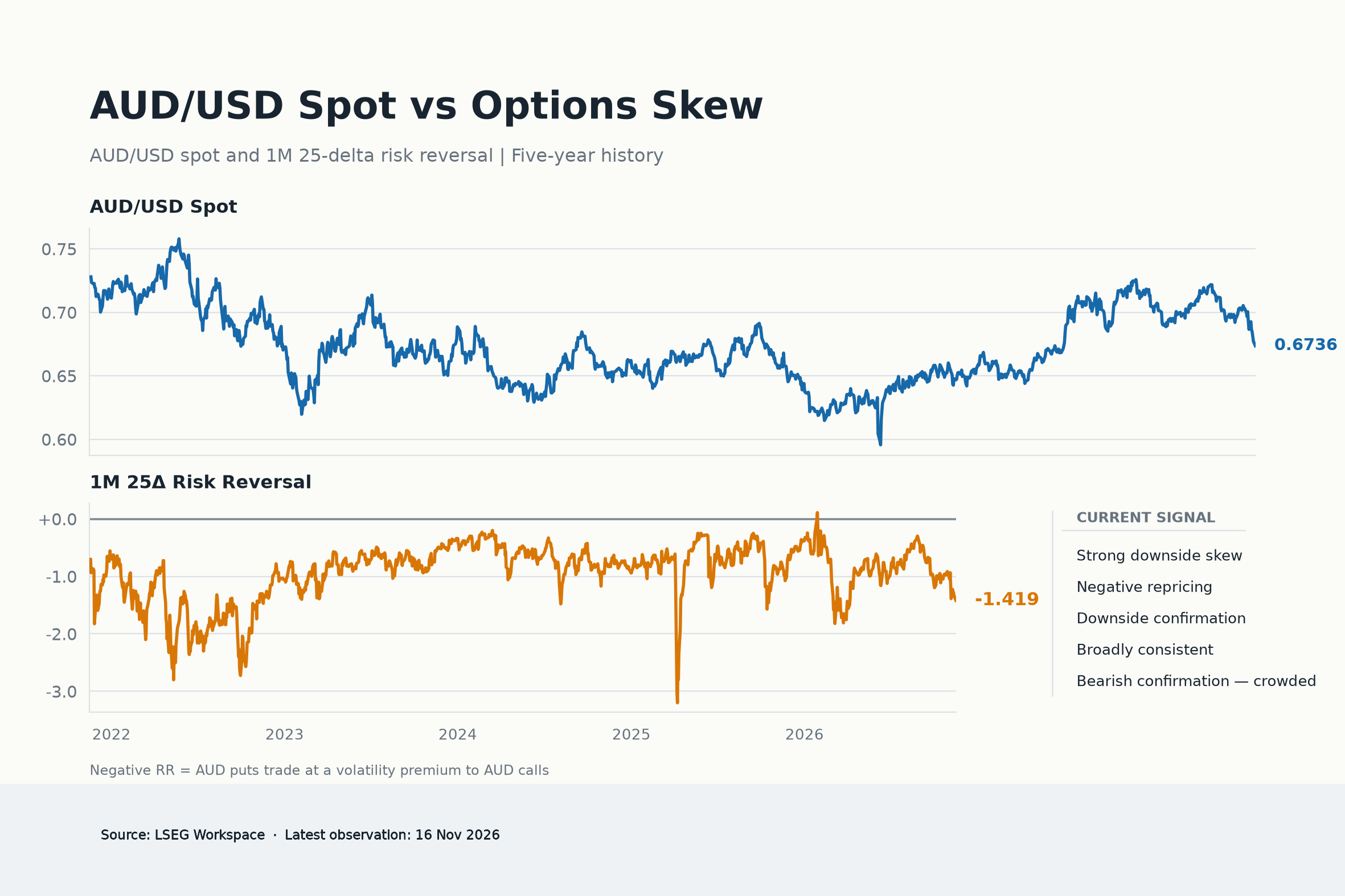
That combination continues to favour further AUD weakness, although increasingly extended non-commercial shorts and signs of moderating options repricing leave the currency vulnerable to a short-covering rebound should selling pressure begin to ease.
What’s next for the Aussie
US Dollar dynamics, global risk sentiment, and geopolitical developments remain the main near-term drivers of AUD/USD.
Next on tap on the domestic docket will be the release of Westpac’s Leading Index, the quarterly Wage Price Index and the speech by Governor Bullock. Outside Oz, the FOMC Minutes should shed extra details on the Fed officials’ debate around the October hawkish hold.
Beyond that, the main risks are expected to emerge from China, a persistently cautious Fed, a deterioration in investor risk appetite or a change in the RBA’s current policy stance.
Any of these developments could quickly alter the outlook for the Australian currency.
Technical analysis
In the daily chart, AUD/USD trades at 0.6741, extending its slide below the key simple moving averages, as the 55-day SMA at 0.7011, the 100-day SMA at 0.7021 and the 200-day SMA at 0.7050 all sit well above spot and reinforce a bearish near-term bias. The pair hovers just above nearby horizontal support at 0.6720, while the Relative Strength Index (14) around 29 signals oversold conditions, suggesting that while selling pressure dominates, scope for a corrective bounce cannot be ruled out. The Average Directional Index (14) rising toward 36 hints at a strengthening underlying trend, keeping bears in control as long as price holds beneath the clustered daily averages.
On the downside, immediate support is seen at 0.6720, ahead of a lower floor at 0.6660, with deeper bearish extension exposing 0.6593 and then 0.6414 as subsequent levels where buyers may attempt to slow the decline. On the topside, initial resistance emerges at 0.6897, followed by a dense barrier formed by the 55-day SMA at 0.7011, the 100-day SMA at 0.7021 and the 200-day SMA at 0.7050; a daily close above this cluster would be needed to ease the prevailing bearish tone and allow a more meaningful recovery toward 0.7147 and 0.7283, with 0.7661 marking a more distant upside hurdle.
(The technical analysis of this story was written with the help of an AI tool. Know more.)
Near-term outlook
In terms of the forecast, a bearish scenario for the pair appears the most favourable option, but the increasingly crowded bearish trade requires some caution.
The AUD has been supported by sticky inflation in Australia and the RBA’s desire to maintain tight monetary policy, but weakening domestic momentum, a patchy recovery in China, and ongoing demand for the US Dollar may limit any major revival.
Currently, the important dividing line is the 200-day SMA: a prolonged rebound above that level would enhance the technical picture and put the 0.7100 barrier back into focus, while further selling might expose recent lows near 0.6700.
For now, the risk balance remains skewed to the negative, with speculative shorts already at record extremes amid cooling downside risks from the options markets. However, an improvement in global mood or further weakening of the Greenback carries the potential to spark a dramatic, albeit transitory, short-covering rally.
Inflation FAQs
Inflation measures the rise in the price of a representative basket of goods and services. Headline inflation is usually expressed as a percentage change on a month-on-month (MoM) and year-on-year (YoY) basis. Core inflation excludes more volatile elements such as food and fuel which can fluctuate because of geopolitical and seasonal factors. Core inflation is the figure economists focus on and is the level targeted by central banks, which are mandated to keep inflation at a manageable level, usually around 2%.
The Consumer Price Index (CPI) measures the change in prices of a basket of goods and services over a period of time. It is usually expressed as a percentage change on a month-on-month (MoM) and year-on-year (YoY) basis. Core CPI is the figure targeted by central banks as it excludes volatile food and fuel inputs. When Core CPI rises above 2% it usually results in higher interest rates and vice versa when it falls below 2%. Since higher interest rates are positive for a currency, higher inflation usually results in a stronger currency. The opposite is true when inflation falls.
Although it may seem counter-intuitive, high inflation in a country pushes up the value of its currency and vice versa for lower inflation. This is because the central bank will normally raise interest rates to combat the higher inflation, which attract more global capital inflows from investors looking for a lucrative place to park their money.
Formerly, Gold was the asset investors turned to in times of high inflation because it preserved its value, and whilst investors will often still buy Gold for its safe-haven properties in times of extreme market turmoil, this is not the case most of the time. This is because when inflation is high, central banks will put up interest rates to combat it. Higher interest rates are negative for Gold because they increase the opportunity-cost of holding Gold vis-a-vis an interest-bearing asset or placing the money in a cash deposit account. On the flipside, lower inflation tends to be positive for Gold as it brings interest rates down, making the bright metal a more viable investment alternative.
Author
Pablo Piovano
FXStreet
Born and bred in Argentina, Pablo has been carrying on with his passion for FX markets and trading since his first college years.