Nonfarm Payrolls Preview: Three reasons for a downside surprise, triggering dollar buy opportunity
- Three consecutive positive surprises in jobs reports are rare.
- The Russia-Ukraine war and inflation may have caused employers to hold back.
- The early release means investors will rely on ADP's upbeat figures, which may be wrong.

Three times a charm? Probably not. After Nonfarm Payrolls figures surprised to the upside in both January and February, the report for March could fall short of estimates. That would knock down the dollar, but probably only temporarily.
Economists expect an increase of 490,000 positions in March, down from the impressive 678,000 recorded in February, but similar to 481,000 in January. Such substantial job gains are well beyond the pre-pandemic levels of roughly 200,000 and reflect a reopening recovery.
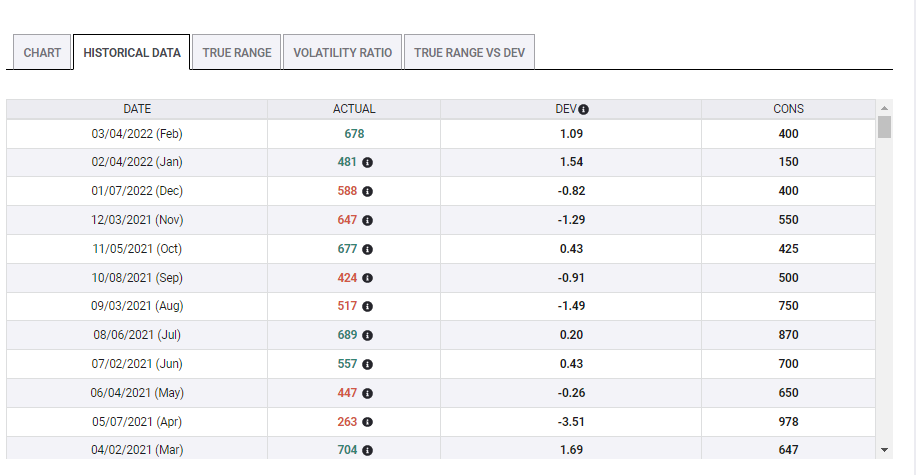
Source: FXStreet
After such outstanding increases, it makes sense to expect a deceleration, but has the consensus dropped far enough? There are additional reasons to expect a slowdown.
1) Three positive surprises in a row are rare
Statistically, an increase beyond expectations would be rare. While Nonfarm Payrolls beat expectations four times in a row in the spring of 2020, the COVID-19 pandemic broke out, and uncertainty peaked.
Taking the virus into account, the last time that America witnessed a trifecta of winning jobs reports was back in the last quarter of 2015. That is more than six years ago. Therefore, there is room for a downside surprise this time.
2) War may have caused worries
Russia invaded Ukraine on February 24, and while America remains far from the hostilities, uncertainty has likely pushed employers to think twice about new hirings. That is especially true in positions that were already hard to fill. It may have caused some employers to give up.
In addition, higher costs, as a result of inflationary pressures seen prior to the war – and somewhat exacerbating them – may have also contributed to some hesitance. Has it likely been a wide phenomenon? Probably not, but enough to trigger a downside surprise.
3) Only ADP to rely on
This jobs report is released on April 1 – the earliest possible date, and that implies there are few leading indicators coming ahead of it. Both the ISM Manufacturing Purchasing Managers' Index and the Services one are scheduled for after the NFP.
The sole economic statistic is ADP's private-sector jobs report, which showed a robust increase of 455,000 positions. That may help push expectations higher. Since the pandemic, however, the payrolls company's figures have been all over the place, often unrelated to the official statistics. High expectations can lead to a bigger disappointment.
All in all, there is room for a downside surprise.
Dollar reaction
A downbeat data point would send the dollar down if the theory above is correct. Investors react first and think later. That initial drop and second thought may provide a buying opportunity on the greenback. But, why would the dollar bounce?
Assuming the NFP is just disappointing – an increase of fewer than 400,000 jobs, but still a healthy figure – it would keep the Federal Reserve on course to raise interest rates by 50 bps in May. The Fed is happy with the strength of the US economy and the labor market, which it may still describe as "tight" even after a not-that-great NFP.
It is essential to note that inflation continues rising at a rapid pace, and officials are currently laser-focused on cooling high prices.
Another reason to see further dollar gains is the general trend of rushing to the greenback while Russia continues its war in Ukraine. The trend remains the trader's friend – at least while there is no sudden breakthrough in talks.
Final thoughts
The dollar is set to emerge on top, either as a result of the scenario described above, of disappointing Nonfarm Payrolls figure – or if data exceeds estimates and boosts the greenback without an initial retreat.
Author

Yohay Elam
FXStreet
Yohay is in Forex since 2008 when he founded Forex Crunch, a blog crafted in his free time that turned into a fully-fledged currency website later sold to Finixio.

















