Nonfarm Payrolls preview: Assessing the market impact of an upside surprise

At 1330 BST we will get the latest reading of the US Non-Farm Payrolls report. Economists are expecting a reading of 75k, up slightly from the 73K for July. The unemployment rate is expected to inch up to 4.3% from 4.2%, and average hourly earnings are expected to drop slightly to a 3.8% annual rate from 3.9% in July.
Revisions will also be watched closely, after a large 258k downward revision to the May and June numbers. This is what ignited the ire of Donald Trump after last month’s report, which resulted in him firing the head of the Bureau of Labor Statistics who produce the numbers. Since then, there has a been a huge tussle between the President and the Fed, which has resulted in a recalibration of interest rate expectations for the US, and a large number of cuts getting priced in.
Politics and payrolls don’t usually mix well, but so far, the impact on financial markets has been small with both US bonds and stocks outperforming their global peers. However, the significance of payrolls beyond the financial realm means that the stakes are high as we lead up to today’s report.
A pivotal report for 2025
There is a sense that the August report could be pivotal for financial markets. A reading around consensus would be a sign that the US labour market is slowing down sharply. It would be the latest in a series of weaker employment data points , after weaker job openings and a 54k reading for ADP private sector payrolls last month. Initial jobless claims also ticked up last week to the highest level since June. Combined, this data paints a picture of a rapidly softening labour market.
The market backdrop
Ahead of this report, the interest rate futures market has fully priced in a rate cut from the Fed for September. There is also an 87% chance of a cut in December and a 57% chance of a cut in October. Between now and the start of 2027, the Fed Fund Futures market is expecting 6 rate cuts, far higher than rate cuts expected elsewhere, like the UK and Europe. In the UK, the neutral rate could be closer to 4%. In the US, the neutral interest rate is currently considered to be below 3%.
The risk of an upside NFP surprise
Due to the rapid repricing of US interest rate expectations in recent months, the biggest risk from a market perspective is an upside surprise to today’s payrolls number. Although historically payrolls tend to underperform in August, some expect a stronger than expected reading for payrolls for last month, and for this labour market report to paint a less dire picture of the US economy. There are several reasons why job growth could be stronger than expected. Firstly, the labour force participation rate is trending lower, which could keep the unemployment rate artificially low, as people leave the workforce and so do not get counted as unemployed. The drop to the lowest level since 2023 in the last reading for the participation rate is worth watching closely.
Secondly, other signs suggest that the US economy is ticking along nicely. For example, the ISM service sector survey rose to its highest level since February. The gain was driven by a surge in new orders, along with a sharp pick up in business activity, which bodes well for the future. The labour market is a lagging indicator, and if sentiment data is strengthening, then the recent deterioration in the labour market could be a temporary blip.
The market impact
The backdrop to this report is worth noting: the S&P 500 reached a record high on Thursday, and so far in 2025, US treasuries are outperforming European and UK sovereign bond yields across the curve. Thus, if this NFP report is not as dire as some expect, then we could see three things happen. Firstly, a sharp upswing in US Treasury yields. It could also trigger a reduction in US interest rate expectations, although we think that the September cut is a done deal at this stage. However, a stronger NFP report for August could cast doubt on the potential for rate cuts further down the line.
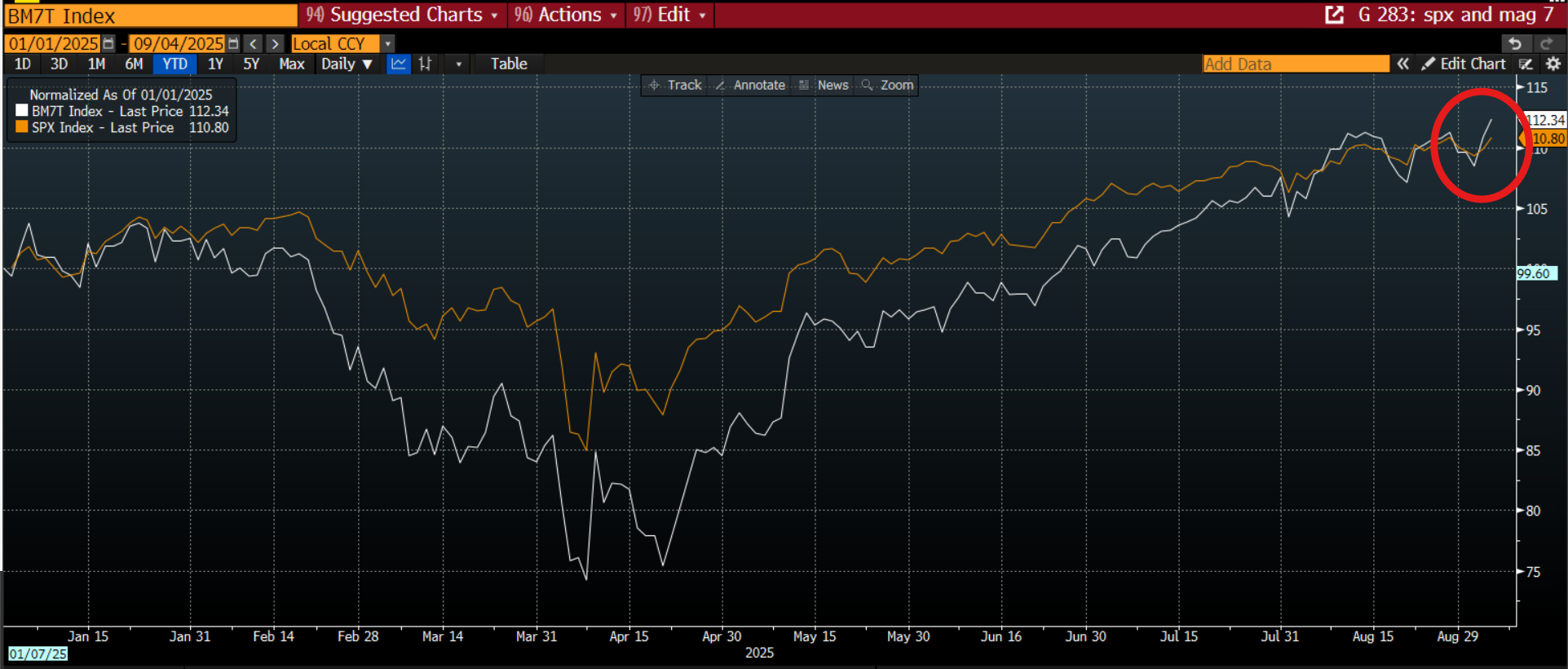
Secondly, a decline in stocks. Earnings season, and especially upward revisions, have been the biggest drivers of US stock market performance in recent weeks. As earnings season draws to a close, the market is losing a key pillar of support. If expectations of interest rate cuts get scaled back on the back of a strong payrolls report, then this could also weigh on US stock prices, and the magnificent 7 tech stocks, in particular. These stocks have had a strong run in recent weeks alongside growing expectations of rate cuts and have been a key driver of the S&P 500 rising to fresh record highs.
Lastly, the gold price could fall if payrolls are stronger than expected. One of the big drivers of the gold price to fresh record highs in recent days has been expectations of US rate cuts, and what this could mean for inflation. If rate cut bets get scaled back, then inflation fears could ease, which may hurt the world’s most famous inflation hedge.
Overall, there is a lot resting on this report, and there could also be political ramifications if President Trump does not like what he sees.
Author

Kathleen Brooks
XTB UK
Kathleen has nearly 15 years’ experience working with some of the leading retail trading and investment companies in the City of London.














