No war worries in the markets


“War, what is it good for? Absolutely nothin’!” — I’ve had the classic Edwin Starr song running in my head ever since news of the U.S. bombing of Iranian nuclear facilities broke Saturday evening.
I was actually alerted to the news by my friend Brent Johnson, who was seated across from me at the speakers’ dinner for the Real Estate Guys Summit in Miami.
I remarked to Brent and the other dignitaries around me that (in addition to the other considerations, of course) it was good that this attack happened over the weekend, with markets closed. This way, the shock of the news would wear off without creating a short-lived spike in the gold price.
These kinds of geopolitical spikes are traps for impetuous gold buyers, and often do more damage to the metal’s price trend by masking the true macroeconomic drivers.
I didn’t need to worry overmuch, however, as gold showed very little reaction at all as markets opened this morning. And neither did any other market.
In fact, as we learned of Iran’s retaliatory attack on U.S. bases in Qatar at midday, gold actually sold off...and U.S. stocks rose...and the price of oil continued to fall!
Shake it off
There are a few things we can take from this reaction...
First, the markets are accurately and efficiently determining that this conflict is no big deal, Iran is essentially helpless, and little will come from all of this.
I have to say, contrary to a number of my friends and colleagues in the hard money universe who are predicting World War III, I pretty much agree with this assessment.
Second, geopolitical brush fires are almost never a reason to buy gold. The record clearly shows that any reaction is short-lived, and anyone who tries to bet on these events usually ends up holding a bag.
That’s proven to be the case once again.
And finally, even our allies who are cheering on from the sidelines (along with, in fact, other area nations that would be vulnerable to nuclear fallout) will look at America’s awesome projection of power and conclude that they need to further insulate themselves from the U.S. hegemony.
In short, they’ll want to buy more gold.
The bull is back
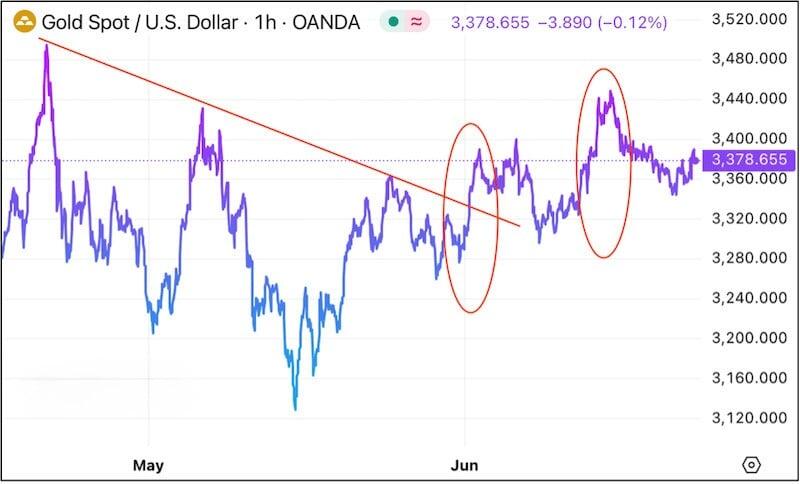
The chart above is quite encouraging for gold bulls.
As you can see, the correction that began in April is marked by a downtrend line that was clearly broken in early June, as I alerted you at the time. That breakthrough, when gold jumped over $80 in one session, is marked by the first oval.
The eruption of the Israel-Iran conflict is marked by the second oval, and there you can see the quick price spike...and then the drop as that geopolitical premium deflated over the following few sessions.
We’re climbing back from that short decline now, as the market is shaking off the U.S. attack and the underlying drivers for this gold bull regain their influence.
To receive free commentary and analysis on the gold and silver markets, click here to be added to the Money Metals news service.
To receive free commentary and analysis on the gold and silver markets, click here to be added to the Money Metals news service.
Author
Brien Lundin
Money Metals Exchange
Brien Lundin is the publisher and editor of Gold Newsletter, the publication that has been the cornerstone of precious metals advisories since 1971. Mr. Lundin covers not only resource stocks but also the entire world of investing.