|

Next off the cliff?

US and European markets took a breather yesterday, on the back of a two-day decline in oil prices thanks to the brief easing of Middle East tensions. That window offered a glimpse of the underlying market dynamic once the geopolitical noise was filtered out: the rotation.

Investors directed capital toward technology-light indices. The FTSE 100 outperformed most European indices despite falling oil prices, and closed the session just a few points below an all-time high. The Dow Jones Industrial Average outperformed its US peers with a 1% gain, while the tech-heavy Nasdaq 100 fell another 1%. The S&P 500 Equal Weight Index advanced to a fresh record high, while the market-cap-weighted version saw its upside capped by pressure on technology valuations.
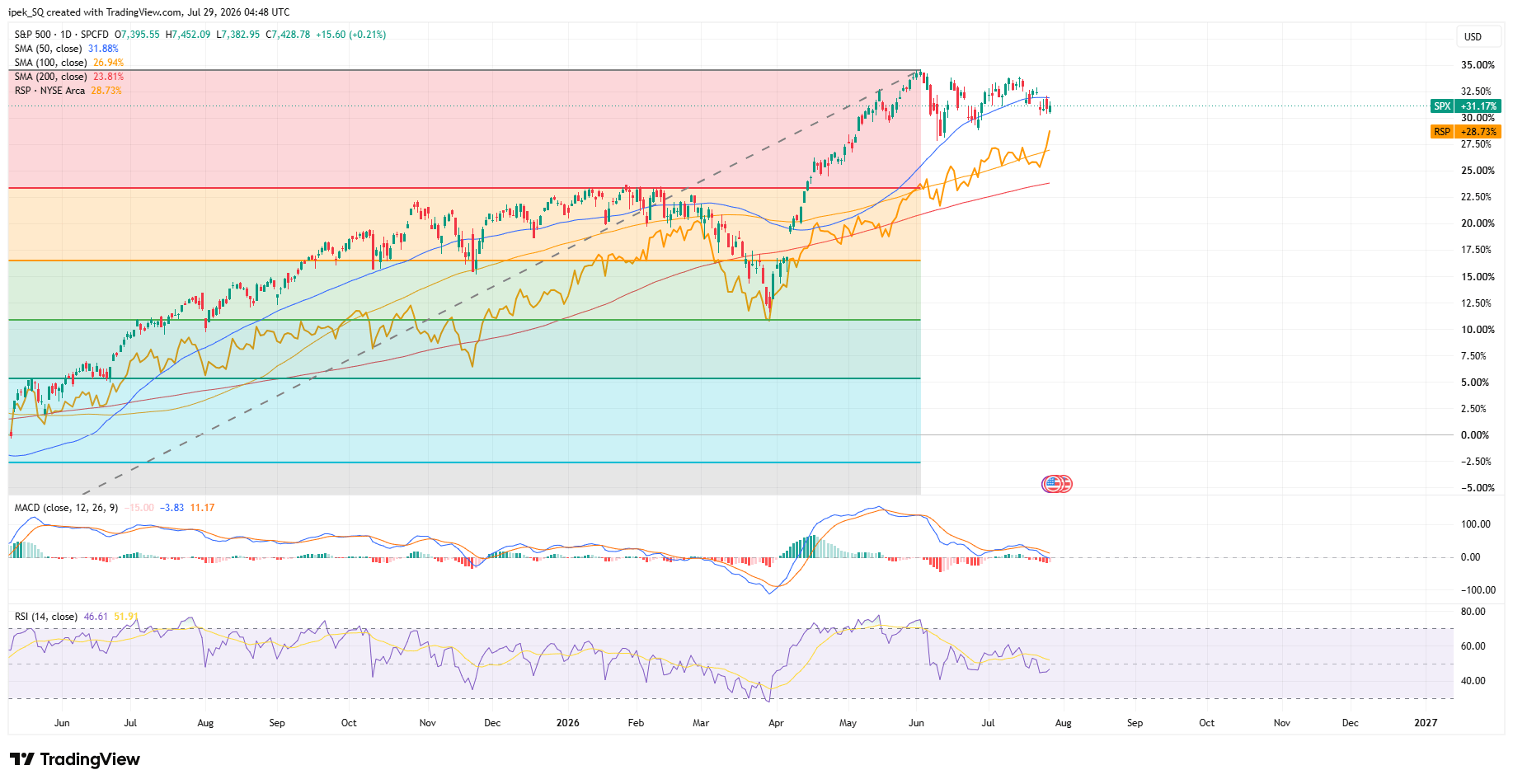
SPX

Earnings Season is going well

On the micro front, the earnings season is going well for most US and European companies. European banks are following their US peers in announcing strong quarterly results (though a bit less impressive than those of their US counterparts, which is at times weighing on their share prices). Across the Atlantic, nearly a third of the S&P 500 companies have already reported results, and their earnings have grown by nearly 38% — well above the 23% growth rate pencilled in by analysts. Quite a surprise for a quarter that was marked by soaring energy prices!


Read the full article here.

Author

Ipek Ozkardeskaya

Ipek Ozkardeskaya began her financial career in 2010 in the structured products desk of the Swiss Banque Cantonale Vaudoise. She worked in HSBC Private Bank in Geneva in relation to high and ultra-high-net-worth clients.


More from Ipek Ozkardeskaya
Share:

Editor's Picks

AUD/USD stays defensive below 0.7150 after Chinese data

AUD/USD remains on the back foot below 0.7150 in the Asian session on Tuesday, close to an over three-week low touched the previous day. US bond yields hold near multi-year highs ahead of the FOMC meeting and oil-driven inflation risks, supporting the US Dollar and weighing on the currency pair. Mixed Chinese activity data for August also fail to inspire the Aussie.

USD/JPY extends gains toward 155.00 amid USD resurgence

USD/JPY keeps pushing higher toward 155.00 early Tuesday, looking for more upside, as traders await the FOMC and BoJ meetings this week. Meanwhile, Fed rate-hike bets and oil-driven inflation risks keep US bond yields near multi-year highs, supporting the US Dollar and the pair. That said, a more hawkish repricing of the BoJ normalization path might continue to underpin the Japanese Yen and could limit USD/JPY's upside. .

Gold regains $4,300 as traders await FOMC meeting

Gold regains $4,300 in the Asian session on Tuesday, but remains vulnerable near a one-month low, touched the previous day. Fed rate-hike expectations and inflation concerns remain supportive of elevated US bond yields, underpinning the US Dollar and weighing on the non-yielding bullion. Bears, however, might wait for the outcome of a two-day FOMC meeting on Wednesday before placing fresh bets.

WTI rises above $98.50 amid Middle East supply fears

West Texas Intermediate oil price extends its gains for the second successive day, trading around $98.60 per barrel during the Asian hours on Tuesday. Crude oil prices appreciate as traders continue to navigate heightened uncertainty over global supply.

Hard assets are entering their next explosive phase – Are you positioned?
It’s official: Commodities and Hard Assets have become the best-performing asset class of 2026. In a year defined by persistent inflation, geopolitical conflict, rising sovereign debt and intensifying supply disruption, capital is rotating aggressively into the one area governments cannot print and central banks cannot manufacture: scarce physical assets.
Venezuela’s 65-billion-barrel Oil deal could reshape America’s inflation fight
The United States (US) has secured unprecedented access to part of Venezuela’s vast Oil reserves. The timing is particularly significant as the war with Iran is disrupting Middle Eastern supplies, keeping energy prices elevated and reviving concerns about inflation.