Messenger RNA in a bottle

The big pharmaceutical companies have always tended to generate a somewhat mixed response when discussed in the wider context of stock picking.
Usually viewed through the lens of being defensive and boring, their PR in recent years hasn’t been particularly positive, with accusations of price gouging as far back as the 2016 Presidential election campaign when Democrat nominee Hillary Clinton pledged to rein in the sector after an outcry over the CEO of Mylan who gradually hiked prices on EpiPen’s to the tune of 461%, from $56.64 to $317.82, since acquiring the rights in 2007.
Mylan also hiked prices on a range of other products and it is a form of behaviour that is quite common on various drugs, where there is little or no alternative.
There was also outrage over a huge price increase on a common drug called Daraprim, which saw a price increase from $13.50 to $750 overnight and which was acquired by Turing Pharmaceuticals run by Martin Shkreli a former hedge fund manager, who eventually ended up in prison for fraud.
In any case, while Senator Clintons’ pledges eventually amounted to nothing, they did strike a chord with a number of Americans about the pharmaceutical sectors lack of innovation, competition as well as regulation.
In January 2018 Amazon, JP Morgan and Berkshire Hathaway took the first steps into disrupting this sector with the announcement of a new venture called Haven Healthcare, in an attempt to bring down costs for a health care system that has huge gaps in it, and where the competition isn’t generally affordable for ordinary Americans.
Nonetheless the sector has had a fairly unremarkable few years dominated largely by the likes of the big guns of Pfizer, Roche, Novartis, Merck, Johnson and Johnson, GlaxoSmithKline and AstraZeneca, which accounted for about a third of total revenue in the sector in 2019.
It also tends to be a sector that gets a lot of M&A attention, given that innovation tends to happen by way of a big multinational swallowing up a more specialist company in order to diversify its drugs model.
In 2019 we saw a significant amount of M&A in the sector from the $74bn Bristol Myers/Celgene deal, to the $63bn AbbVie/Allergan deal, as well as the $58.6bn Takeda, Shire deal.
Even Pfizer got in on the act, acquiring Array Biopharma for $11.4bn, however this year M&A activity has been much more subdued, and we don’t have to look too far to understand why, though that didn’t stop AstraZeneca from trying to acquire Gilead Sciences during the summer.
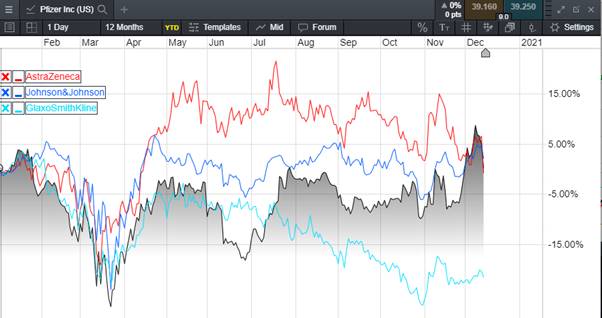
The arrival of the coronavirus pandemic at the beginning of the year thrust the biotech giants into the spotlight once again, and while governments around the world threw billions of dollars at attempting to create a vaccine, it has also given the pharmaceutical sector the opportunity to repair its image, even if some of the share price performance of some has been a little disappointing, particularly from the bigger players.
Source: CMC Markets
This underperformance has largely been down to the fact that the companies have pledged not to profit from the vaccine, however the technology that it uses, particularly in respect of messenger RNA could well have other practical uses for other as yet undiagnosed diseases, as well as existing ones.
The US governments operation warp speed has funded a good proportion of some of this research into the vaccine, though it has also been notable that not all companies availed themselves of it, while the UK, as well as the EU, also pledged vast amounts of money, along with orders for some of the most promising candidates.
The front runners in Europe, and the US have been the Pfizer/BioNTech collaboration which targets the virus using messenger RNA to prompt the immune systems to recognise the virus, by way of its spike proteins. This has never been done before, most vaccines are created by using weakened or inactive versions of the existing virus.
The vaccine requires two doses about a month apart, however its distribution does present challenges due to it being required to be stored at -70C. It also has a reported 94% efficacy rate.
We also have the AstraZeneca/Oxford vaccine, which has been developed again by way of a joint venture, and also requires two doses, 28 days apart, however it does have a lower efficacy rate, which could change as further testing and assessment is completed.
On a more positive note, the Oxford candidate is much easier to store in that it can be kept at the temperature of a normal freezer of about -20C. It is also different to the Pfizer vaccine in that it is made from a weakened version of the common cold virus, which has then been genetically altered to target and recognise the protein spikes of the virus and destroy them.
Another candidate is the Moderna candidate which, like the Pfizer, BioNTech vaccine is also a messenger RNA vaccine, also reported to have a high efficacy rate of 94.5%, according to the latest trial results. It also, unlike the Pfizer vaccine can also be stored at a much higher temperature of -20C, the same as a normal freezer.
While the bigger players have seen rather unremarkable share price performance the same can’t be said from the likes of Moderna and BioNTech who have seen a remarkable change of fortune.
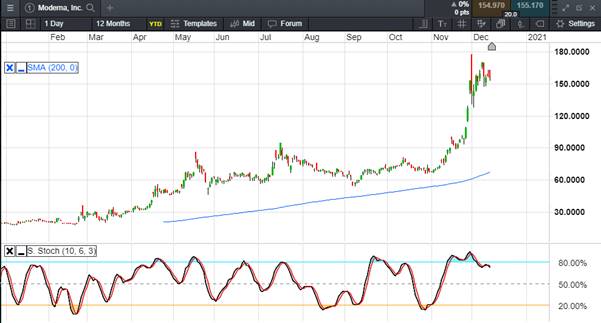
At the beginning of this year Moderna Biotechnology was a small company in Cambridge Massachusetts, specialising in unproved messenger RNA technology, with a market cap of $6.6bn, and which only listed in June 2018. Since it became apparent that this new technology was going to be a game changer the share price surged, from levels of around $60 in the middle of the summer to peaks just shy of $180 at the end of last month.
Source: CMC Markets
BioNtech is another success story, a German company founded by a husband-and-wife team, based in Mainz, and which specialised in cancer therapy treatments, using messenger RNA gene therapy.
In January Dr Sahin, read an article in the medical journal the Lancet about a new respiratory virus coming out of China, and realised it had the potential due to potential pathogenic qualities to turn into a global pandemic.
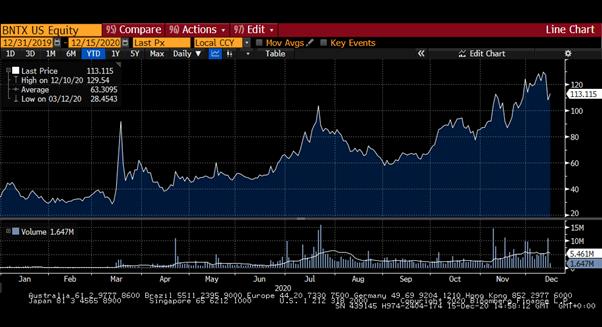
Within weeks, on the 17th March he had secured a deal with Pfizer to help the company with clinical trials, the announcement of which sent the share price soaring. The first stage of trials began in April, while most of Europe was still in lockdown.
BioNTech share price YTD
Source: Bloomberg
Phase three trials began in late July, and were expanded all over the world beyond just the US and Germany, to South America, as well as Turkey.
The rest as they say is history.
Other candidates include a couple from China, Sinovac Biotech and Beijing Institute of technology, and one from Russia, its Sputnik V, all of which are based on variously different common cold viruses.
The past few months have offered the pharmaceutical sector a shot at redemption after some pretty wretched PR in recent years, however it has been notable that for all the success this year of a vaccine candidate, it has been the smaller specialised biotech companies that have delivered a solution, that big pharma for all of the size of its R&D budgets has been unable to.
It’s been the little guy that has delivered the goods, though the scale of the big pharma companies has helped in terms of the trials and the testing.
In terms of success, it’s not always about the share price performance, and that’s certainly true of the performance of big pharma this year, which has been, pretty unremarkable, when you consider the potential for further advances in messenger RNA technology.
As for Moderna, and BioNTech the success story has probably only just begun.
Author

Michael Hewson MSTA CFTe
Independent Analyst
Award winning technical analyst, trader and market commentator. In my many years in the business I’ve been passionate about delivering education to retail traders, as well as other financial professionals. Visit my Substack here.