|

Loonie Crushed as Oil Prices Tumble on Pandemic Fears

USDCAD

USD/CAD rallied to its highest levels since June of 2019 in early trading on Friday. The Canadian dollar was pressured as crude oil prices fell to their lowest levels in over a year. The Canadian dollar has a positive correlation with crude oil, since it is one of the world’s leading oil producing nations.

The selloff in crude oil was spurred by fears of a coronavirus pandemic that could hinder global economic growth and in turn reduce demand. China and the United States are the world’s largest oil consumers. Earlier in February, the International Energy Agency said that it expects global oil demand will fall in the first quarter of 2020 - which would mark its first quarterly contraction in over 10 years.

On Wednesday, the number of new coronavirus infections in China was exceeded by new cases abroad, underscoring the danger of the outbreak becoming a pandemic. Over 83,000 people in at least 53 countries have been infected, and more than 2,800 have lost their lives. The vast majority of cases have been in China so far.

On Thursday, Tedros Adhanom Ghebreyesus, the director general of the World Health Organization (WHO) said: “This virus has pandemic potential”. He also warned; “we are actually in a very delicate situation in which the outbreak can go in any direction based on how we handle it.”

European markets sank in early trading on Friday, following Thursday’s bloodbath in US stocks, with the Dow closing 1,190 points lower. US stock index futures currently point to a lower open. Meanwhile the safe haven Japanese yen and Swiss franc are trading sharply higher.

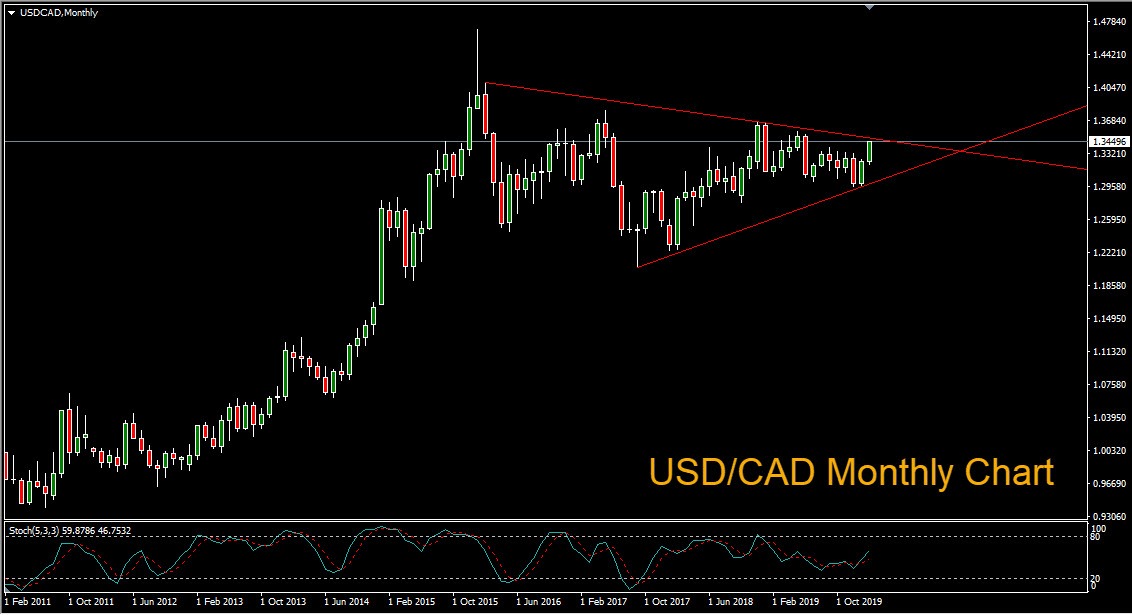
Looking at the USD/CAD monthly chart we can see that a pennant pattern has formed and that price is currently pressed against the upper trendline. A break above will bring the prior high of 1.3664 into view for the bulls.

Author

Dan Blystone

Dan Blystone

TradersLog.com

Experience Dan Blystone began his career in the trading industry in 1998. He worked as an arb clerk on the floor of the Chicago Mercantile Exchange (CME), flashing orders into the currency futures pits.


More from Dan Blystone
Share:

Editor's Picks

AUD/USD advances modestly, hovers around 0.7050

AUD/USD reverses part of Friday’s sharp decline and gyrates around the 0.7050 region ahead of the opening bell in Asia. The pair’s modest recovery comes amid humble losses in the Greenback, always amid the steady uncertainty on the geopolitical front. Moving forward, Westpac’s Consumer Confidence measure will be the salient release on Tuesday.

USD/JPY holds higher ground toward 160.50 despite 'Yentervention' fears

USD/JPY holds higher ground toward 160.50 in Monday's Asian trading, despite intervention fears. Japan’s revised GDP print, which confirmed that the economy lost momentum in the first quarter, weighs on the Japanese Yen. Meanwhile, Friday's upbeat US NFP report and fresh Israel-Iran attacks favor the US Dollar bulls, underpinning the currency pair.

Gold faces initial resistance near  $4,350

Gold manages to reclaim the $4,300 mark per troy ounce and above on Monday. The yellow metal’s small uptick comes on the back of modest losses in the US Dollar, while traders continue to follow geopolitical events in the Middle East and the likelihood of a tighter-for-longer Fed.

Why institutions prefer Solana over newer rivals for stablecoin adoption – Solstice CEO
The cryptocurrency industry has entered a new era spearheaded by stablecoins, real-world asset (RWA) tokenization, decentralized finance (DeFi), and Artificial Intelligence (AI) applications.
$1.75 trillion: Is SpaceX the most popular IPO in history, or the most engineered?

On June 12, the largest initial public offering (IPO) in history is set to hit the tape, and almost nobody is asking whether the price is right, because almost everybody already wants in.

The US economy defies the rules: 100 days into the Oil shock and the recession signal is still missing

More than three months after the start of the Iran war and the resulting disruption to global energy markets, the US economy continues to display remarkable resilience. The conflict has triggered a sharp rise in Oil prices, reignited inflationary pressures and fueled widespread concerns about a potential economic slowdown.