Lean hogs reach an all-time COT extreme as the livestock complex turns bullish

Lean hogs produced the most striking signal in this week’s Commitments of Traders report. In the available futures-and-options history for this market, large speculators have never held a larger net-long position.
A record does not provide a next-day or next-week forecast. It does, however, mark an exceptional positioning condition, and the historical behaviour around earlier extremes gives the signal meaningful medium-term context.
Lean hogs have entered positioning territory never recorded before
Large speculators often follow established trends, so a heavily net-long position should not automatically be read as a contrarian sell signal. In lean hogs, the interpretation is different: earlier periods of strongly stretched speculative positioning have repeatedly appeared around market bottoms.
That history makes the present all-time extreme a medium-term bullish signal in my view. It suggests that the market may be moving through a broader bottoming process, even though the COT reading alone cannot identify the exact low or tell us when the next upward move should begin.
I think of COT analysis rather like a seismograph near a volcano: it can reveal pressure building beneath the surface, but it cannot specify the precise moment when the visible move will occur. Here the pressure is unusually clear; timing still has to come from price behaviour and subsequent data.
Live cattle strengthens the bullish case across livestock
Lean hogs are not an isolated signal. Live cattle is showing a bullish positioning extreme on roughly a two-year lookback, adding a second constructive reading within the same broad sector.
The aggregated livestock complex is also under bullish COT stress. That alignment matters because it reduces the risk that the lean-hog reading is merely a market-specific anomaly. It does not guarantee that both contracts will rise together, but it gives the medium-term bullish interpretation a wider base.
Cotton’s 247-report extreme keeps the risk tilted lower
Cotton sits at a 247-report bearish extreme, one of the longest-duration signals in this week’s review. The reading describes a historically stretched positioning condition across that lookback rather than a weekly change in net positions.
My conclusion remains directional but deliberately limited: the COT structure favours continued weakness, while the extreme itself cannot determine the exact path or timing. If the stress persists and price remains soft, the bearish case would continue to carry more weight than an attempt to call an immediate reversal.
Sugar’s bearish signal is developing, but price has not confirmed it
Sugar requires a more nuanced reading. An earlier bearish COT change signal has not yet received price confirmation, as the market has continued to climb. At the same time, the one-year chart now shows an unquestionable bearish positioning extreme, and the stress is also significant on the five-year view.
The lack of confirmation means I would not treat the bearish case as complete. Even so, the accumulation of positioning stress suggests that the rally’s internal dynamics may be weakening. I would want to see bearish iCOT readings strengthen further, ideally alongside a loss of momentum in price, before taking a more confident bearish view.
The South African Rand shows a sharp bearish commercial shift
The South African Rand recorded a 30% bearish change in commercials’ net positions after a rally lasting several weeks. The adjustment is larger than average, and the accompanying iCOT Scores support the short-term bearish message from the COT change signal.
The longer-term stress picture is less definitive, so I would not extend this into a broad structural forecast. For now, it is a developing warning that near-term weakness may follow the rally, with confirmation still dependent on how price responds.
The main takeaway is the alignment inside livestock
Lean hogs lead this week because the large-speculator net-long position has moved beyond every previous reading in the available futures-and-options history. Previous extremes appearing around bottoms make that record relevant as medium-term bullish context, while live cattle and the aggregated livestock complex provide useful confirmation.
Elsewhere, cotton presents a long-lookback bearish extreme, sugar’s bearish COT evidence is building without price confirmation, and the Rand shows a sizeable bearish weekly commercial change. Together, these markets illustrate what COT data does best: identify unusual pressure and changing participation, while leaving precise timing to price and subsequent confirmation.
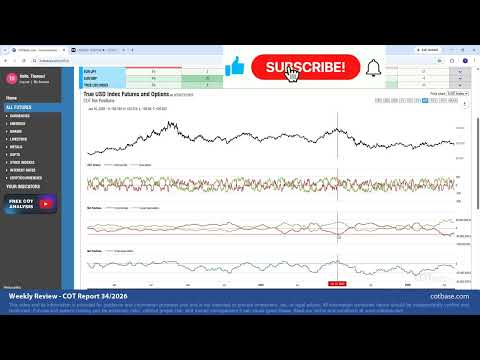
I explain the full report and walk through every chart in this week’s COTbase video review
This content was partially created by an AI tool.
Author

Thomas Lukacs
COTBase.com
Thomas Lukacs is the founder and CEO of COTbase.com.

















