Land of confusion: Why the global bond sell-off may be far from over
Government borrowing costs have climbed sharply across the world as higher Oil prices revive inflation fears and force investors to reconsider whether the main central banks have finished raising interest rates.
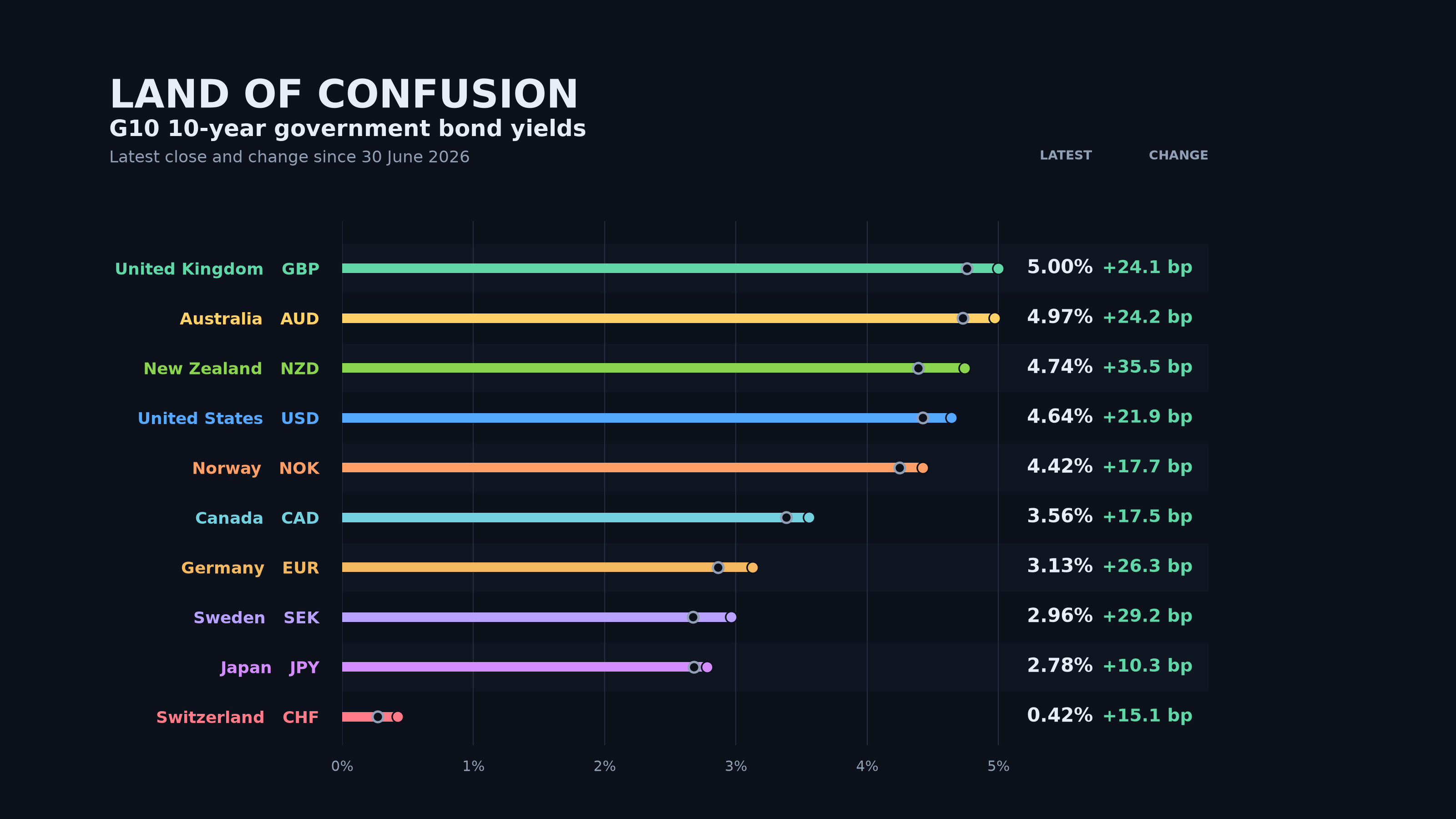
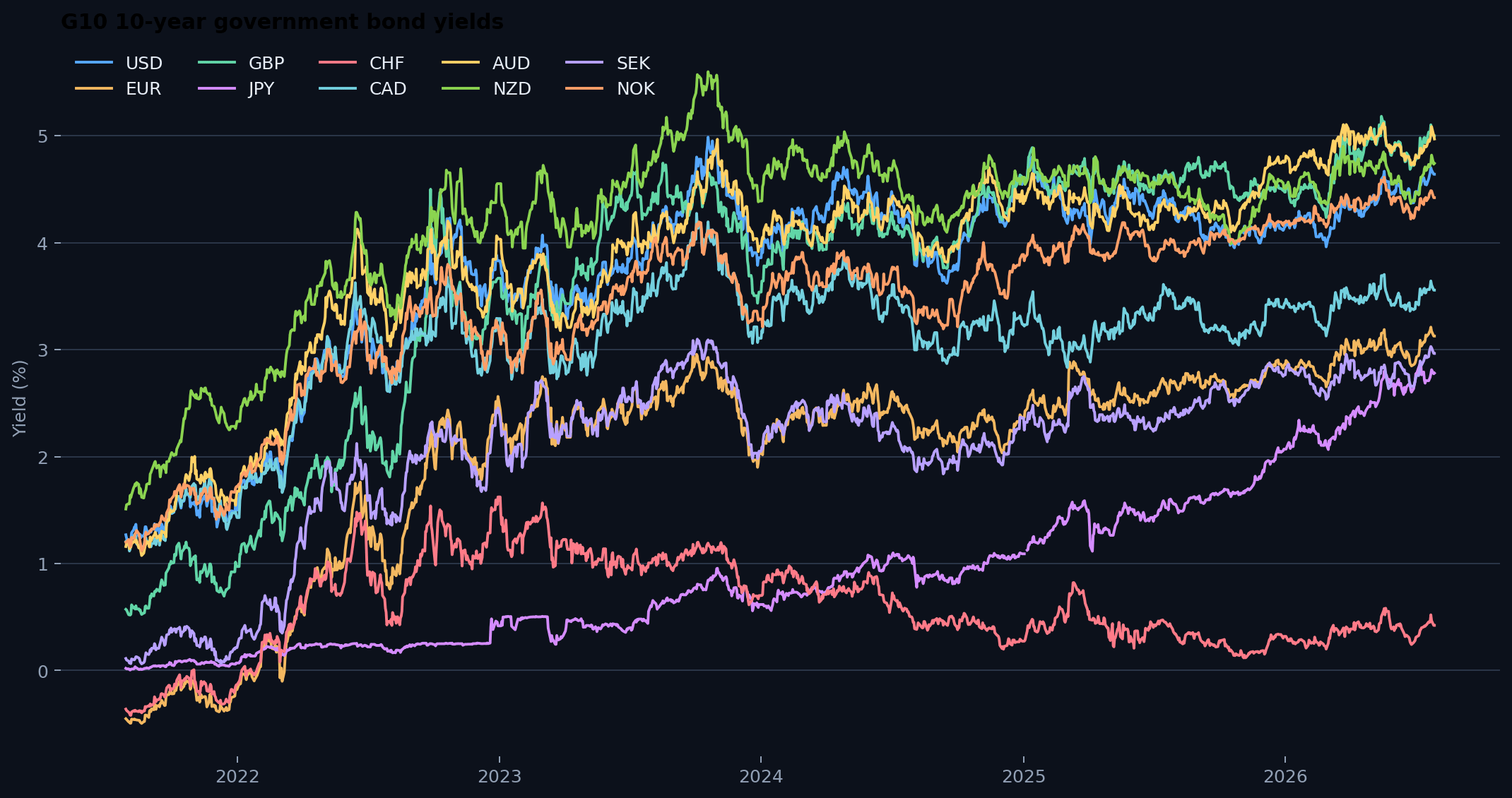
The sell-off has spread across the G10 space, lifting yields on everything from US Treasuries and British gilts to German Bunds, Japanese government bonds (JGB) and Australian debt (AGB). Although yields have started the week on a negative tone, they remain close to some of their highest levels in many months.
The benchmark 10-year US Treasury yield briefly moved above 4.70% last week, reaching an 18-month high, while the 30-year yield approached levels unseen in nearly two decades. Germany’s 10-year Bund yield climbed beyond 3.20%, the British equivalent moved above 5.00% and Australia’s 10-year yield surpassed 5.00%.
Japan has experienced an even more dramatic adjustment. Its 10-year government bond yield reached 2.90% earlier in July, its highest level since 1996, while yields on longer-dated debt climbed above 4.00%.
The simultaneous rise has delivered a blunt warning from global bond markets: inflation may prove harder to defeat, interest rates may remain elevated for longer and governments will have to pay considerably more to finance their debts.
Oil, inflation and the return of higher-for-longer
The latest catalyst has been the renewed surge in energy prices caused by fighting between the US and Iran and disruption fears surrounding the Strait of Hormuz.
Brent crude rose above $100 a barrel to hit two-month tops last week, threatening to lift fuel, transport and production costs across the global economy. That matters because central banks had been relying on softer inflation to support lower interest rates.
Expensive energy threatens to reverse part of that progress. Investors have consequently reduced expectations for rate cuts and, in several G10 economies, begun pricing the possibility of fresh increases.
However, crude Oil prices fell sharply on Monday after the US and Iran paused military strikes over the weekend, providing some relief. Both Brent and West Texas Intermediate (WTI) prices dropped sharply, while the US 10-year Treasury yield built on Friday’s pullback and approached the 4.60% region. However, the move only partially reversed July’s broader repricing.
The energy shock is not the only explanation, as resilient economic activity, persistent underlying inflation and rising government borrowing requirements were already placing upward pressure on yields and adding to the combo.
Governments across the G10 are issuing substantial volumes of debt to finance defence, infrastructure, energy security and ageing populations. Investors are demanding higher returns to absorb that supply, particularly where there are doubts about future deficits or political willingness to control spending.
When US Treasury yields rise, the whole world listens
Movements in US Treasuries influence borrowing costs across the global financial system, making the rise in American yields particularly important.
The 10-year Treasury yield surpassed 4.70% on Friday, while the 30-year yield faltered in levels shy of 5.20% after touching a 19-year high. In the meantime, investors are weighing persistent inflation, elevated federal borrowing and the possibility that the Federal Reserve (Fed) may need to raise interest rates again.
The Fed is widely expected to leave rates unchanged at its July meeting, although it no longer sees the decision as entirely straightforward. The Oil shock and uncertainty surrounding the inflation outlook have made a rate increase a closer call than markets anticipated only a few weeks ago.
Higher Treasury yields can quickly spill into US mortgage rates, corporate borrowing costs and the valuation of global stocks. They can also support the US Dollar (USD) by making dollar-denominated assets more attractive, although concerns about the country’s fiscal position could complicate that relationship.
Same sell-off, different headaches
The United Kingdom is particularly exposed because inflation remains sensitive to energy prices and the Gilt market is already carrying a substantial fiscal risk premium.
The 10-year gilt yield has traded beyond 5.00%, while markets have revived speculation that the Bank of England (BoE) could be forced to tighten policy again. Expectations eased on Monday after the fall in crude prices, with the two-year gilt yield dropping many basis points, but investors still see a meaningful possibility of a rate increase later this year. So far, market participants expect roughly 40 basis points of tightening from the “Old Lady” by year-end.
In the Eurozone, the German 10-year Bund yield climbed above 3.20% before easing some ground on Monday. Germany faces a combination of renewed energy vulnerability and increased public spending, while the European Central Bank (ECB) must decide whether the inflationary impact of oil outweighs the damage to growth, as the stagflationary narrative remains far from abated in Euroland.
Japan’s challenge is different: the Bank of Japan (BoJ) is normalising monetary policy after decades of exceptionally low interest rates, while investors are questioning whether the government can combine large spending plans with sustainable public finances.
The 10-year Japanese yield approached the 3.00% threshold earlier in the month, while yields on longer tenors moved above 4.00%. The scale of the shift suggests investors want considerably more compensation for holding long-term Japanese debt.
Australia and New Zealand are also vulnerable to renewed inflation and rate-hike expectations. Australia’s 10-year yield rose above 5.00% last week, adding pressure to interest-rate-sensitive stocks and a housing market where borrowers are highly exposed to changing financing costs.
From trading screens to mortgage bills
Yields on government bonds are not the direct setting of the rate on every mortgage or loan, but they do influence the price at which banks, companies and governments can get long-term financing.
If yields stay high, new fixed-rate mortgages could get more expensive and refinancing more difficult. Companies could also hold back on investment or hiring as their cost of capital rises.
Equity markets face another problem. Higher bond yields increase the return available from relatively safe government debt, making expensive shares less attractive by comparison. Growth and technology companies are often the most sensitive, with valuations that depend heavily on profits expected far into the future.
Governments also suffer from the higher cost of refinancing, meaning a bigger slice of tax revenue must be spent servicing existing debt, leaving less for public services, tax cuts or investment.
Regarding the FX universe, currencies could become more volatile as investors compare how aggressively each central bank is likely to respond. Countries expected to maintain higher rates may initially see their currencies gather steam, but that advantage can disappear if rising yields reflect concerns about fiscal sustainability rather than stronger growth.
A brief ceasefire… or the calm before another sell-off?
The current (temporary?) retreat in yields shows how quickly the picture can change when energy prices fall. However, it does not resolve the wider questions facing bond markets.
Investors will now watch Oil prices, inflation data, central bank gatherings and government debt auctions for evidence that the pressure is fading. If the US and Iran manage to clinch a sustainable pause and crude Oil prices continue to retreat, some of the most aggressive rate-hike expectations may be unwound.
If, on the flip side, energy prices rebound or inflation proves persistent, the global sell-off could resume.
The crucial issue is no longer simply how high central banks set short-term interest rates. Bond markets are also demanding a larger premium for inflation, heavy debt issuance and political uncertainty.
That suggests borrowing costs may remain higher than households, companies and governments have become accustomed to during the decade before the pandemic, even if the latest geopolitical shock begins to ease.
Author

Pablo Piovano
FXStreet
Born and bred in Argentina, Pablo has been carrying on with his passion for FX markets and trading since his first college years.