Job Openings: What sectors are still desperate for workers?


The number of quits hit a record high in November in the latest BLS JOLTS Labor Turnover report.

Openings, Hires, Separations, and Quits, Data from BLS, Chart by Mish
Job Openings and Labor Turnover Survey
The latest Job Openings and Labor Turnover Survey (JOLTS) shows a bit of improvement for Leisure and Hospitality (restaurants, hotels, ect.), in the form of fewer openings.
The total number of quits is at a record high of 4.5 million compared to the pre-pandemic total of 3.4 million.
Job Openings
- On the last business day of November, the number and rate of job openings decreased to 10.6 million (-529,000) and 6.6 percent, respectively.
- Job openings decreased in several industries with the largest decreases in accommodation and food services (-261,000); construction (-110,000); and nondurable goods manufacturing (-66,000).
- Job openings increased in finance and insurance (+83,000) and in federal government (+25,000).
Hires
- In November, the number and rate of hires were little changed at 6.7 million and 4.5 percent, respectively.
- Hires were little changed in all industries and in all four regions.
Separations
- Total separations includes quits, layoffs and discharges, and other separations. Quits are generally voluntary separations initiated by the employee. Therefore, the quits rate can serve as a measure of workers’ willingness or ability to leave jobs.
- Layoffs and discharges are involuntary separations initiated by the employer.
- Other separations includes separations due to retirement, death, disability, and transfers to other locations of the same firm.
- In November, the number of total separations increased to 6.3 million (+382,000). The total separations rate was little changed at 4.2 percent. Total separations increased in accommodation and food services (+130,000) but decreased in federal government (-9,000).
- The number of quits increased in November to a series high 4.5 million (+370,000). The quits rate increased to 3.0 percent, matching the series high in September.
- Quits increased in several industries with the largest increases in accommodation and food services (+159,000); health care and social assistance (+52,000); and transportation, warehousing, and utilities (+33,000).
- The number of layoffs and discharges was little changed in all four regions. The number of other separations was little changed in November at 377,000. The number of other separations decreased in real estate and rental and leasing (-5,000) and in federal government (-3,000).
Openings by Sector
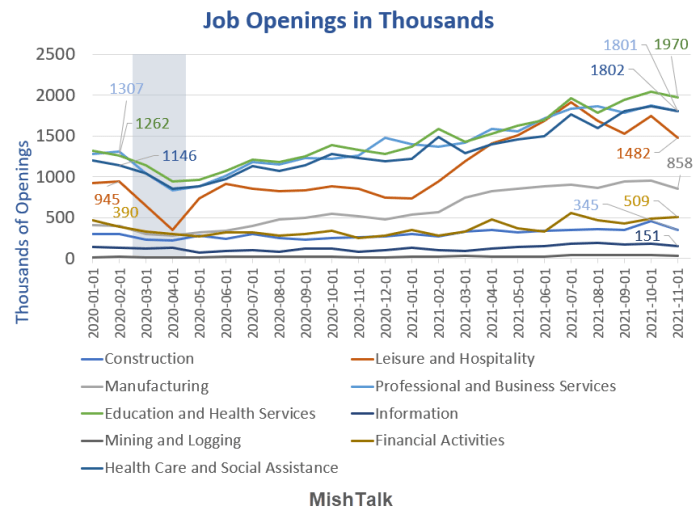
Job Openings by Sector, Data from BLS, Chart by Mish
Key Points
- There's a bit of improvement in for Leisure and Hospitality (restaurants, hotels, ect.), in the form of fewer openings. That means positions are slowly being filled. Anecdotally, I see help wanted signs nearly everywhere I go.
- Education and Health Services, Health Care and Social Assistance, and Professional and Business Services openings are are or near record high openings.
Openings by Sector
- Construction : 345,000
- Leisure and Hospitality : 1,482,000
- Manufacturing : 858,000
- Professional and Business Services 1,801,000
- Education and Health Services : 1,970,000
- Information : 151,000
- Mining and Logging : 34,000
- Financial Activities : 509,000
- Health Care and Social Assistance: 1,802,000
Health Care Competition
On January 22, I noted Wisconsin Judge Amazingly Rules 7 Health Care Workers Cannot Switch Jobs
7 employees quit one health care firm for another and a judge temporarily blocked the move. The employees were not under contract and left for better pay.
Telling people they cannot quit for a better opportunity is blatantly unconstitutional. But that just happened in Wisconsin. See the link for details.
Thanks for Tuning In!
Author
Mike “Mish” Shedlock's
Sitka Pacific Capital Management,Llc