|

Japanese Yen soars as Tokyo Core CPI falls to 2%

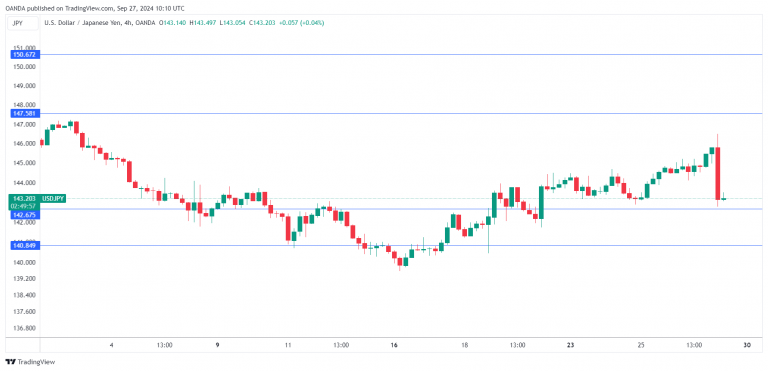
The Japanese yen is sharply higher on Friday. USD/JPY is trading at 143.49 in the European session, down a massive 1.1%.

Tokyo Core CPI matches BoJ’s target

Tokyo Core CPI, which excludes fresh food, slowed to 2% in September, down from 2’s.4% in August and matching the market estimate. The drop was largely driven by the resumption of government subsidies for utility bills.

The inflation reading indicates that Japan is on track to hit the Bank of Japan’s target of sustainable 2% inflation and the yen has responded with sharp gains today. This reading will support the case for further rate hikes, although that’s unlikely until December or early next year.

Governor Ueda said this week that the BoJ is not in any rush to hike rates and that the focus will be on services prices data for October, which won’t be released until November, too late for the October 31 meeting. Wages have been rising but it remains to be seen if this will translate into higher services inflation. If it does, there will be pressure on the BoJ to raise rates at the December meeting.

The week wraps up with US Core PCE Price Index, which is considered the Fed’s preferred inflation indicator. The index has hovered at 2.6% for the past three months and is expected to tick up to 2.7% for August. Monthly, the Core PCE is expected to remain at 0.2%. An unexpected reading could shake up the US dollar and the rate-cut odds for the Fed’s November meeting. The odds of a 50-basis point cut have slipped to 47%, down from 54% a day earlier, according to the CME’s FedWatch tool.

USD/JPY technical

  • USD/JPY faces weekly resistance lines at 147.58 and 150.66.

  • There is support at 142.67 and 140.84.
USDJPY

Author

Kenny Fisher

Kenny Fisher

MarketPulse

A highly experienced financial market analyst with a focus on fundamental analysis, Kenneth Fisher’s daily commentary covers a broad range of markets including forex, equities and commodities.


More from Kenny Fisher
Share:

Editor's Picks

AUD/USD renews two-month lows near 0.6950 after Australian CPI data

AUD/USD is renewing two-month lows near 0.6950 in the Asian session on Wednesday, as below-expectations August Australian underlying CPI data pours cold water on expectations for further RBA interest rate hikes. Chinese PMI data also fail to inspire the Australian Dollar, despite a pause in the US Dollar advance.

USD/JPY drops below 157.00 as intervention risks counter Japan's weak data

USD/JPY keeps losses below 157.00 in the Asian session on Wednesday, as hawkish BoJ expectations, along with intervention risks, underpin the Japanese Yen, countering dismal domestic factory output and retail sales data. Meanwhile, a broad US Dollar retreat also collaborates to the pair's downside.

Gold consolidates below $4,200, looks to US ADP and PCE

Gold struggles to capitalize on the previous day's recovery from an eight-week low, consolidating below $4,200 in the Asian session on Wednesday. The overnight slide in oil prices eased the US Treasury bond rout, supporting the bullion. However, Fed rate-hike bets and inflationary concerns keep bond yields near multi-year highs. Moreover, geopolitical uncertainties underpin the safe-haven US Dollar, which, in turn, limits bullion.

Ethereum sees profit-taking near $2,700 ahead of key US economic data
Ethereum (ETH) has shown signs of profit-taking near $2,700 over the past few days, with rising exchange deposits and a slowdown in exchange-traded fund (ETF) inflows ahead of US inflation and labor market data releases. The top altcoin's Exchange Reserves, which track the total amount of a crypto asset held across exchange wallets, have increased by roughly 125K ETH since Friday.
Silver is more volatile than Gold ahead of PCE and NFP. This chart shows the positioning gap
The market’s attention is focused on American data this week, but there’s something only those with a trained eye may be looking at: Gold and Silver positioning gap. Financial markets are moving on fears, mostly related to persistently high energy prices driven by the Middle East war. Sure, the US Dollar (USD) is strong, but at what cost?
Silver is more volatile than Gold ahead of PCE and NFP. This chart shows the positioning gap
The market’s attention is focused on American data this week, but there’s something only those with a trained eye may be looking at: Gold and Silver positioning gap. Financial markets are moving on fears, mostly related to persistently high energy prices driven by the Middle East war. Sure, the US Dollar (USD) is strong, but at what cost?