Bitcoin just lost $70,000 and the oversold signal isn't stopping sellers

Bitcoin is under $70K for the first time since August, a month after a popular momentum gauge first called the selling overdone. Sellers include fund investors pulling money out, and traders forced out of borrowed bets, with another US rate increase expected in December.
One of the most-used chart signals has called Bitcoin's sell-off overdone for about a month, and in that month the price has lost roughly $13K. On Friday, it fell below $70K for the first time since August, taking the slide from the late-September high past a fifth.
A signal like that works when the sellers are traders who look at charts and decide they've sold enough. It works badly when the selling comes from people who have no choice, or who are reacting to something that isn't on the chart. That describes most of November's sellers. Fund investors are taking money out, traders are closing borrowed bets, and US interest rates are about to rise again.
Oversold since Bitcoin was $13K higher
The signal is the daily Stochastic Relative Strength Index (Stoch RSI), a momentum gauge on a scale of 0-100 that measures how one-sided the recent trading has been. A reading under 20 is called oversold, meaning sellers have dominated for long enough that a bounce often follows. The gauge dropped below 20 in mid-October, with Bitcoin near $82K, and it hasn't been above 30 since.
Since then, the price has kept falling, the 50-day average has turned down, and Bitcoin is on track for a sixth straight weekly loss. The gauge recovered a little twice, once in late October and once in the days before Friday's break, and traders sold into both recoveries.
For precedent, the same chart has one from the start of the year. The gauge fell below 20 in late January, with Bitcoin near $89K, and stayed there into February, by which point the price was close to $60K. An oversold reading was correct: sellers had been busy, and it was about a third too early to say where they'd stop.
The sellers aren't looking at the chart
Start with the US Bitcoin exchange-traded funds (ETFs), which hold the coins and sell shares in them on the stock market. Those funds have had six straight trading days of net withdrawals, and more than $2.5 billion has left since October 30. BlackRock (BLK)'s iShares Bitcoin Trust, the largest of them, had seen withdrawals for nine straight sessions by Wednesday. When investors cash in those shares, the fund sells Bitcoin to pay them, whatever the gauge reads.
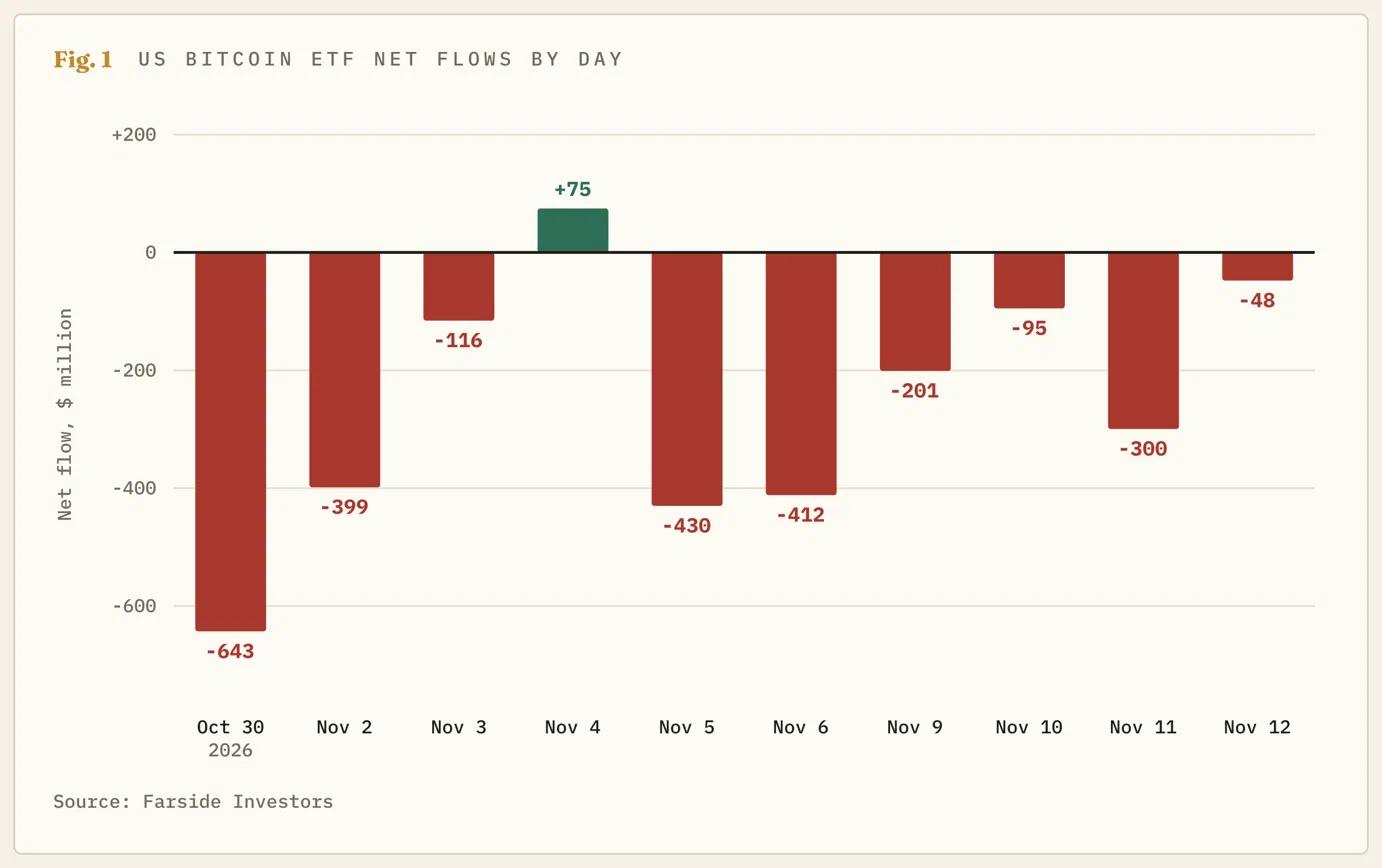
From there, the selling fed on borrowed money. Traders on crypto exchanges can bet on Bitcoin with loans many times the size of their own stake, and the exchange sells them out automatically when the price falls far enough. More than $1.3 billion of those bets were forced out in the 24 hours around the break of $70K, about half of it in Bitcoin. Longs, the bets on a rise, made up more than 96% of the Bitcoin total, which means Friday's forced sellers were the market's buyers.
On top of those two, a third source is already on the calendar. Index provider MSCI (MSCI) will drop the Michael Saylor-founded Strategy (MSTR), a company holding more than 840K Bitcoin, from its indices after November 30. Funds that copy those indices then have to sell the shares, selling JPMorgan (JPM) put at about $2.8 billion in a 2025 estimate, and none of it touches a coin directly. Strategy largely pays for its Bitcoin by selling new shares and borrowing, so a weaker share price could leave one of the market's steadiest buyers with less to spend.
A government bond pays 5% and Bitcoin pays nothing
Behind the fund withdrawals is a change in what money can earn elsewhere. Tuesday's Consumer Price Index (CPI) report showed US prices rising faster than forecast in October, and traders now fully expect the Federal Reserve (Fed) to raise interest rates on December 9. Fed Governor Christopher Waller has floated a half-point increase, which traders give about a 13% chance, and the US Dollar is at a 19-month high on the same bets.
In response, the 10-year Treasury yield, what the US government pays to borrow for a decade, went back above 5% on Thursday, and a two-year government bond pays 4.86%. Bitcoin pays no interest or dividend, so the only reason to hold it is the expectation that the price will go up. Each rise in what a government bond pays makes that expectation more expensive to wait on, and an ETF holder can act on it in one trade.
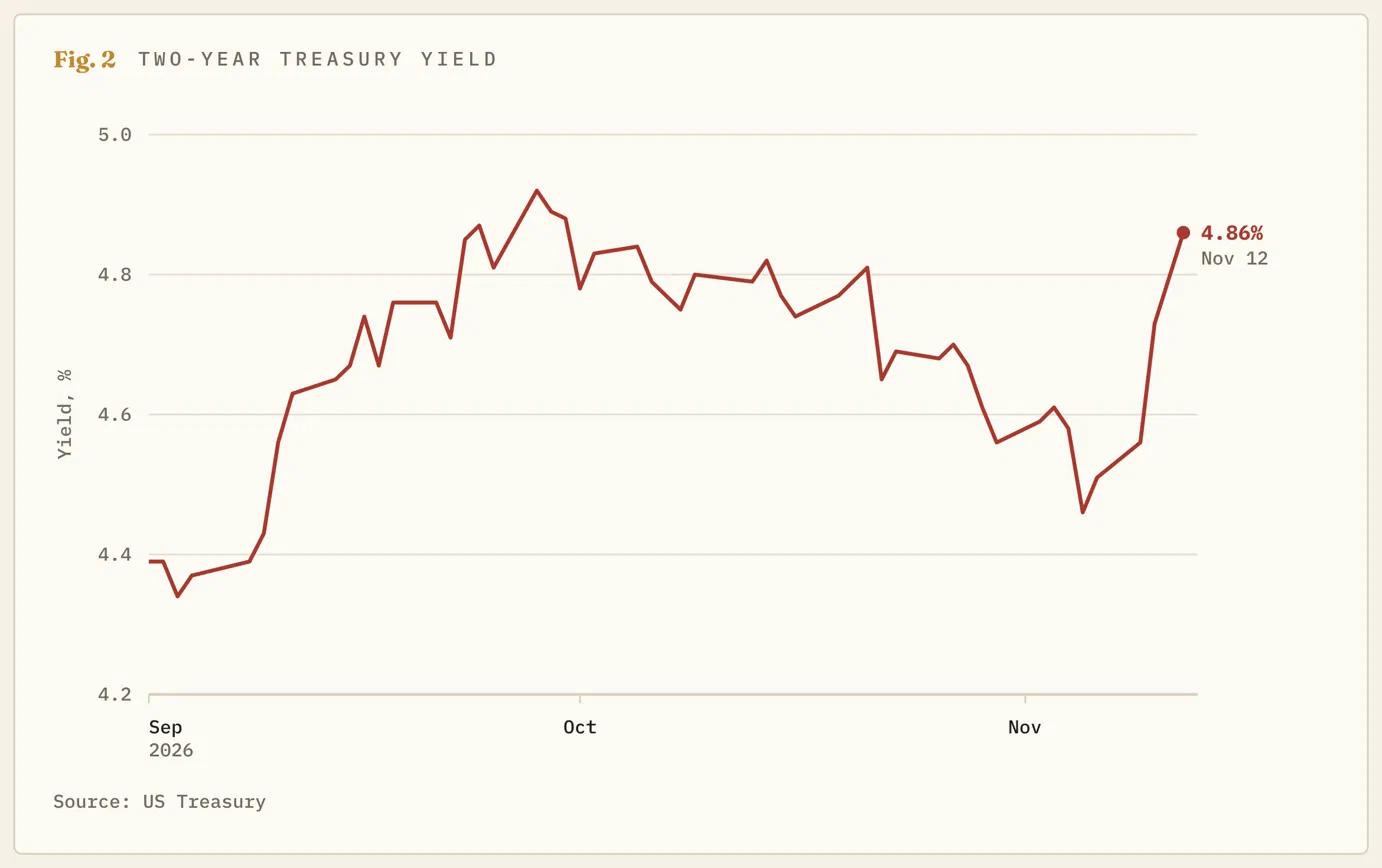
For the gauge to matter, pressure from rates would likely have to ease first, and the next scheduled chance of that is the Fed's December meeting. The gauge measures how hard Bitcoin has been sold, and it has no input for what a Treasury pays.
What the signal has got right this year
The strongest case against all this is that the gauge has a decent record once the forced selling is done. It was under 20 at the early-February low, after which Bitcoin recovered more than a third by May. The same reading in mid-September came just before a rally of about $12K.
Beyond the chart, there is more evidence on the buyers' side. On-chain data, the public record of which wallets hold which coins, points to large holders buying more during the fall, and November has been Bitcoin's strongest month on average since 2010. On that reading, a month of oversold is a spring being wound, and the rebound would be large when it comes.
Even so, the trouble is the timing. Both of the gauge's good calls this year came after the last forced seller was out, and it gave no warning of when that would be. November has the best average of any month, and this one is two losing weeks from two.
Two dates come before the gauge gets a say
The fork is whether the forced and rate-driven selling ends before the next two scheduled events or runs through them. Index funds have to be out of Strategy after November 30. On December 9, the Fed decides, and a quarter-point increase with a signal to wait would likely pull Treasury yields down and take the pressure off the ETFs. In that case, a month-old oversold reading would have buyers behind it at last, and the rebound could be fast.
Flip the Fed's message, though, and the outcome flips with it. A half-point increase, or a quarter-point with a promise of more, would likely send yields up again and more ETF money out. The gauge could then stay at the floor while the price keeps falling, as it did at the start of the year.
For now, the lean is that the selling isn't over, because none of the three sources has switched off. That view is wrong if the ETFs take in money for several days in a row while Bitcoin trades back above $70K. Until that shows up, the oversold signal is reporting that sellers have been busy, which the sellers have been making clear themselves for a month.
Author

Joshua Gibson
FXStreet
Joshua joins the FXStreet team as an Economics and Finance double major from Vancouver Island University with twelve years' experience as an independent trader focusing on technical analysis.