Iran's real weapon isn't Uranium – It's payment rails

This week, markets learned - again - that wars are no longer fought only with missiles, sanctions, and carefully staged presidential speeches.
Sometimes, they are fought with payment rails.
And yes, once again, the geopolitical soap opera starring President Donald Trump delivered another dramatic episode.
On May 11, Trump rejected Iran’s peace counteroffer, calling it “totally unacceptable.” Tehran reportedly offered to transfer portions of its uranium stockpile while refusing to dismantle its nuclear infrastructure fully.
The market reaction was textbook: Oil jumped. The dollar strengthened. Traders rushed into defensive positioning. Analysts rediscovered the phrase “geopolitical premium” for the 400th time this decade
But beneath the noise, something far more important happened.
Iran just demonstrated why weaponizing the global financial system creates incentives for alternatives… And markets are still underpricing that reality.
The Dollar’s "exorbitant privilege" was never permanent
Go back a decade. In 2012, the EU sanctioned Iranian banks. Then came the decisive moment: SWIFT disconnected them from its system.
It was a demonstration of raw geopolitical power. The U.S. weaponized the dollar and its settlement infrastructure.
The message was simple:
Use the dollar system against U.S. interests, and you can be removed from global finance altogether.
Efficient. Brutal. Effective.
But that decision planted a seed, and for the first time, major FX reserves themselves were perceived as potentially geopolitical liabilities.
Once a system becomes a geopolitical weapon, other countries start looking for exits.
Former Fed Chair Ben Bernanke famously described the dollar’s role as an “exorbitant privilege.”
Meanwhile, Mark Carney warned years ago that excessive reliance on the U.S. dollar would not last forever. Why? Because he understood that any privilege, once weaponized, creates incentives for alternatives.
Iran understood this earlier than most. While the world argued on social media about whether crypto was “real money,” Iran spent over a decade quietly building parallel infrastructure:
- Alternative settlement rails.
- Digital asset channels.
- Stablecoin-based trade mechanisms.
- Peer-to-peer systems outside traditional correspondent banking.
Not ideology.
Necessity.
For 12 years, quietly, while under sanctions, Iran built the proof that you can transact globally without SWIFT, without Federal Reserve permission, without dollar dominance.
You know... If reserves and payment systems can become geopolitical weapons, diversification becomes national security.
And this week, they proved it works.
Iran didn’t panic – That’s the story
When Trump tightened sanctions again, when he rejected peace, Iran did not suddenly disappear from global trade.
They simply kept transacting. They kept selling oil. They kept importing goods. Why? Because parallel infrastructure already existed.
That matters.
A lot.
Iran was already selling oil below benchmark pricing. With Hormuz disrupted and shipping risk elevated, they're just getting the price their enemies were getting before the conflict.
And at the top of it, Tehran effectively turned sanctions survival into a long-term stress test for alternative finance. They're winning the long-term structure.
And now every central bank paying attention understands the real lesson:
If you wait too long to build alternatives, you may eventually need them under crisis conditions.
China is watching. Russia is watching. India is watching.
Don't get me wrong, the USD dominance is not ending. But empires that weaponize privilege create the conditions for their own challengers. Right... Luke?
Monopolies rarely disappear all at once. They weaken gradually - then suddenly.
Oil markets are pricing scarcity wrong
For traders, the real story is not simply that oil is expensive.
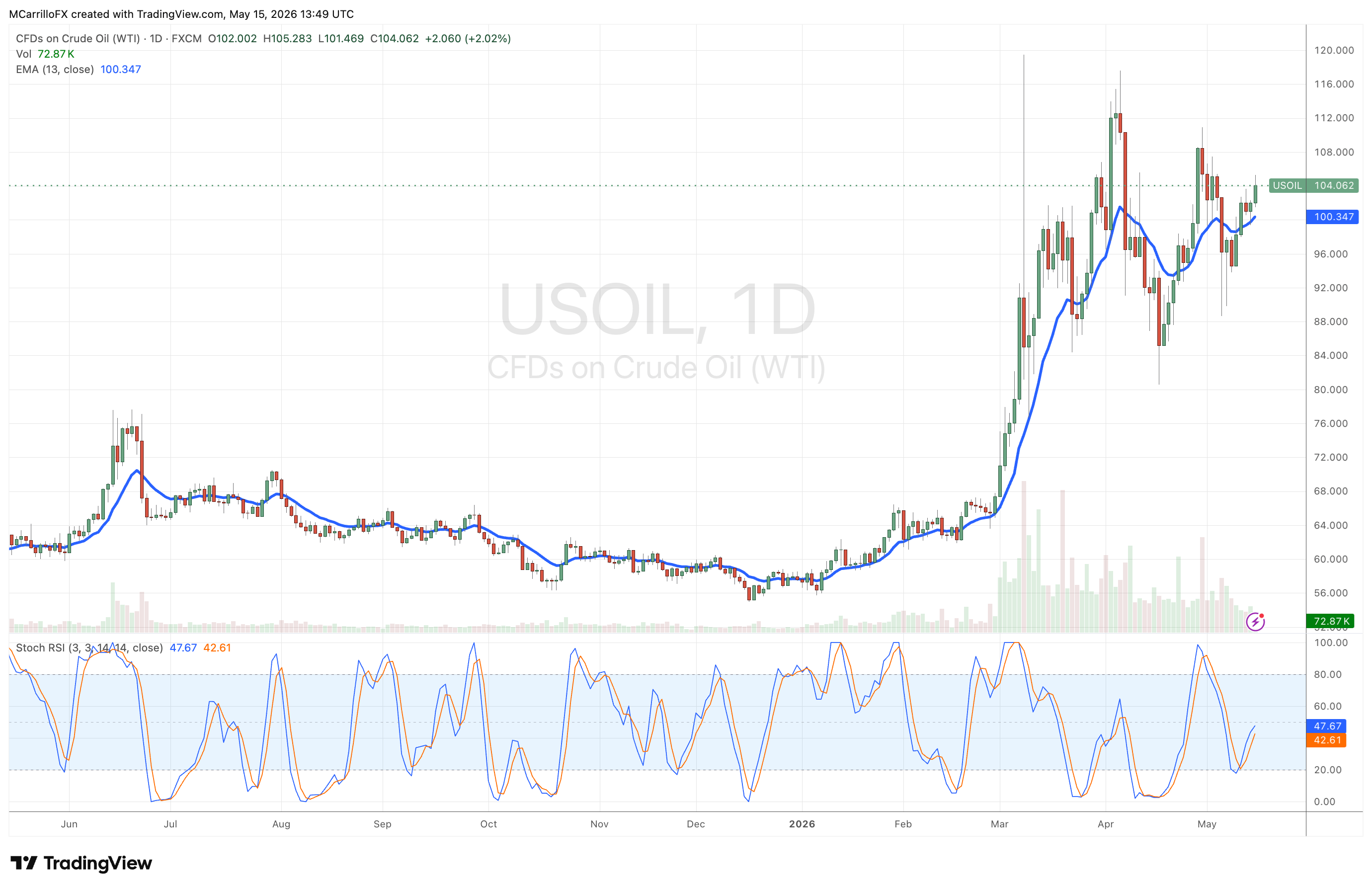
WTI sits near $100, up 40% since the conflict started. Production from Kuwait, Iraq, Saudi Arabia, and UAE dropped 6.7 million barrels per day by March 10, reaching 10 million bpd by March 12.
That's structural supply destruction.
But here's the key: Chevron CEO Mike Wirth told CNBC the issue isn't just price - it's logistics. "Can we get the fuel? I think over the course of the next several weeks, we'll see those effects begin to move throughout the system."
Shortages are no longer theoretical. They're logistical.
Brent surged past $120 in early March, then stabilized lower for two reasons: Strategic petroleum reserves cushioned the blow, and Iran has hundreds of millions of barrels in tankers ready to deploy.
But here's the trade: Iran won't flood the market at $98. They'll release when maximum leverage exists - economically and politically.
That timing advantage is structural.
For the medium term, oil remains structurally bullish until diplomacy really changes. Prices will only go down if peace talks are restarted in a meaningful way, SPR refills or demand decline accelerate. Price would go up if new attacks occur or regional shortages worsen.
Technically, dips below the $94 area is likely to attract buying interest, while upside targets remain around $112 if disruptions persist.
But keep an eye on the Fed and watch the dollar.
If the Fed hints any cuts or softens its view on geopolitical tensions, the dollar will go down, removing one of the last brakes on oil. And that will be the green flag for the acceleration of a new bullish leg for oil prices.
The stablecoin revolution is no longer theoretical
Here is the part legacy finance still struggles to admit publicly: Stablecoins already function as global settlement infrastructure.
In 2025 alone, stablecoin transaction volumes reportedly surpassed 33 trillion dollars globally, dominated by instruments like USD Coin and Tether.
Not because people suddenly became crypto evangelists. It was because the rails worked.
Fast settlement, 24/7 operation, lower friction, reduced dependence on correspondent banking. And critically: less vulnerability to geopolitical chokepoints.
This is no longer about “crypto adoption.” This is about infrastructure competing with infrastructure.
Iran merely accelerated the demonstration effect.
The bigger market signal
Most traders are still staring at:
- Fed speeches.
- Oil charts.
- CPI prints.
- Military headlines.
Fair enough.
But the deeper signal sits underneath: How are countries settling trade during periods of geopolitical fragmentation?
Because that answer tells you where the next decade of global finance is heading.
The dollar remains dominant. But dominance is no longer unconditional. And that may end up being the most important macro story markets still refuse to fully price.
Iran’s most important weapon was never uranium.
It was proving that alternative infrastructure could survive pressure.
Author

Mauricio Carrillo
Witbrew
Mauricio Carrillo is a financial journalist, fintech executive, and inter-markets analyst with fifteen years of experience at the intersection of traditional finance and digital asset infrastructure.