Gold Weekly Forecast: US-Iran ceasefire uncertainty keeps bulls at bay
- Gold registered weekly gains but struggled to gather momentum.
- The uncertainty surrounding the US-Iran ceasefire could cause markets to turn cautious.
- Despite the recent gains, the near-term technical outlook is yet to confirm a bullish reversal.

Gold (XAU/USD) posted another week of gains as headlines from the Middle East remained the main driver for the precious metal and will continue to do so in the short term.
The announcement of a temporary ceasefire between the US and Iran pushed XAU/USD to its highest level in nearly three weeks, but lost its momentum as investors grew doubtful about a further de-escalation of the conflict in the region.
Gold bulls remain tentative as Middle East uncertainty persists
Over the weekend, US President Trump set a deadline at 20:00 EST on Tuesday for Iran to open the Strait of Hormuz and threatened to attack Iranian infrastructure, including power plants and bridges. In response, Iran said that there would be a "much more devastating" retaliation if the US were to carry on with its threats. Late Monday, Trump reiterated that every bridge and every power plant in Iran would be destroyed by midnight if Iran didn't agree to a deal that was acceptable to him, only for Iran to respond back by calling his threats delusional. Still, Gold’s action remained relatively subdued at the beginning of the week.
In the meantime, the data from the US showed on Monday that the business activity in the service sector expanded at a healthy pace in March, with the Institute for Supply Management's (ISM) Services Purchasing Managers' Index (PMI) coming in at 54. On a negative note, the Employment Index of the survey dropped to 45.2 from 51.8 in February, highlighting a decline in the service sector payrolls, while the Prices Paid Index climbed to 70.7 from 63, reflecting stronger input inflation.
Just a couple of hours ahead of the deadline, Trump announced that he agreed to a two-week ceasefire with Iran on the condition that Iran opens the Strait of Hormuz during this period. With the immediate reaction, crude Oil prices fell sharply and the US Dollar (USD) came under heavy bearish pressure. As a result, Gold advanced to its highest level since March 19 above $4,850 midday Wednesday.
However, market mood soured and the risk rally lost its steam in the second half of the day as the latest headlines from the Middle East caused investors to doubt the sustainability of the ceasefire. In turn, Gold reversed its direction and registered marginal losses, closing the day slightly above $4,700.
Iranian officials argued that Israel's ongoing aggression against Lebanon is a violation of the ceasefire agreement and noted that it would be "unreasonable" to proceed with the negotiations to reach a permanent peace deal with the US. Moreover, Iran's Fars News Agency reported late Wednesday that oil tankers passing through the Strait of Hormuz have been stopped after Israel breached the ceasefire, per Reuters. As Israel continued to attack Lebanon on Thursday, markets remained cautious, limiting Gold’s upside.
Israeli Prime Minister Benjamin Netanyahu announced late Thursday that he has ordered the start of direct negotiations with Lebanon "as soon as possible," but clarified that there is "no ceasefire in Lebanon" and that they will continue to strike Hezbollah with full force. Meanwhile, US President Donald Trump said that Iran was doing a "very poor job" of allowing Oil to go through the Strait of Hormuz.
On Friday, the data from the US showed that annual inflation, as measured by the change in the Consumer Price Index (CPI), jumped to 3.3% in March from 2.4% in February, as expected. The core CPI, which excludes volatile energy prices, rose 2.6% on a yearly basis, compared to analysts’ estimate of 2.7%. These figures helped Gold hold its ground and end the week in positive territory.
Commenting on Gold’s recent fluctuations, ING’s Ewa Manthey and Warren Patterson note that conflicting geopolitical signals are causing choppy action in the precious metal, “with safe‑haven demand offset by shifts in risk sentiment and dollar moves.”
“Looking ahead, gold is likely to remain headline‑driven in the near term, with further clarity on the durability and scope of the ceasefire key for determining whether prices can regain upside momentum," they explain.
Gold traders will watch US-Iran negotiations closely
The US economic calendar will feature the Producer Price Index (PPI) data for March on Tuesday. While a stronger-than-forecast monthly producer inflation reading could be supportive for the USD in the near term and weigh on XAU/USD, Gold’s valuation is likely to depend on the fate of the ceasefire in the Middle East.
Following the announcement of the ceasefire, Iran's foreign minister said that Iran's military will coordinate the passage of vessels in the Strait of Hormuz, while Iran’s semi-official Tasnim News Agency reported that Iran and Oman are planning to charge transit fees. Negotiations between the US and Iran are set to start this weekend in Pakistan's Islamabad.
Even if sides manage to reach a permanent truce, a steady decline in Oil prices could be hard to come by in case Iran ends up controlling the Strait of Hormuz. Insurers could refrain from offering coverage unless they are convinced of vessels’ safety and cause further delays, while the fees charged by Iran could also be reflected upon Oil prices transported via the strait.
If Oil prices remain elevated, investors could see that as a sign of higher inflation for longer and refrain from pricing in a Federal Reserve (Fed) interest-rate cut later this year. In this scenario, Gold is likely to stay under bearish pressure in the near term. According to the CME FedWatch Tool, markets are currently pricing in about a 75% probability that the Fed will keep the policy rate unchanged at 3.5%-3.75% by end-2026. This positioning suggests that there is headroom for the USD.
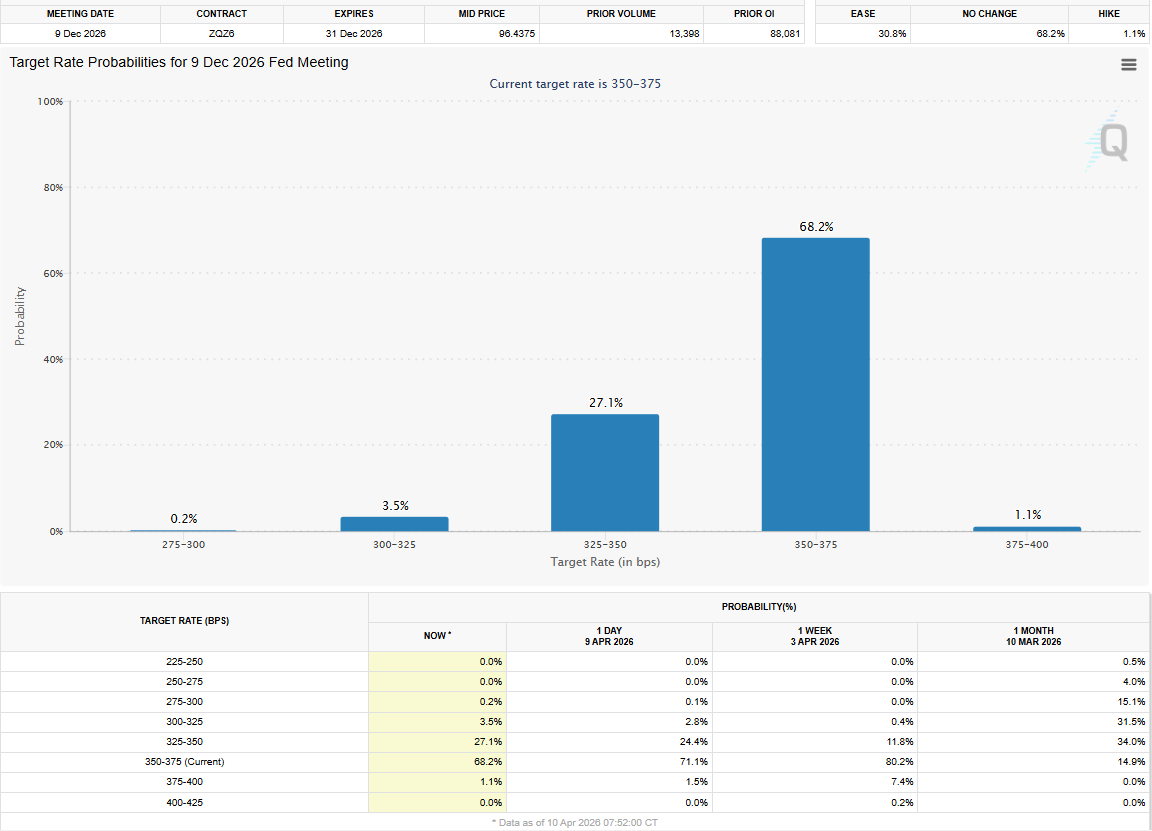
Conversely, a steady decline in Oil prices, with Iran agreeing to fully open the Strait of Hormuz and Israel opting for a diplomatic solution with Lebanon, could pave the way for a decisive bullish action in Gold.
To summarize, Gold’s near-term valuation will largely depend on how Oil prices react to news coming out of the Middle East. Hence, any positive headlines suggesting that sides are making progress in negotiations could be bullish for the yellow metal, while heightened uncertainty could force it to start erasing the gains recorded in the past couple of weeks.
TD Securities strategists argue that higher energy-linked inflation and delayed Fed cuts keep the opportunity cost of holding Gold elevated in the near term.
"Even with the ceasefire, it will take time to reverse higher inflation expectations along with higher energy, fertilizer, and chemical prices, making it difficult for the Fed to cut soon,” they add and argue that a only a “broader normalization in energy and rates” could weaken the USD and allow Gold to return above $5,000 in the latter part of 2026.
Gold technical analysis is yet to point to a bullish reversal
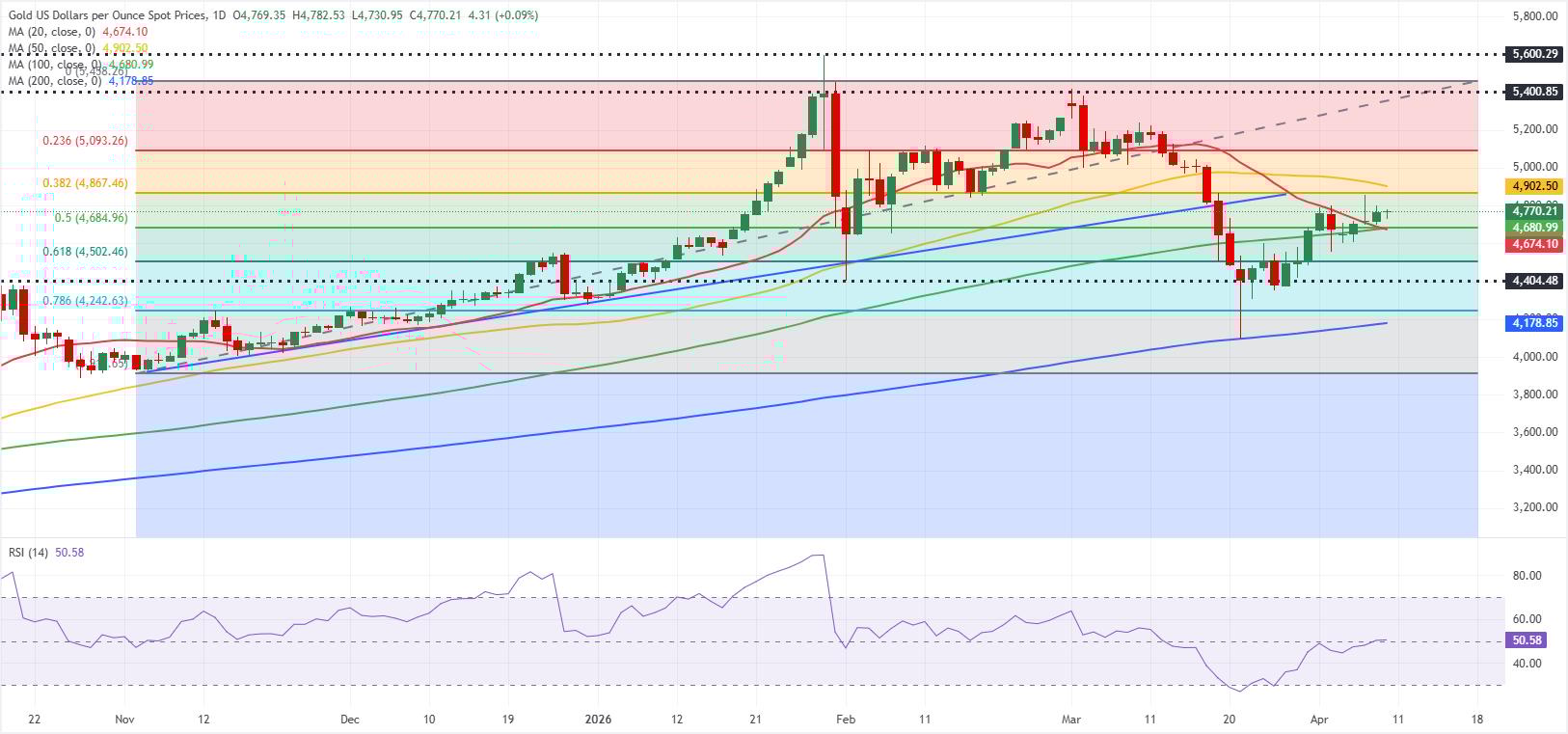
Gold climbed above the 100-day Simple Moving Average (SMA) but the Relative Strength Index (RSI) indicator on the daily chart turned flat near 50, reflecting a slightly bullish stance that lacks momentum.
On the upside, Gold faces initial resistance area at $4,865-$4,900, where the Fibonacci 38.2% retracement of the November-February uptrend meets the 50-day SMA. In case XAU/USD manages to stabilize above this region, technical buyers could show interest, opening the door for a leg higher toward $5,000 (static level, psychological level) and $5,100 (Fibonacci 23.6% retracement).
Looking south, a key support level could be spotted at $4,680 (100-day SMA, Fibonacci 50% retracement). If this level fails, the technical selling pressure could gather strength and drag XAU/USD toward $4,500 (Fibonacci 61.8% retracement) and $4,400 (static level, round level).
Gold FAQs
Gold has played a key role in human’s history as it has been widely used as a store of value and medium of exchange. Currently, apart from its shine and usage for jewelry, the precious metal is widely seen as a safe-haven asset, meaning that it is considered a good investment during turbulent times. Gold is also widely seen as a hedge against inflation and against depreciating currencies as it doesn’t rely on any specific issuer or government.
Central banks are the biggest Gold holders. In their aim to support their currencies in turbulent times, central banks tend to diversify their reserves and buy Gold to improve the perceived strength of the economy and the currency. High Gold reserves can be a source of trust for a country’s solvency. Central banks added 1,136 tonnes of Gold worth around $70 billion to their reserves in 2022, according to data from the World Gold Council. This is the highest yearly purchase since records began. Central banks from emerging economies such as China, India and Turkey are quickly increasing their Gold reserves.
Gold has an inverse correlation with the US Dollar and US Treasuries, which are both major reserve and safe-haven assets. When the Dollar depreciates, Gold tends to rise, enabling investors and central banks to diversify their assets in turbulent times. Gold is also inversely correlated with risk assets. A rally in the stock market tends to weaken Gold price, while sell-offs in riskier markets tend to favor the precious metal.
The price can move due to a wide range of factors. Geopolitical instability or fears of a deep recession can quickly make Gold price escalate due to its safe-haven status. As a yield-less asset, Gold tends to rise with lower interest rates, while higher cost of money usually weighs down on the yellow metal. Still, most moves depend on how the US Dollar (USD) behaves as the asset is priced in dollars (XAU/USD). A strong Dollar tends to keep the price of Gold controlled, whereas a weaker Dollar is likely to push Gold prices up.
Author

Eren Sengezer
FXStreet
As an economist at heart, Eren Sengezer specializes in the assessment of the short-term and long-term impacts of macroeconomic data, central bank policies and political developments on financial assets.