Gold Weekly Forecast: US employment data and tariff announcements to trigger next big action
- Gold shined as the go-to safe-haven asset amid growing fears over a deepening global trade war.
- US tariff announcements and key employment data could lift XAU/USD’s volatility.
- The technical outlook points to overbought conditions in the near term.

Gold (XAU/USD) gathered bullish momentum and surged to a new record high above $3,080 on Friday after struggling to find direction at the beginning of the week. The unveiling of the United States’ (US) reciprocal tariffs and key macroeconomic data releases from the US could drive Gold’s valuation in the near term.
Gold attracts safe-haven flows, surges to all-time peak
Gold registered small losses on Monday as the US Dollar (USD) benefitted from the upbeat Purchasing Managers Index (PMI) data. The S&P Global Composite PMI improved to 53.5 in March’s flash estimate from 51.6 in February, showing that the business activity in the private sector continued to expand at an accelerating pace. Meanwhile, the Wall Street Journal reported over the weekend that the White House is adjusting its approach to tariffs set to take effect on April 2, likely omitting a set of industry-specific tariffs while applying reciprocal tariffs aimed at countries with significant trade ties to the US. This headline helped the market mood improve and made it difficult for XAU/USD to gain traction.
In the absence of high-tier data releases and fundamental drivers, Gold fluctuated in a tight range above $3,000 on Tuesday and Wednesday. As safe-haven flows started to dominate the action in financial markets in the Asian session on Thursday, XAU/USD gathered bullish momentum.
US President Donald Trump announced late Wednesday that the White House is planning to impose a 25% tariff on all car imports to the US. Trump added that auto tariffs will be permanent and go into effect on April 2. In a social media post early Thursday, the President said that they will impose large-scale tariffs, "far larger than currently planned," on Canada and the European Union if they do economic harm to the US. This development revived fears over an economic downturn in the US and the potential negative impact of a deepening trade war on global economic activity. In turn, Gold rose more than 1% on Thursday. Additionally, XAU/EUR and XAU/GBP both gained about 0.8% on the day, suggesting that Gold captured capital outflows out of the Pound Sterling and the Euro as well.
Markets remained risk-averse in the first half of the day on Friday and Gold extended its rally to a new record-high above $3,080. The final data of the week from the US showed that the Personal Consumption Expenditures (PCE) Price Index, the Federal Reserve’s preferred gauge of inflation, rose 2.5% on a yearly basis in February, matching the market expectation and January’s increase. The core PCE Price Index, which excludes volatile food and energy prices, increased 2.8% in this period. Markets largely ignored this data, allowing Gold to stay near record-highs heading into the weekend.
Gold investors await US tariff headlines, NFP
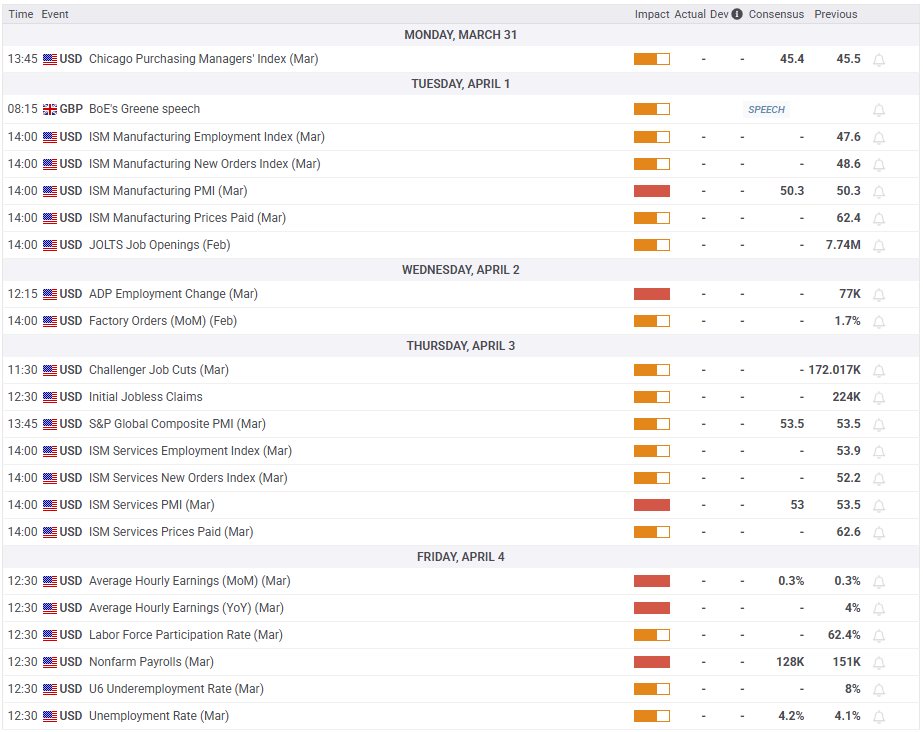
The Institute for Supply Management (ISM) Manufacturing PMI and JOLTS Job Openings data will be featured in the US economic calendar on Tuesday. Investors are likely to ignore these releases and refrain from taking large positions before the Trump administration shares the details about reciprocal tariffs on Wednesday.
It will be a difficult task for market participants to assess all decisions related to tariffs and determine their short-term and long-term potential impacts. Other nations could also react by announcing retaliatory tariffs, further complicating the matter. Hence, investors could stay on the sidelines and wait until the dust settles. Following the initial volatile action, the performance of Wall Street’s main indexes could provide useful insights into the risk mood. Gold could stage a deep correction if markets turn risk-positive. On the other hand, the precious metal is likely to preserve its strength in case investors grow increasingly concerned about a deepening trade war and seek refuge.
On Friday, the US Bureau of Labor Statistics will publish employment data for March. In case Nonfarm Payrolls (NFP) rise by 200,000 or more, the immediate market reaction is likely to boost the USD and cause XAU/USD to turn south heading into the weekend. On the flip side, a reading at or below 100,000 could have the opposite effect on Gold’s valuation. According to the CME FedWatch Tool, markets are currently pricing in a less-than-15% probability of a 25 basis points Fed interest rate cut in May. A disappointing NFP print, combined with a possible downturn in the US economy due to tariffs, could cause markets to lean toward a rate cut at the upcoming policy meeting and open the door for another leg higher in Gold prices.
Gold technical analysis
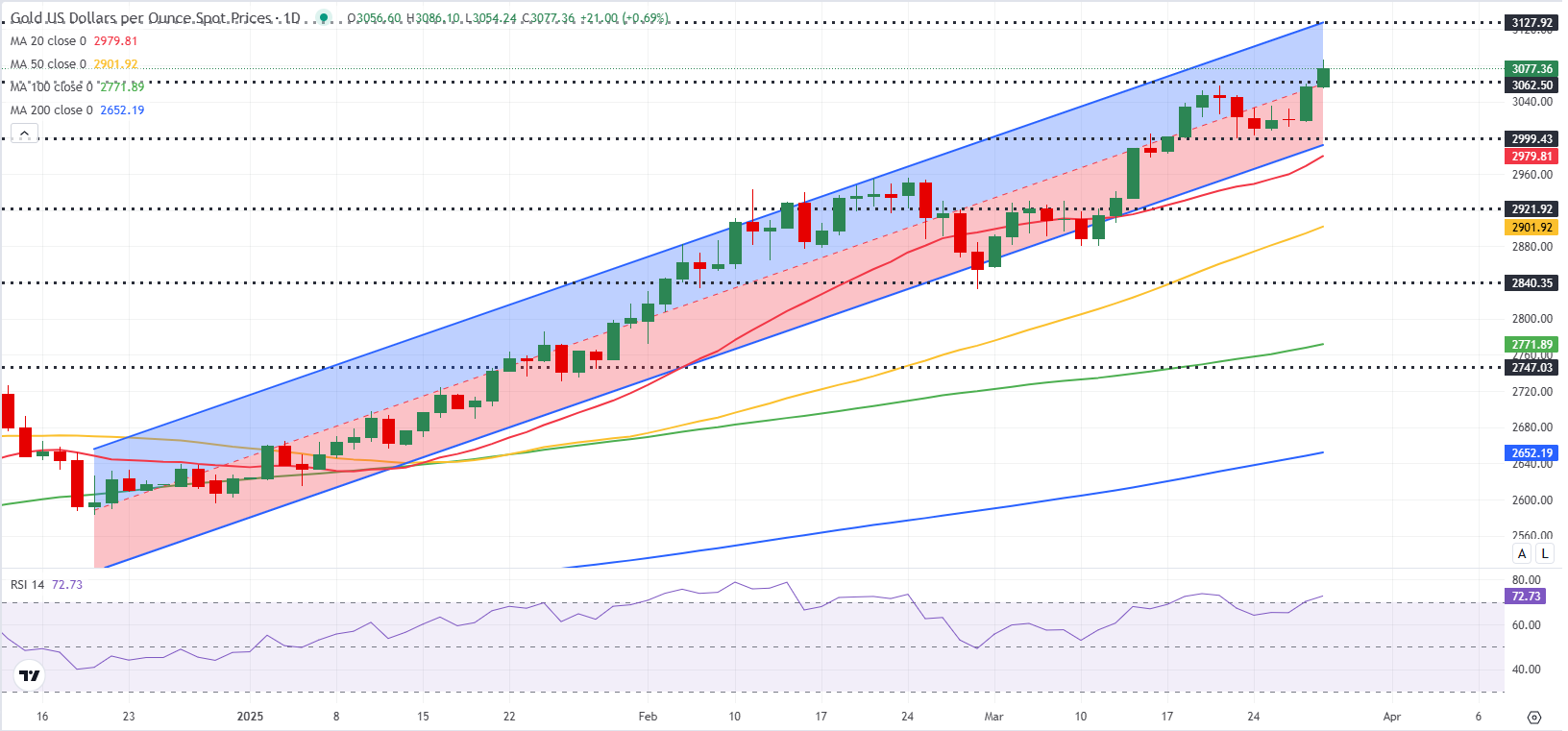
The Relative Strength Index (RSI) indicator on the daily chart has risen above 70, pointing to overbought conditions in the near term. On the upside, immediate resistance is located at $3,100 (psychological level) before $3,130 (upper limit of the four-month-old ascending regression channel) and $3,200 (psychological level).
In case Gold stages a technical correction, $3,060 (mid-point of the ascending channel) could be seen as the first support before $3,000-$2,990 (static level, lower limit of the ascending channel) and $2,980 (20-day Simple Moving Average).
Gold FAQs
Gold has played a key role in human’s history as it has been widely used as a store of value and medium of exchange. Currently, apart from its shine and usage for jewelry, the precious metal is widely seen as a safe-haven asset, meaning that it is considered a good investment during turbulent times. Gold is also widely seen as a hedge against inflation and against depreciating currencies as it doesn’t rely on any specific issuer or government.
Central banks are the biggest Gold holders. In their aim to support their currencies in turbulent times, central banks tend to diversify their reserves and buy Gold to improve the perceived strength of the economy and the currency. High Gold reserves can be a source of trust for a country’s solvency. Central banks added 1,136 tonnes of Gold worth around $70 billion to their reserves in 2022, according to data from the World Gold Council. This is the highest yearly purchase since records began. Central banks from emerging economies such as China, India and Turkey are quickly increasing their Gold reserves.
Gold has an inverse correlation with the US Dollar and US Treasuries, which are both major reserve and safe-haven assets. When the Dollar depreciates, Gold tends to rise, enabling investors and central banks to diversify their assets in turbulent times. Gold is also inversely correlated with risk assets. A rally in the stock market tends to weaken Gold price, while sell-offs in riskier markets tend to favor the precious metal.
The price can move due to a wide range of factors. Geopolitical instability or fears of a deep recession can quickly make Gold price escalate due to its safe-haven status. As a yield-less asset, Gold tends to rise with lower interest rates, while higher cost of money usually weighs down on the yellow metal. Still, most moves depend on how the US Dollar (USD) behaves as the asset is priced in dollars (XAU/USD). A strong Dollar tends to keep the price of Gold controlled, whereas a weaker Dollar is likely to push Gold prices up.
Author

Eren Sengezer
FXStreet
As an economist at heart, Eren Sengezer specializes in the assessment of the short-term and long-term impacts of macroeconomic data, central bank policies and political developments on financial assets.














