Gold stays cautious as Fed rate hike bets keep markets on edge

Gold (XAUUSD) remains under pressure as markets prepare for major US economic events this week. Expectations for higher US interest rates continue to weigh on sentiment, while a weaker US Dollar helps limit additional losses. Market attention now turns to key economic data and geopolitical developments that could provide fresh direction for gold.
Gold holds ground as softer Dollar offsets hawkish Fed expectations
Gold starts the week on a cautious note as markets prepare for the US Nonfarm Payrolls report later this week. Expectations for a US Federal Reserve interest rate hike in September remain elevated. According to the CME FedWatch Tool, markets currently assign a roughly 65% probability to a rate increase. Higher interest rate expectations continue to reduce the appeal of non-yielding assets like gold.
At the same time, weakness in the US Dollar helped limit gold's downside. The US Dollar came under pressure after the Japanese Yen strengthened sharply as markets focused on the possibility of another round of official intervention. USD/JPY fell to its lowest level in three months before recovering part of its losses. The softer US Dollar provided underlying support for gold and prevented a deeper decline.
Geopolitical developments continue to influence gold prices. Market sentiment improved after US President Donald Trump announced that fresh attacks on Iran had been cancelled and peace talks would begin soon. The announcement pushed oil prices lower and eased concerns about higher inflation driven by energy markets. Attention now turns to the US ISM Manufacturing PMI and developments surrounding the US-Iran discussions. These events, together with the US Nonfarm Payrolls report later this week, could determine the next short-term move in both the US Dollar and gold.
Gold technical analysis: Descending wedge keeps recovery limited
The gold chart below shows price trading within a broad descending wedge that has guided price action in recent months. The pattern reflects a sustained corrective phase, with both the upper resistance line and the lower support line continuing to contain price movements. Gold remains below the descending resistance line, indicating that the broader corrective structure is still intact.
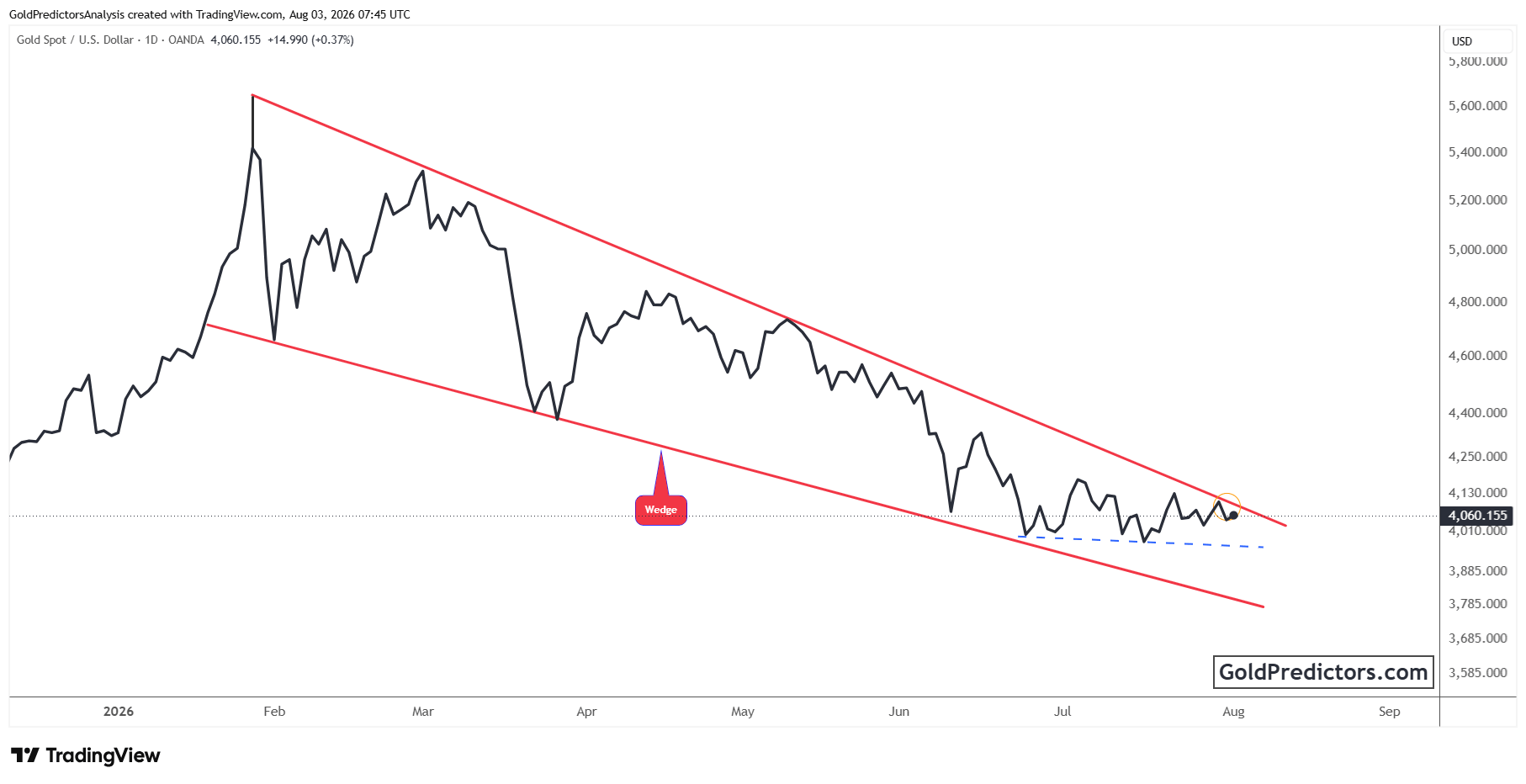
Recent price action shows gold stabilizing above an important horizontal support area. The decline has lost momentum, and price is consolidating while remaining within the wedge. This suggests that downside pressure has eased, although the broader corrective structure has yet to show a confirmed reversal. The descending resistance trendline continues to represent the key technical barrier for any sustained recovery.
Gold is now trading close to the wedge resistance, making this an important technical level to monitor. A sustained move above this resistance would suggest that the corrective phase is weakening and could improve the near-term technical outlook. Conversely, another rejection from the resistance would keep the wedge structure intact and maintain the current corrective bias. Until price breaks decisively in either direction, the wedge continues to define the near-term technical outlook.
Gold outlook: Economic reports and geopolitical developments in focus
Gold continues to hold a cautious tone as markets prepare for major US economic releases and geopolitical updates. Expectations for higher US interest rates continue to weigh on sentiment, while a weaker US Dollar helps limit additional losses. From a technical perspective, gold continues to trade within its descending wedge. A sustained move above the wedge resistance could improve the near-term outlook, while another rejection would keep the current corrective structure intact.
Unlock exclusive gold and silver trading signals and updates that most investors don’t see. Join our free newsletter now!
Author

Muhammad Umair, PhD
Gold Predictors
Muhammad Umair is a financial markets analyst and investor who focuses on the forex and precious metals markets.