Gold slides amid fragile US-Iran ceasefire that jolts US Dollar, Oil
- Ceasefire collapse fears push WTI higher and support the US Dollar.
- Strong ISM Manufacturing data reinforces US economic resilience narrative.
- Markets price higher Fed hike odds before NFP release.

Gold price retreats by more than 1% on Monday as the market mood shifts to neutral amid developments in the Middle East that threaten to end the ceasefire between the US and Iran. The XAU/USD trades at $4,490 after reaching a daily high of $4,546.
XAU/USD falls as Oil spike revives inflation and Fed fears
Geopolitics continued to drive price action in the precious metal segment. US-Iran negotiations appear to have stalled after Iran stopped exchanging messages with the US in protest over what Tasnim described as Israeli crimes. Meanwhile, Iranian state television reported that the ceasefire could collapse if Israel does not end its attack on Lebanon.
Odds for Fed rate hike, increase
Oil prices spiked $6, with WTI peaking at around $94.78 per barrel, before trimming some of its gains. But the front-month contract is still up 4.50% at $91.79 at the time of writing. The positive correlation between the Greenback and WTI propelled the US Dollar Index (DXY) higher by 0.22% to 99.17.
The US economic data release began with the ISM Manufacturing PMI hitting its highest level since 2022, as companies accelerated orders to avoid rising prices. The index rose to 54.0 in May, up from 52.7 in April, while the Prices Paid sub-component decreased from 84.6 to 82.1.
The data showed the economy’s resilience, but also that input costs remained high, fueling speculation that major central banks would need to hold interest rates higher for longer. Data from Prime Terminal revealed that money markets had priced in a nearly 68% chance of a Federal Reserve (Fed) rate hike toward the end of 2026.
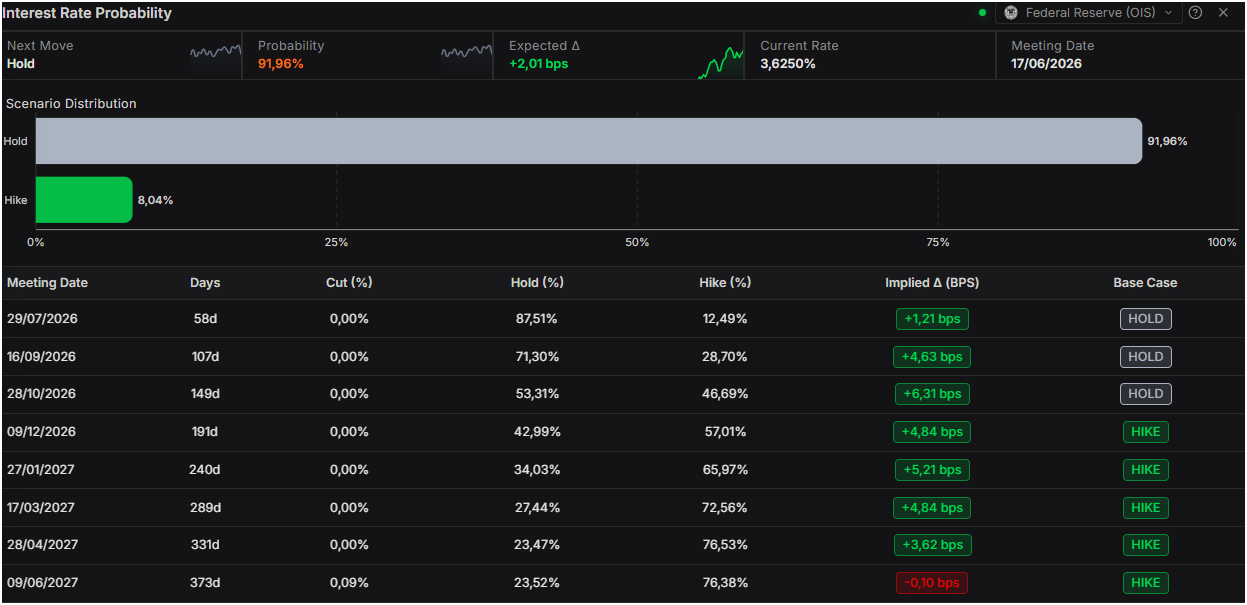
Ahead this week, market players will eye a series of US jobs data releases, ahead of Friday’s Nonfarm Payrolls report and alongside remarks by Fed officials. Also, the release of the Beige Book could be of interest as the new Fed Chair, Kevin Warsh, is expected to lead the US central bank's first meeting on June 16-17.
XAU/USD technical analysis: Gold price clears $4,500, eyes on 20-day SMA
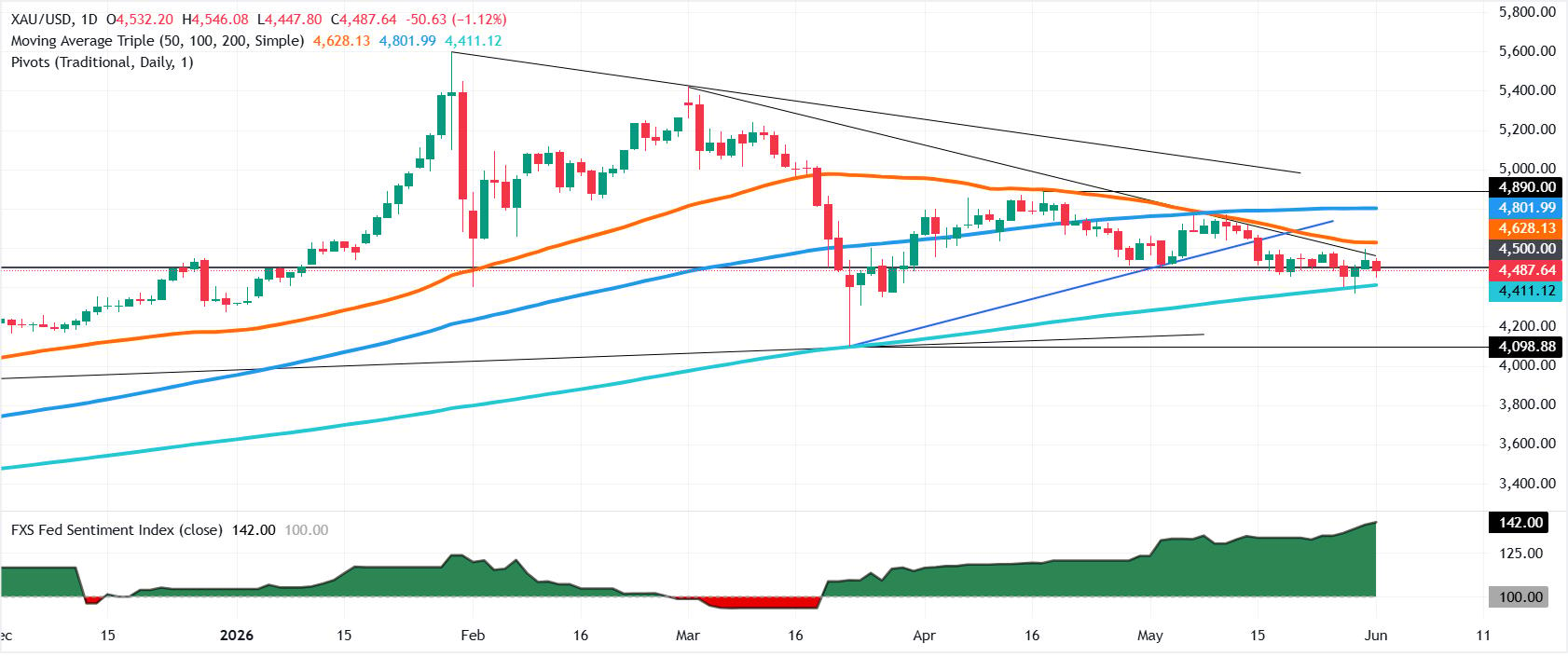
Price action shows Gold resumed its downtrend after testing the 20-day Simple Moving Average (SMA) at $4,580, but buyers were unable to hold above $4,500, which opened the door to a two-day low at $4,447.
The Relative Strength Index (RSI) shows that momentum is bearish, aiming downwards, an invitation for sellers to drive Gold prices lower.
A breach of $4,450 opens the door to test the 200-day SMA at $4,411, ahead of the $4,400 figure. Once hurdled, the next stop would be the March 23 daily low of $4,098.
Above, the first key resistance is $4,500, followed by the 20-day SMA. Once those levels are cleared, the 50-day SMA emerges as the next resistance at $4,628.
Gold FAQs
Gold has played a key role in human’s history as it has been widely used as a store of value and medium of exchange. Currently, apart from its shine and usage for jewelry, the precious metal is widely seen as a safe-haven asset, meaning that it is considered a good investment during turbulent times. Gold is also widely seen as a hedge against inflation and against depreciating currencies as it doesn’t rely on any specific issuer or government.
Central banks are the biggest Gold holders. In their aim to support their currencies in turbulent times, central banks tend to diversify their reserves and buy Gold to improve the perceived strength of the economy and the currency. High Gold reserves can be a source of trust for a country’s solvency. Central banks added 1,136 tonnes of Gold worth around $70 billion to their reserves in 2022, according to data from the World Gold Council. This is the highest yearly purchase since records began. Central banks from emerging economies such as China, India and Turkey are quickly increasing their Gold reserves.
Gold has an inverse correlation with the US Dollar and US Treasuries, which are both major reserve and safe-haven assets. When the Dollar depreciates, Gold tends to rise, enabling investors and central banks to diversify their assets in turbulent times. Gold is also inversely correlated with risk assets. A rally in the stock market tends to weaken Gold price, while sell-offs in riskier markets tend to favor the precious metal.
The price can move due to a wide range of factors. Geopolitical instability or fears of a deep recession can quickly make Gold price escalate due to its safe-haven status. As a yield-less asset, Gold tends to rise with lower interest rates, while higher cost of money usually weighs down on the yellow metal. Still, most moves depend on how the US Dollar (USD) behaves as the asset is priced in dollars (XAU/USD). A strong Dollar tends to keep the price of Gold controlled, whereas a weaker Dollar is likely to push Gold prices up.
Author

Christian Borjon Valencia
FXStreet
Markets analyst, news editor, and trading instructor with over 14 years of experience across FX, commodities, US equity indices, and global macro markets.