Gold Price Forecast: XAUUSD looks south amid firmer yields, 200-DMA at risk?
- Gold Price remains pressured amid renewed USD strength.
- Rebounding Treasury yields could add to the weight on the yellow metal.
- XAUUSD tested 21-DMA support, more downside in the offing?

Gold Price changed course and flipped to the red zone on Monday, kicking off the week on the wrong footing. Despite the retreat in the yellow metal, bulls succeeded in defending the $1,850 level. The metal witnessed good two-way businesses but remained in a familiar trading range between $1,870 and $1,840, having struggled to capitalize on Friday’s rebound. Initially, XAUUSD advanced towards the two-week highs of $1,870 as the US dollar extended its downward correction at the beginning of the Nonfarm Payrolls week. The US Treasury yields also lingered near over month lows, lending support to the bullion. China’s covid easing optimism combined with reduced bets for aggressive Fed tightening lifted the overall market mood, weighing negatively on the safe-haven dollar.
However, the tide turned in favor of gold bears in the American trading after German inflation surprised markets to the upside and hit a record high, reviving concerns over raging inflation and growth outlook. The dollar rebounded sharply, although remained capped by thinner liquidity due to a Memorial Day holiday in the US.
Gold Price is attempting a minor recovery but remains on the back foot, as the dollar springs back to life this Tuesday. Germany’s inflation-led global growth fears amid policy tightening remain in play while improving Chinese business activity and policy support measures from the world’s second-biggest economy have managed to calm nerves, for the time being. Also, further easing of covid restrictions in China is helping support the recovery in the Asian stocks. If risk-on flows return with a bang, the dollar could resume its downside, although the sentiment around the bond market holds the key for placing fresh bets on gold price. The US rates are staging a solid rebound, with the benchmark 10-year yields up roughly 3.5% so far. Also, of note remains the preliminary inflation print from the Eurozone and the US CB Consumer Confidence data for fresh cues on the broader market sentiment.
Gold Price Chart: Daily chart
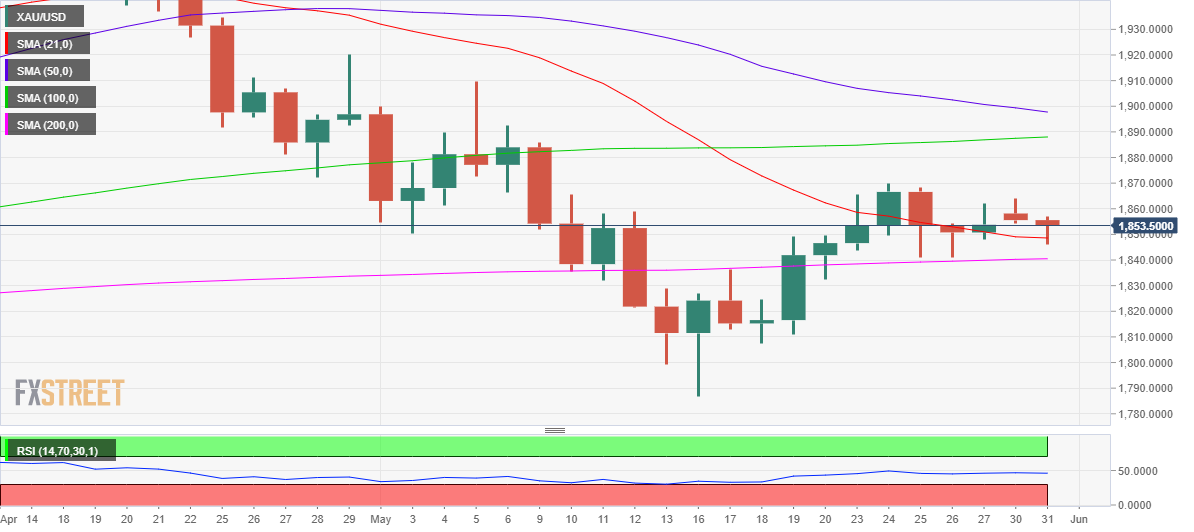
Gold Price tested the bearish 21-Daily Moving Average (DMA), now at $1,849, with bears eyeing a decisive break below the latter to extend the ongoing downbeat momentum.
The 14-day Relative Strength Index (RSI) is inching below the midline, allowing room for more declines.
Acceptance below the 21-DMA will trigger a fresh drop towards the horizontal 200-DMA at $1,840.
Daily closing below the latter is needed to fade the recovery and turn the focus back on the May 18 low of $1,807.
On the flip side, recapturing the daily highs of $1,857 is critical to take on the upside towards the previous day’s high of $1,864.
Further up, the two-week highs at $1,870 will be next on the buyers’ radars, above which the mildly bullish 100-DMA at $1,888 will be challenged.
Author

Dhwani Mehta
FXStreet
Residing in Mumbai (India), Dhwani is a Senior Analyst and Manager of the Asian session at FXStreet. She has over 10 years of experience in analyzing and covering the global financial markets, with specialization in Forex and commodities markets.