Gold Price Forecast: XAU/USD struggles around 100-day SMA as Trump ratches up pressure on Iran
- Gold opens gap down on Monday, tests $4,600 again as US-Iran tensions intensify.
- The US Dollar extends the previous week’s late recovery amid broad risk aversion, hawkish Fed bets.
- Gold eyes a daily closing below the 100-day SMA support-turned-resistance for additional downside.


Gold has managed to defend the $4,600 level despite the bearish opening gap this Monday. However, the bright metal remains defensive as hopes of any de-escalation in the Middle East conflict were dashed by US President Donald Trump’s latest threat on Iran's infrastructure if the Strait of Hormuz remains blocked.
Gold: More pain in store as US-Iran war escalates?
Gold struggles to hold ground early Monday, as traders weigh Trump’s social media threat posted on Sunday, in which he ratcheted up pressure on Iran, while extending the deadline to reopen the Strait to Tuesday at 8 PM Eastern Time or Wednesday 00 GMT.
Trump said in a Truth Social post: "Tuesday will be Power Plant Day, and Bridge Day, all wrapped up in one, in Iran. There will be nothing like it!!!"
"Open the Fuckin' Strait, you crazy bastards, or you'll be living in Hell - JUST WATCH!" Trump warned, ending his Easter morning post with: "Praise be to Allah."
In response, Iran's Islamic Revolutionary Guard Corps (IRGC) warned that attacks against the US economic interests in the region would be intensified if attacks on civilian targets in Iran are repeated.
The Guardian also reported that Iran is mulling a “much more devastating” retaliation if civilian targets are hit.
Markets remain on edge as the Middle East war seems to enter a new phase of escalation, with investors scurrying for safety in the world’s reserve currency, the US Dollar (USD), once again. The extended recovery in the Greenback from the previous week remains a drag on the USD-denominated Gold.
The Greenback also remains supported by increased hawkish expectations about the US Federal Reserve’s (Fed) interest rate outlook, especially after a blockbuster February jobs report.
Data released by the Bureau of Labor Statistics (BLS) on Friday showed that US Nonfarm Payrolls jumped by 178K in March, against the consensus of +60K and a 133K drop recorded in February (revised down from -92K). Unemployment Rate unexpectedly fell to 4.3%, vs. 4.4% consensus and 4.4% prior.
Markets currently price in virtually no probability of a move at the April 28-29 Fed meeting and a roughly 77% probability that the US central bank will hold rates through the end of the year, according to the CME Group’s FedWatch tool.
Looking ahead, all eyes remain on the probable reopening of the Strait in the wake of Trump’s threat. In the meantime, the Easter Monday-driven thin trading could exaggerate the Gold price action as US traders return after the long Easter weekend. The top-tier US ISM Services PMI data will also offer some trading incentives later on Monday.
Gold price technical analysis: Daily chart
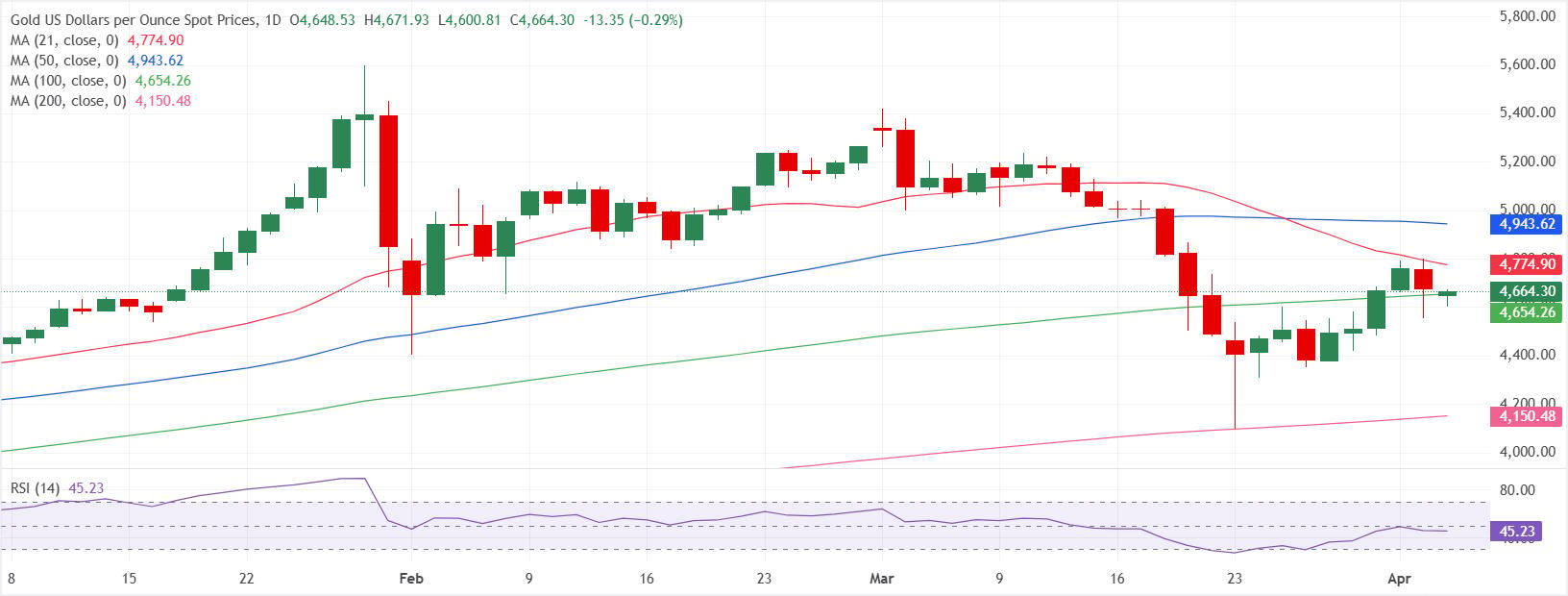
The metal holds a broadly bearish near-term bias as it remains entrenched below the 21-day simple moving average (SMA) at $4,774.95 and the 50-day SMA at $4,943.64, keeping the recent rebound capped within a corrective context. Momentum aligns with this tone, with the Relative Strength Index (14) hovering around 45, suggesting subdued buying interest after the earlier oversold bounce.
On the downside, immediate support is seen at the 100-day SMA near $4,654.27, where a clear break would expose the next, more strategic floor at the 200-day SMA around $4,150.48. On the topside, bulls would need a daily close above the 21-day SMA at $4,774.95 to ease current pressure, with further resistance then anticipated at the 50-day SMA at $4,943.64, which guards a more meaningful recovery phase.
(The technical analysis of this story was written with the help of an AI tool.)
Gold FAQs
Gold has played a key role in human’s history as it has been widely used as a store of value and medium of exchange. Currently, apart from its shine and usage for jewelry, the precious metal is widely seen as a safe-haven asset, meaning that it is considered a good investment during turbulent times. Gold is also widely seen as a hedge against inflation and against depreciating currencies as it doesn’t rely on any specific issuer or government.
Central banks are the biggest Gold holders. In their aim to support their currencies in turbulent times, central banks tend to diversify their reserves and buy Gold to improve the perceived strength of the economy and the currency. High Gold reserves can be a source of trust for a country’s solvency. Central banks added 1,136 tonnes of Gold worth around $70 billion to their reserves in 2022, according to data from the World Gold Council. This is the highest yearly purchase since records began. Central banks from emerging economies such as China, India and Turkey are quickly increasing their Gold reserves.
Gold has an inverse correlation with the US Dollar and US Treasuries, which are both major reserve and safe-haven assets. When the Dollar depreciates, Gold tends to rise, enabling investors and central banks to diversify their assets in turbulent times. Gold is also inversely correlated with risk assets. A rally in the stock market tends to weaken Gold price, while sell-offs in riskier markets tend to favor the precious metal.
The price can move due to a wide range of factors. Geopolitical instability or fears of a deep recession can quickly make Gold price escalate due to its safe-haven status. As a yield-less asset, Gold tends to rise with lower interest rates, while higher cost of money usually weighs down on the yellow metal. Still, most moves depend on how the US Dollar (USD) behaves as the asset is priced in dollars (XAU/USD). A strong Dollar tends to keep the price of Gold controlled, whereas a weaker Dollar is likely to push Gold prices up.
Author
Dhwani Mehta
FXStreet
Residing in Mumbai (India), Dhwani is a Senior Analyst and Manager of the Asian session at FXStreet. She has over 10 years of experience in analyzing and covering the global financial markets, with specialization in Forex and commodities markets.