Gold holds firm as Fed rate outlook, Middle East developments remain in focus
- Gold consolidates on Monday following last week’s strong breakout.
- Traders turn to US inflation data for fresh direction on the Fed’s interest rate path.
- The near-term technical outlook stays bullish, with the 100-day SMA near $4,389 capping immediate gains.

Gold (XAU/USD) struggles to extend gains on Monday as buyers take a breather following last week’s sharp rally, with the broader market theme still centred on the Federal Reserve’s (Fed) interest-rate outlook and developments in the Middle East. At the time of writing, XAU/USD trades around $4,345 after reaching an intraday high of $4,362.
The precious metal gained more than 7% last week and climbed to its highest level since June 17 on Friday. The advance was driven by a dovish repricing of Fed rate-hike expectations following weaker-than-expected US Nonfarm Payrolls (NFP) data. Inflation concerns also eased as Iran and Oman reportedly moved closer to finalising an agreement to reopen the Strait of Hormuz, pushing Oil prices lower.
These developments weighed on the US Dollar (USD) and US Treasury yields, although the downside has been limited as Oil prices remain well above pre-war levels, keeping energy-driven inflation concerns alive.
The US Dollar Index (DXY) is attempting to form a base near a two-month low, trading around 99.70, up 0.10% on the day. Meanwhile, the benchmark 10-year US Treasury yield holds near 4.67%, below its recent peak of around 4.74%, the highest level since January 2025.
According to the CME FedWatch Tool, markets price in around a 44% probability of a rate hike at the September meeting, down from 67% a week earlier.
Attention now turns to the US Consumer Price Index (CPI) data on Wednesday and the Producer Price Index (PPI) on Thursday, as traders look for fresh clues about the Fed’s interest-rate path, which could drive the next moves in the US Dollar and Gold.
Strategists at Brown Brothers Harriman argue that the balance of risks around the upcoming US inflation data is skewed against the US Dollar. They note that “a soft US CPI print would strengthen the case for a dovish repricing in Fed hike expectations and further undermine USD,” while “a hot US CPI print may deliver a knee-jerk USD bounce via higher front-end yields.”
However, BBH cautions that with “Fed policy already restrictive (assuming a neutral rate of 3.00%), the scope for a material hawkish repricing looks limited,” which they see as a lingering “USD headwind.”
On the geopolitical front, US President Donald Trump says Washington is “semi-negotiating” with Tehran while “low-keying” its military campaign. Iran, however, denies holding direct talks. Iran's Foreign Ministry spokesperson Esmaeil Baghaei says security in the Strait of Hormuz depends on an end to military action and compensation for previous attacks.
Technical Analysis: Gold maintains a constructive bullish bias amid firm bullish momentum
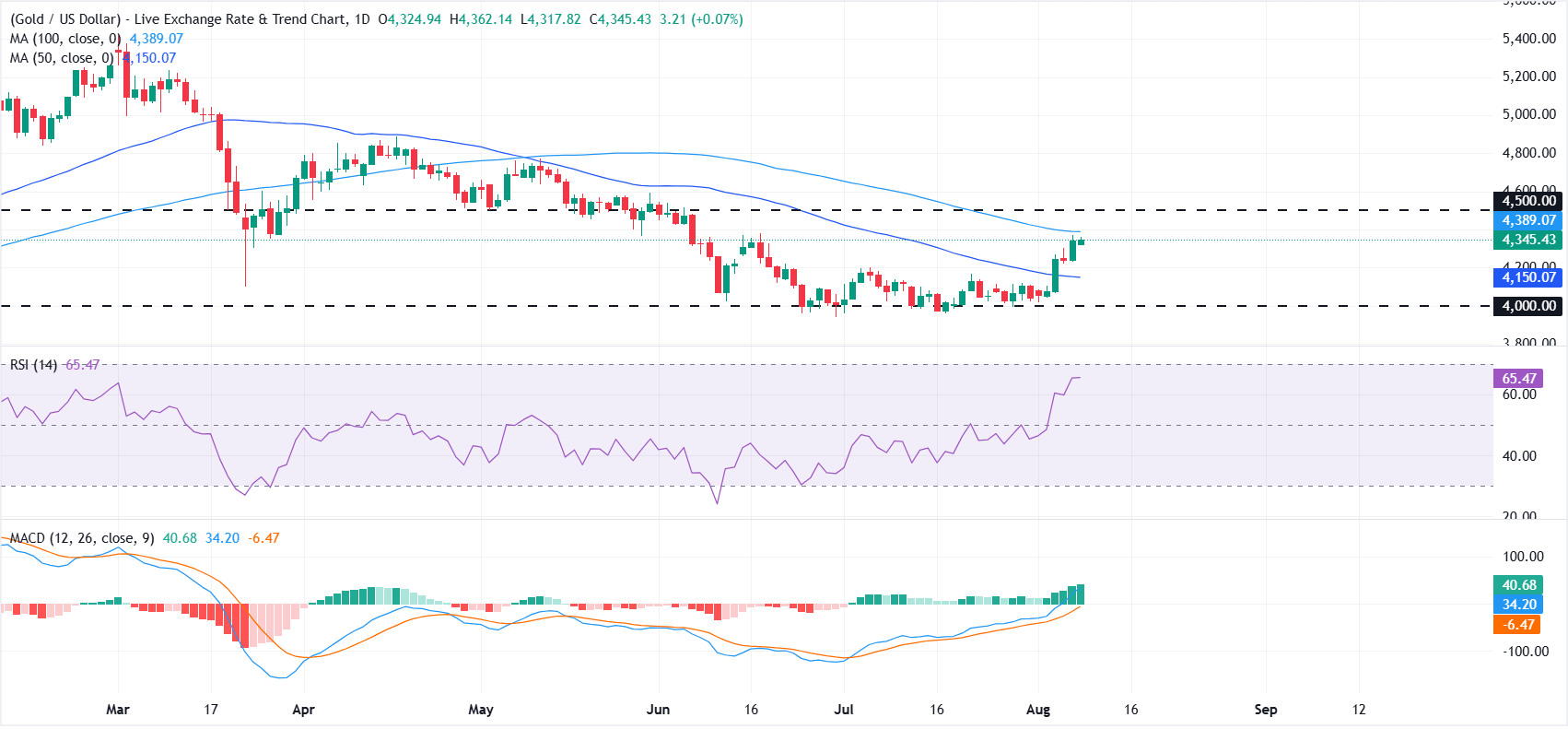
XAU/USD maintains a constructive bullish bias as it holds above the 50-day Simple Moving Average (SMA) near $4,150 while still trading below the 100-day SMA around $4,389. The price action suggests a developing recovery phase, with the Relative Strength Index (RSI) on the daily chart hovering in the mid-60s to hint at firm but not yet overextended upside momentum, while the Average Directional Index (ADX) in the high-20s suggests a moderately strengthening trend.
On the topside, immediate resistance emerges at the 100-day SMA around $4,389, with a subsequent barrier layered higher at the horizontal resistance zone near $4,500. On the downside, initial demand is seen at the 50-day SMA around $4,150, ahead of a more substantial horizontal support shelf near $4,000, where a break would undermine the current bullish tone and expose a deeper corrective phase.
(The technical analysis of this story was written with the help of an AI tool. Know more.)
Gold FAQs
Gold has played a key role in human’s history as it has been widely used as a store of value and medium of exchange. Currently, apart from its shine and usage for jewelry, the precious metal is widely seen as a safe-haven asset, meaning that it is considered a good investment during turbulent times. Gold is also widely seen as a hedge against inflation and against depreciating currencies as it doesn’t rely on any specific issuer or government.
Central banks are the biggest Gold holders. In their aim to support their currencies in turbulent times, central banks tend to diversify their reserves and buy Gold to improve the perceived strength of the economy and the currency. High Gold reserves can be a source of trust for a country’s solvency. Central banks added 1,136 tonnes of Gold worth around $70 billion to their reserves in 2022, according to data from the World Gold Council. This is the highest yearly purchase since records began. Central banks from emerging economies such as China, India and Turkey are quickly increasing their Gold reserves.
Gold has an inverse correlation with the US Dollar and US Treasuries, which are both major reserve and safe-haven assets. When the Dollar depreciates, Gold tends to rise, enabling investors and central banks to diversify their assets in turbulent times. Gold is also inversely correlated with risk assets. A rally in the stock market tends to weaken Gold price, while sell-offs in riskier markets tend to favor the precious metal.
The price can move due to a wide range of factors. Geopolitical instability or fears of a deep recession can quickly make Gold price escalate due to its safe-haven status. As a yield-less asset, Gold tends to rise with lower interest rates, while higher cost of money usually weighs down on the yellow metal. Still, most moves depend on how the US Dollar (USD) behaves as the asset is priced in dollars (XAU/USD). A strong Dollar tends to keep the price of Gold controlled, whereas a weaker Dollar is likely to push Gold prices up.
Author

Vishal Chaturvedi
FXStreet
I am a macro-focused research analyst with over four years of experience covering forex and commodities market. I enjoy breaking down complex economic trends and turning them into clear, actionable insights that help traders stay ahead of the curve.