Gold Price Forecast: XAU/USD looks to all-time highs at $2,956, awaiting US Nonfarm Payrolls
- Gold price sits at one-week highs near $2,930 early Thursday, awaits US data and Trump’s tariff news.
- The US Dollar stays vulnerable to Euro strength and tariff war-led economic concerns.
- Gold price defends 21-day SMA at $2,906 as further upside appears on the cards.


Gold price is sitting at one-week highs near $2,930 early Thursday, consolidating a three-day recovery while aiming for a retest of lifetime highs of $2,956 ahead of mid-tier US economic data releases.
Gold price remains exposed to upside risks, US NFP eyed
Gold price has entered a brief phase of upside consolidation as buyers take a breather before the next leg higher. The buying interest around the bright metal remains unabated amid sustained US Dollar (USD) weakness as increased odds of further interest rate cuts by the Federal Reserve (Fed) due to US economic slowdown concerns.
US President Donald Trump’s tariff war is expected to increase inflation, rekindling stagflation fears.
Even though Trump announced a one-month pause on the auto tariffs while considering agricultural exemptions on Canada and Mexico, the USD sellers refuse to give up amid a recent series of dismal US economic data and a relentless surge in the EUR/USD pair.
Data released by the ADP Research showed on Wednesday that the US private sector added 77K jobs in February after creating 186K jobs in January. The data missed the expectations of 140K by a wide margin. However, the Institute for Supply Management (ISM) Services PMI rose to 53.5 in February, exceeding forecasts for 52.6. The ISM Services Employment Index jumped to 53.9 in February from 52.3 in January.
The Euro (EUR) jumped to a four-month high against the USD, tracking the rally in the German bund yields after German political parties agreed on a massive spending plan to support the Eurozone’s biggest economy. Surging German bund yields drove global yields higher, including the US Treasury bond yields, capping the Gold price recovery.
Gold traders now eagerly await Friday’s Nonfarm Payrolls (NFP) data to assess the Fed’s easing trajectory amid growing trade tensions between the US and its trading partners.
In the meantime, the mid-tier US Jobless Claims data and further developments on the tariffs front by the Trump administration will be closely followed for any impact on the USD performance and the Gold price action.
The upcoming European Central Bank (ECB) policy decision could curb the EUR/USD rally, fuelling a fresh US Dollar rebound. In such a scenario, Gold price could see a corrective move lower, which could also be seen as a profit-taking decline ahead of the all-important US payrolls data on Friday.
Gold price technical analysis: Daily chart
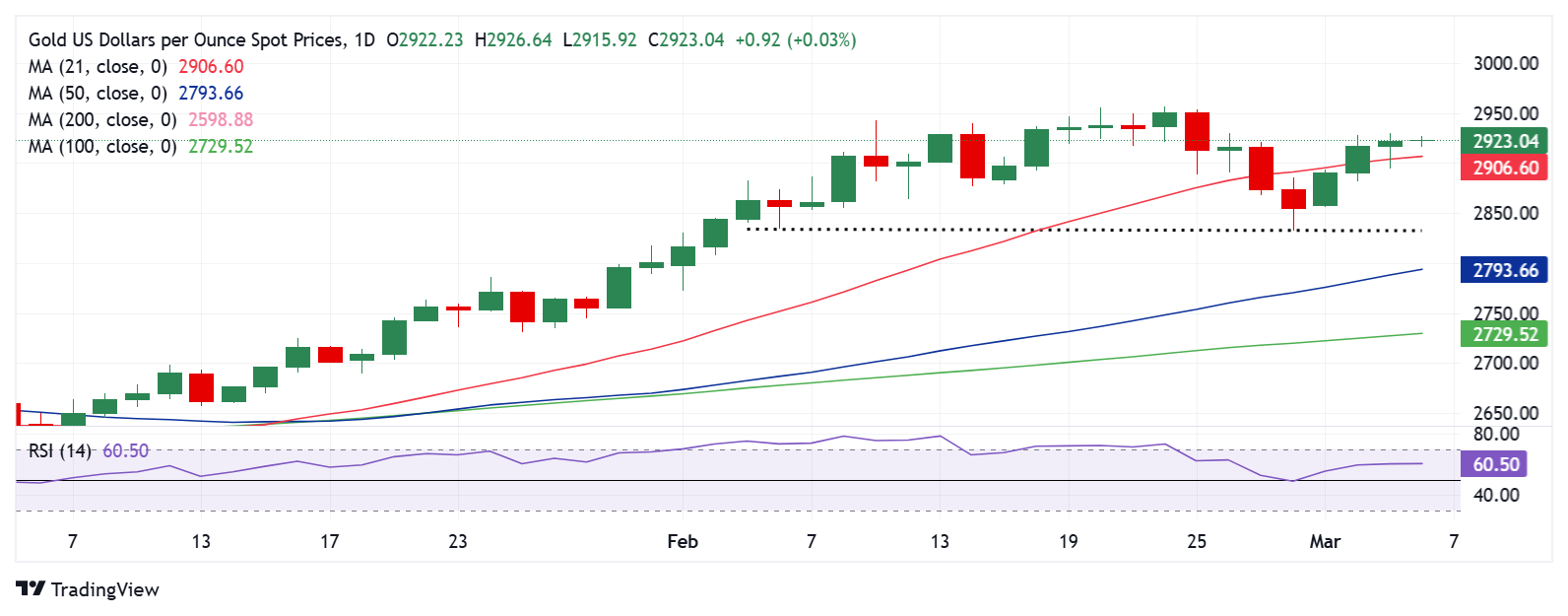
The short-term technical outlook for Gold price remains more or less the same as long as it defends the 21-day Simple Moving Average (SMA) of $2,906.
The uptrend could regain traction only on acceptance above the $2,930 static resistance on a daily candlestick closing basis.
The Relative Strength Index (RSI) has turned slightly lower but holds well above the 50 level, suggesting that the bullish potential remains in place.
If the February 26 high of $2,930 is taken out sustainably, the next topside barriers are at an all-time high of $2,956 and the $2,970 round level.
If sellers fight back control, immediate support is seen at the 21-day SMA at $2,906, below which the $2,850 psychological barrier will be challenged.
The $2,835 demand area will then come into play.
(This story was corrected on March 6 at 07:30 GMT to say that "Gold price defends 21-day SMA at $2,906, not $2,903.7 )
Gold FAQs
Gold has played a key role in human’s history as it has been widely used as a store of value and medium of exchange. Currently, apart from its shine and usage for jewelry, the precious metal is widely seen as a safe-haven asset, meaning that it is considered a good investment during turbulent times. Gold is also widely seen as a hedge against inflation and against depreciating currencies as it doesn’t rely on any specific issuer or government.
Central banks are the biggest Gold holders. In their aim to support their currencies in turbulent times, central banks tend to diversify their reserves and buy Gold to improve the perceived strength of the economy and the currency. High Gold reserves can be a source of trust for a country’s solvency. Central banks added 1,136 tonnes of Gold worth around $70 billion to their reserves in 2022, according to data from the World Gold Council. This is the highest yearly purchase since records began. Central banks from emerging economies such as China, India and Turkey are quickly increasing their Gold reserves.
Gold has an inverse correlation with the US Dollar and US Treasuries, which are both major reserve and safe-haven assets. When the Dollar depreciates, Gold tends to rise, enabling investors and central banks to diversify their assets in turbulent times. Gold is also inversely correlated with risk assets. A rally in the stock market tends to weaken Gold price, while sell-offs in riskier markets tend to favor the precious metal.
The price can move due to a wide range of factors. Geopolitical instability or fears of a deep recession can quickly make Gold price escalate due to its safe-haven status. As a yield-less asset, Gold tends to rise with lower interest rates, while higher cost of money usually weighs down on the yellow metal. Still, most moves depend on how the US Dollar (USD) behaves as the asset is priced in dollars (XAU/USD). A strong Dollar tends to keep the price of Gold controlled, whereas a weaker Dollar is likely to push Gold prices up.
Author
Dhwani Mehta
FXStreet
Residing in Mumbai (India), Dhwani is a Senior Analyst and Manager of the Asian session at FXStreet. She has over 10 years of experience in analyzing and covering the global financial markets, with specialization in Forex and commodities markets.