Gold Price Forecast: XAU/USD finds temporary floor near $3,850, downside risks persist
- Gold price gains a temporary ground after posting a fresh 13-month low near $3,850.
- ANZ warns that the Fed could deliver a 50 bps interest rate hike in December.
- Renewed risks of Middle East conflicts have de-anchored inflation expectations again.

Gold rises almost 0.9% to near $3,915 in the early trade on Friday after posting a fresh 13-month low near $3,850 the previous day. The recovery move in the Gold price after a massive decline in the past few days started Tuesday appears to be short-lived as several headwinds are boosting bears to keep up the dominance.
According to analysts at ANZ, Gold's break below $3,900 is linked to rising energy costs, stronger economic data, higher bond yields and a dollar above 103, all of which have weakened investment demand.
What happened on November 10, Tuesday?
The comments from Federal Reserve (Fed) Governor Christopher Waller before the release of the United States (US) Consumer Price Index (CPI) data for October that the central bank could go for a bigger interest rate hike in the December meeting if core inflation grows 0.3% Month-on-Month (MoM) or higher led to carnage in the Gold price.
Fed’s Waller delivered a notably more hawkish tone on Tuesday, with a 9/10 FXS Speechtracker score standing well above the 7.3/10 historical average, underscoring a clear shift toward tighter policy bias. The conditional endorsement of a half-point December rate hike if October core CPI prints at 0.3% or higher, alongside support for a quarter-point hike even on better inflation data, signals a strong reaction function to any sign that inflation is drifting away from target. Emphasis on the breadth of price increases, insufficient restrictiveness of current policy, and the need for higher real rates reinforces upside risks for U.S. yields and supports the Dollar, while Waller’s downbeat view on near-term AI-driven productivity gains suggests limited relief from supply-side disinflation.
The FXS Fed Sentiment Index rose by 3.17 points to 145.50, firmly in hawkish territory and consistent with the elevated FXS Speechtracker reading. This move confirms that Fed communication is skewing more aggressively toward further tightening, a backdrop that should keep Dollar supported and weigh on risk-sensitive currencies as markets reprice December hike probabilities.
On top of that, the report showing a faster-than-expected growth in the core CPI at 0.3% did the rest. Financial markets started taking the possibility of 50 basis points (bps) interest rate hike in the December meeting into consideration. However, the CME FedWatch tool shows that the possibility of a fat rate hike next month is just 11%.
Regarding Fed’s monetary policy decision in December, ANZ warned that “the Fed could even go for 50bp rate hikes in December”, adding that the economic resilience reinforces the case of aggressive tightening.
Renewed Middle East tensions de-anchor inflation expectations again
The remarks from US President Donald Trump that he won’t hesitate in launching fresh military attacks on Iran again after threats of executing US officials have revived fears of aggression in the Middle East.
Meanwhile, threats from Iran’s Foreign Ministry spokesperson Esmaeil Baghaei that countries providing military or logistical support for US operations against Tehran would be considered participants in Washington’s aggression have also fanned fears of fresh military campaign by both economies.
The renewal of military aggression between the US and Iran could prompt energy supply risks again, a scenario that accelerates inflation expectations and fears of prolonged monetary tightening by global central banks. Such a case bodes poorly for non-yielding assets, like Gold.
Gold Technical Analysis
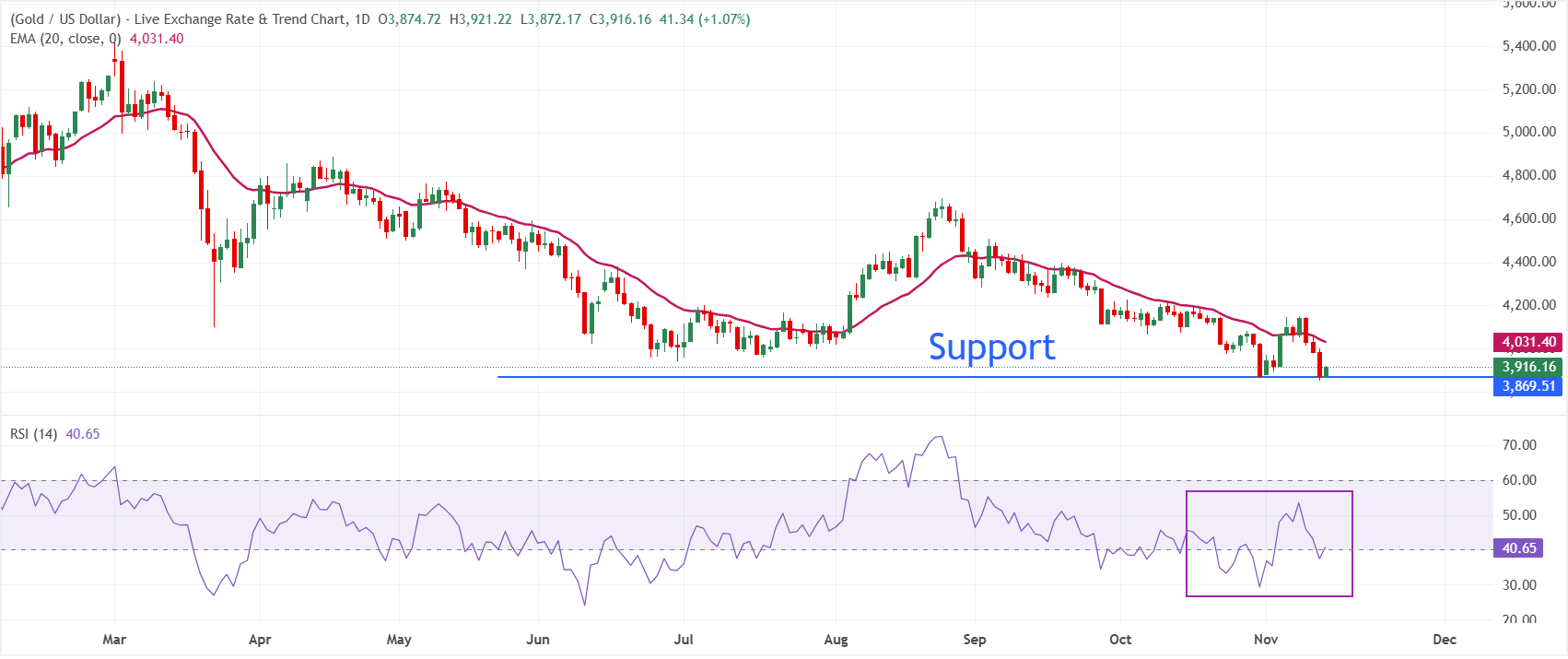
In the daily chart, XAU/USD rebounds to near $3,916.10, but is retaining a bearish near-term tone as it remains under the 20-day exponential moving average (EMA) at $4,031.39. The price action below this short-term trend marker suggests rallies are still being capped, while the Relative Strength Index (14) at 40.64 stays below the neutral 50 line, hinting at persistent but not extreme selling pressure.
On the topside, initial resistance is defined by the 20-day EMA at $4,031.39, and a daily close above this barrier would be needed to ease the current downside bias and open the way for a stronger recovery phase. Looking down, the Gold price would be exposed to $3,800 and $3,700 if it fails to hold the immediate support at $3,850.
(The technical analysis of this story was written with the help of an AI tool. Know more.)
Gold FAQs
Gold has played a key role in human’s history as it has been widely used as a store of value and medium of exchange. Currently, apart from its shine and usage for jewelry, the precious metal is widely seen as a safe-haven asset, meaning that it is considered a good investment during turbulent times. Gold is also widely seen as a hedge against inflation and against depreciating currencies as it doesn’t rely on any specific issuer or government.
Central banks are the biggest Gold holders. In their aim to support their currencies in turbulent times, central banks tend to diversify their reserves and buy Gold to improve the perceived strength of the economy and the currency. High Gold reserves can be a source of trust for a country’s solvency. Central banks added 1,136 tonnes of Gold worth around $70 billion to their reserves in 2022, according to data from the World Gold Council. This is the highest yearly purchase since records began. Central banks from emerging economies such as China, India and Turkey are quickly increasing their Gold reserves.
Gold has an inverse correlation with the US Dollar and US Treasuries, which are both major reserve and safe-haven assets. When the Dollar depreciates, Gold tends to rise, enabling investors and central banks to diversify their assets in turbulent times. Gold is also inversely correlated with risk assets. A rally in the stock market tends to weaken Gold price, while sell-offs in riskier markets tend to favor the precious metal.
The price can move due to a wide range of factors. Geopolitical instability or fears of a deep recession can quickly make Gold price escalate due to its safe-haven status. As a yield-less asset, Gold tends to rise with lower interest rates, while higher cost of money usually weighs down on the yellow metal. Still, most moves depend on how the US Dollar (USD) behaves as the asset is priced in dollars (XAU/USD). A strong Dollar tends to keep the price of Gold controlled, whereas a weaker Dollar is likely to push Gold prices up.
Author

Sagar Dua
FXStreet
Sagar Dua is associated with the financial markets from his college days. Along with pursuing post-graduation in Commerce in 2014, he started his markets training with chart analysis.