Gold Price Forecast: XAU/USD consolidates before resuming the record rally
- Gold price remains in a bullish consolidation phase below all-time highs early Monday.
- US Treasury yields rebound offsets US Dollar decline, leaving Gold price in a familiar range.
- Gold price needs acceptance above $2,935 resistance on the 4H chart for further upside.

Gold price extends its consolidative mode into a second consecutive day on Monday, having struggling near record highs of $2,955 set last Thursday. Gold traders remain cautious amid lingering tariff threats from US President Donald Trump while bracing for the US inflation data due later this week.
Gold price trades with caution as new week kicks in
Gold price is unable to attract any haven demand in Asian trading on Monday as Asian markets seem to have shrugged off Friday’s Wall Street sell-off in the face of renewed hopes surrounding the second round of US-Russia peace talks to end the Ukraine conflict.
Russian Deputy Foreign Minister Sergei Ryabkov said over the weekend that the next meeting on a likely peace deal will be at the level of heads of departments and not at deputy foreign minister level,
Additionally, China rolled out fresh rural revitalization measures in its annual rural policy blueprint for 2025, known as the “No.1 document”, on Sunday, lifting the market sentiment at the start of the week.
Furthermore, markets cheer for better Euro area economic prospects and fiscal reforms after Germany’s Conservative Party won the national elections on Sunday.
Risk appetite is diminishing the appeal of safe-haven assets such as the Gold price and US government bonds, fuelling a comeback in the US Treasury bond yields across the curve.
However, a broadly weaker US Dollar (USD), courtesy of the German election results-led EUR/USD rally, cushions the Gold price downside.
The bright metal could also draw support from increased expectations of two interest rate cuts by the US Federal Reserve (Fed) this year, affirmed by the US Composite Flash PMI Output Index, which fell from 52.7 in January to 50.4, a 17-month low.
The weak PMI data for February rekindled worries over the US economic outlook amid uncertainty over trade policies and potential inflationary pressures.
Looking ahead, the focus remains on the US-Russia meeting, chances of any fresh tariff threats from Trump and US economic data releases this week for fresh directional impetus in Gold price.
In the meantime, Gold buyers could continue to derive strength from favorable technical setup on the four-hour timeframe and the sustained US Dollar weakness.
Gold price technical analysis: Four-hour chart
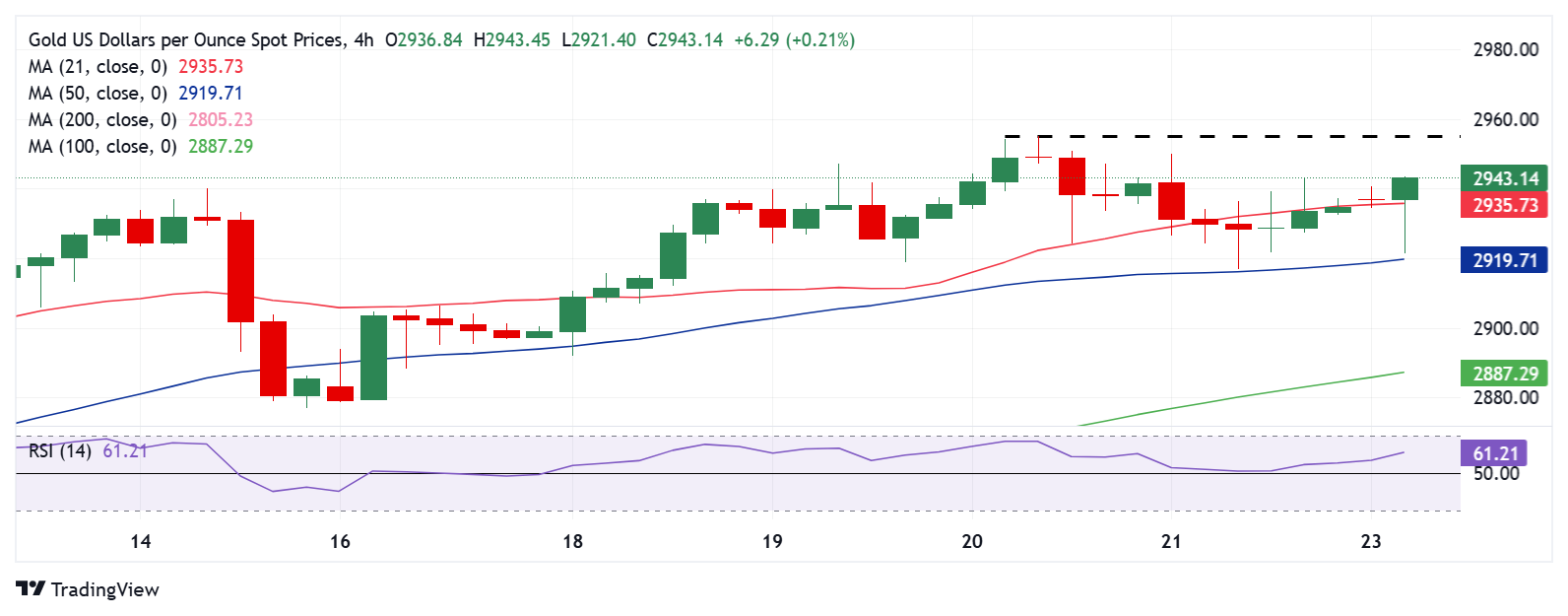
Having found support at the 50- four hourly Simple Moving Average (SMA) at $2,920 on several occasions, Gold price must seek a sustained move above the 21-four hourly SMA at $2,935 on a candlestick closing basis to resume the record rally.
The Relative Strength Index (RSI) points north above the midline, currently near 60, suggesting more room to the upside.
Recapturing $2,935 convincingly could open doors for a retest of the record high at $2,955, above which the $2,970 resistance will come into play.
Conversely, if buyers face exhaustion at higher levels, the 50-four hourly SMA at $2,920 will be challenged again, with the downside opening toward the $2,900 round level on a failure to defend that key support.
The February 14 low of $2,877 will be the line in the sand for Gold optimists.
Gold FAQs
Gold has played a key role in human’s history as it has been widely used as a store of value and medium of exchange. Currently, apart from its shine and usage for jewelry, the precious metal is widely seen as a safe-haven asset, meaning that it is considered a good investment during turbulent times. Gold is also widely seen as a hedge against inflation and against depreciating currencies as it doesn’t rely on any specific issuer or government.
Central banks are the biggest Gold holders. In their aim to support their currencies in turbulent times, central banks tend to diversify their reserves and buy Gold to improve the perceived strength of the economy and the currency. High Gold reserves can be a source of trust for a country’s solvency. Central banks added 1,136 tonnes of Gold worth around $70 billion to their reserves in 2022, according to data from the World Gold Council. This is the highest yearly purchase since records began. Central banks from emerging economies such as China, India and Turkey are quickly increasing their Gold reserves.
Gold has an inverse correlation with the US Dollar and US Treasuries, which are both major reserve and safe-haven assets. When the Dollar depreciates, Gold tends to rise, enabling investors and central banks to diversify their assets in turbulent times. Gold is also inversely correlated with risk assets. A rally in the stock market tends to weaken Gold price, while sell-offs in riskier markets tend to favor the precious metal.
The price can move due to a wide range of factors. Geopolitical instability or fears of a deep recession can quickly make Gold price escalate due to its safe-haven status. As a yield-less asset, Gold tends to rise with lower interest rates, while higher cost of money usually weighs down on the yellow metal. Still, most moves depend on how the US Dollar (USD) behaves as the asset is priced in dollars (XAU/USD). A strong Dollar tends to keep the price of Gold controlled, whereas a weaker Dollar is likely to push Gold prices up.
Author

Dhwani Mehta
FXStreet
Residing in Mumbai (India), Dhwani is a Senior Analyst and Manager of the Asian session at FXStreet. She has over 10 years of experience in analyzing and covering the global financial markets, with specialization in Forex and commodities markets.
















