Two Burnhams, One Budget: The Pound trades the gap between promise and premise
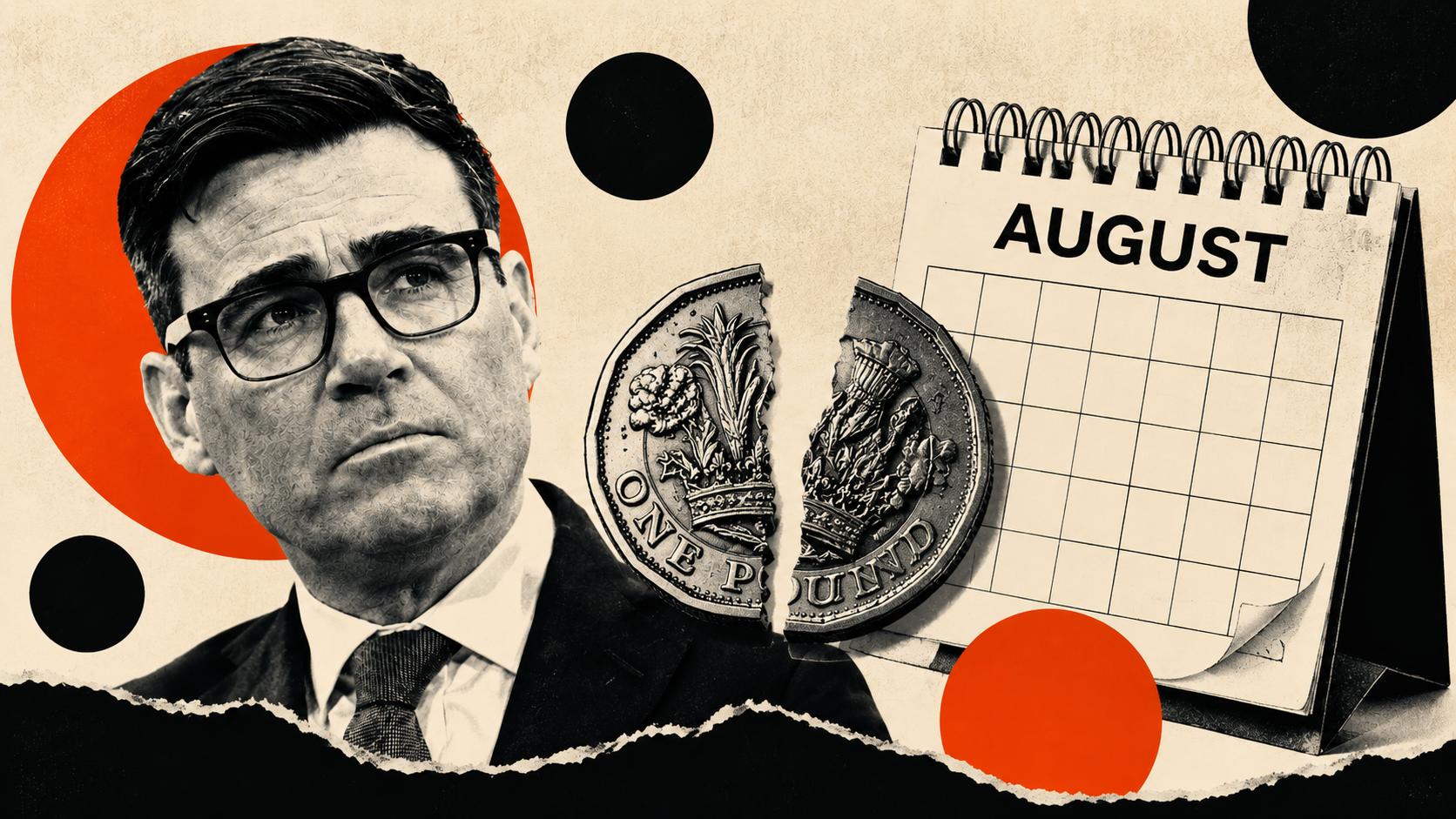
One month ago, this column left an open question hanging. The iceberg that drove the spring Gilt sell-off was drifting away, the credibility premium was the only layer Westminster could actually steer, and nobody knew how big the new government would let it grow. On Monday the question got its owner. Andy Burnham walked into Downing Street as Britain's seventh prime minister in a decade, recommitted to the incumbent fiscal rules, and promised in the same breath to use every inch of give inside them.
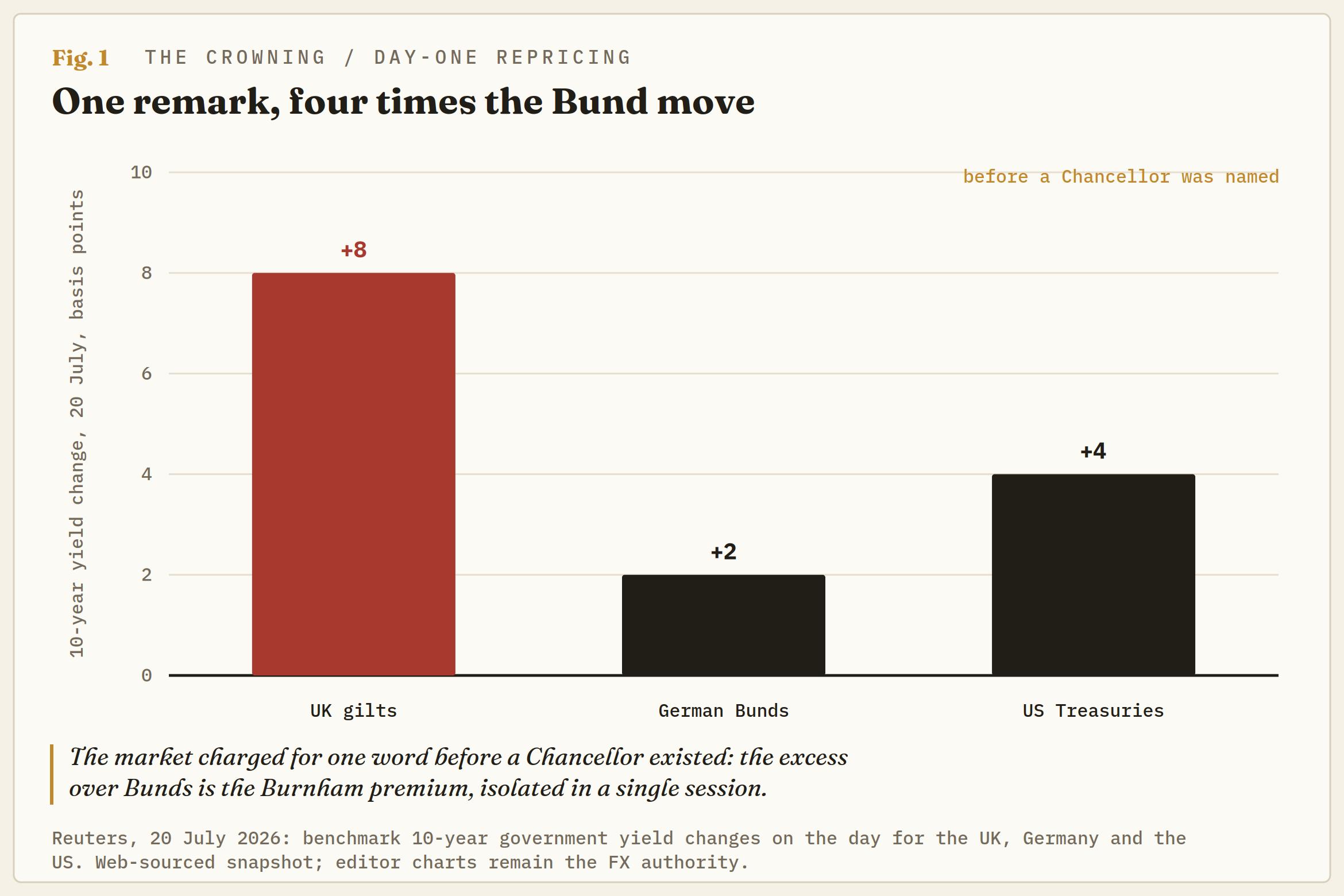
He had not yet named a Chancellor. The Gilt market did not wait for one.
A crowning without a contest
The route matters because of what it skipped. Labour lost a February by-election on Burnham's home turf, then a disastrous set of May locals, and the party cleared the Manchester mayor to fight his way back into Parliament through a summer by-election he duly won. Starmer initially signalled he would contest any challenge, then resigned.
The one heavyweight rival who spent weeks insisting he had the numbers stood down within days and has since resurfaced holding the Defence brief. What Britain got was a coronation, and a coronation skips the stress test.
There was no contest to force the platform through scrutiny, no manifesto priced line by line by opponents, no costings document for the market to mark, and betting desks keep a live tail on the new man seeking his own mandate early. The first fully specified statement of what this government intends is the budget pencilled for October. Until then, the premium prices words, and Monday showed the going rate: one remark about working the rules to their limits moved a bond market that had spent a month waiting to hear exactly that.
Two Burnhams, one budget
The market's deeper problem is that there are two of him on the record. The September Burnham told an interviewer the country had to get beyond being beholden to the bond market, floated bringing key industries into public hands, and backed a 50% top rate of income tax. Gilts sold off on those remarks at the time, and the tape has not forgotten.
The July Burnham has recommitted to the rules and the tax lock, argues that public control of essential services lowers the state's long-run costs, and insists his approach, the one he brands Manchesterism, is precisely what should reassure investors. Both are him. Neither has been tested by office.
The cabinet was the first hard evidence, and it reads two ways, which is the point. John Healey at the Treasury looks like the safe pair of hands, a veteran of Treasury jobs under Blair and Brown. He is also the man who resigned the Defence post in June because he thought the budget was too small, a resignation that helped push Starmer out, and the stated logic of his appointment is that he shares the new Prime Minister's outlook. Wes Streeting, who made the same spending argument from outside, now holds the Defence budget Healey wanted.
Yvette Cooper has been handed the social care overhaul Burnham calls his top priority, a reform with a multi-billion-Pound price tag attached before design work begins. Angela Rayner returns to Housing for the council house-building push, and the energy brief goes to Miatta Fahnbulleh, the economist who has been drafting his plans, tasked with moving utilities toward public control. Read charitably, it is experience. Read literally, every senior appointment is a person whose brief is to spend.
The headroom that wasn't
Day one also produced the first giveaway: value-added tax (VAT) comes off domestic electricity bills from 1 October, with income-tax threshold rises floated alongside and a pledge to end rough sleeping on top. The arithmetic those promises land on is thin. The roughly £20 billion of headroom marked at the spring forecast was, by the fiscal watchdog's own signalling, stale even as it was being presented, priced before the war repriced everything.
That makes it a fourth entry in the born-stale series this publication has tracked all year: the Federal Reserve (Fed) June Minutes, the Bank of Canada's July projection, June's US CPI, and now a British forecast overtaken between drafting and delivery. May borrowing overshot the official forecast by £5.6 billion, and independent analysts put the debt-interest cost of higher rates alone at more than £5 billion. The tax lock, re-committed, shuts the big revenue doors.
Which leaves exactly one lever, and it is the one the market heard him reach for on Monday. Give inside the rules. Off-balance-sheet vehicles for public investment. A Defence carve-out already floated.
None of it breaks the letter of the framework. All of it moves borrowing toward the limit of what investors will tolerate, and Burnham has said in terms that testing the limit is the plan. The one genuine tailwind he inherited is inflation: the June Consumer Prices Index (CPI) eased to 2.6% from 2.8%, core held at 2.6%, and services ticked down to 3.6%.
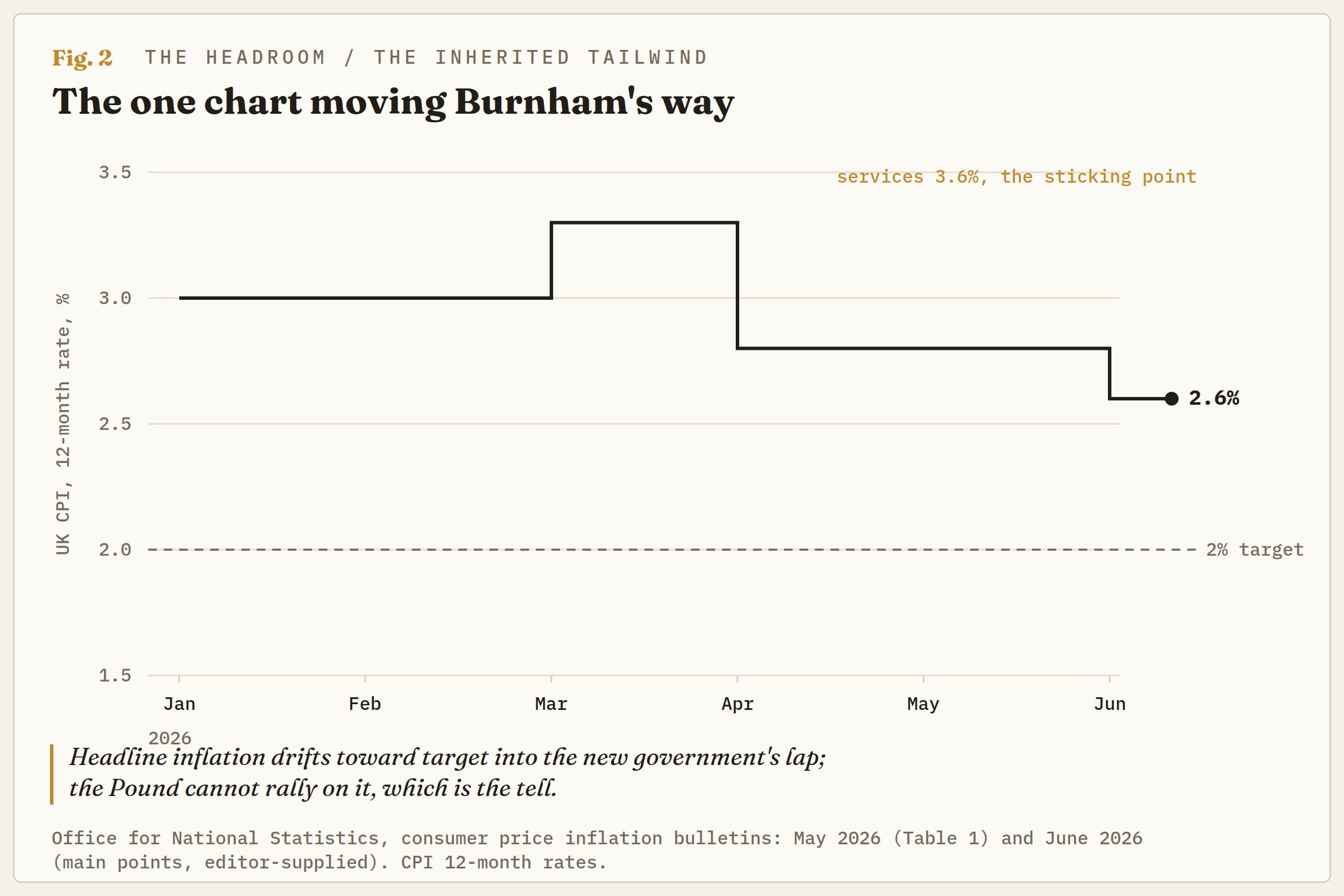
That print trims the near-term hike case at the Bank of England (BoE), hands the Treasury a friendlier Gilt backdrop than the spring, and gives the new government cover it did nothing to earn. The Pound still cannot rally on it. When a currency ignores its own good news, it is telling you what it is actually pricing.
Drilling through a war
The energy file shows the same two-Burnhams split in miniature. Within days his team moved to fast-track the two blocked Scottish fields, Rosebank and Jackdaw, and to expand drilling tied back to existing fields, while holding the manifesto ban on new exploration licences. Washington cast the shift as a full reopening of the North Sea, which flatters the policy considerably.
The economically live decision is the windfall levy on producers, the Energy Profits Levy (EPL), and it lands squarely in the October budget: extend it and the investment case for the fields he just unblocked erodes, soften it and the revenue hole widens just as the spending list grows.
For the Pound, the field approvals themselves are noise. The levy treatment is a tell, and the war is the backdrop the whole trade lives in. The US Dollar side of the pair carries a war bid and higher US yields, which means the Pound needs domestic good news simply to stand still, and the domestic news is currently a new government talking about flexibility.
The tape is offered
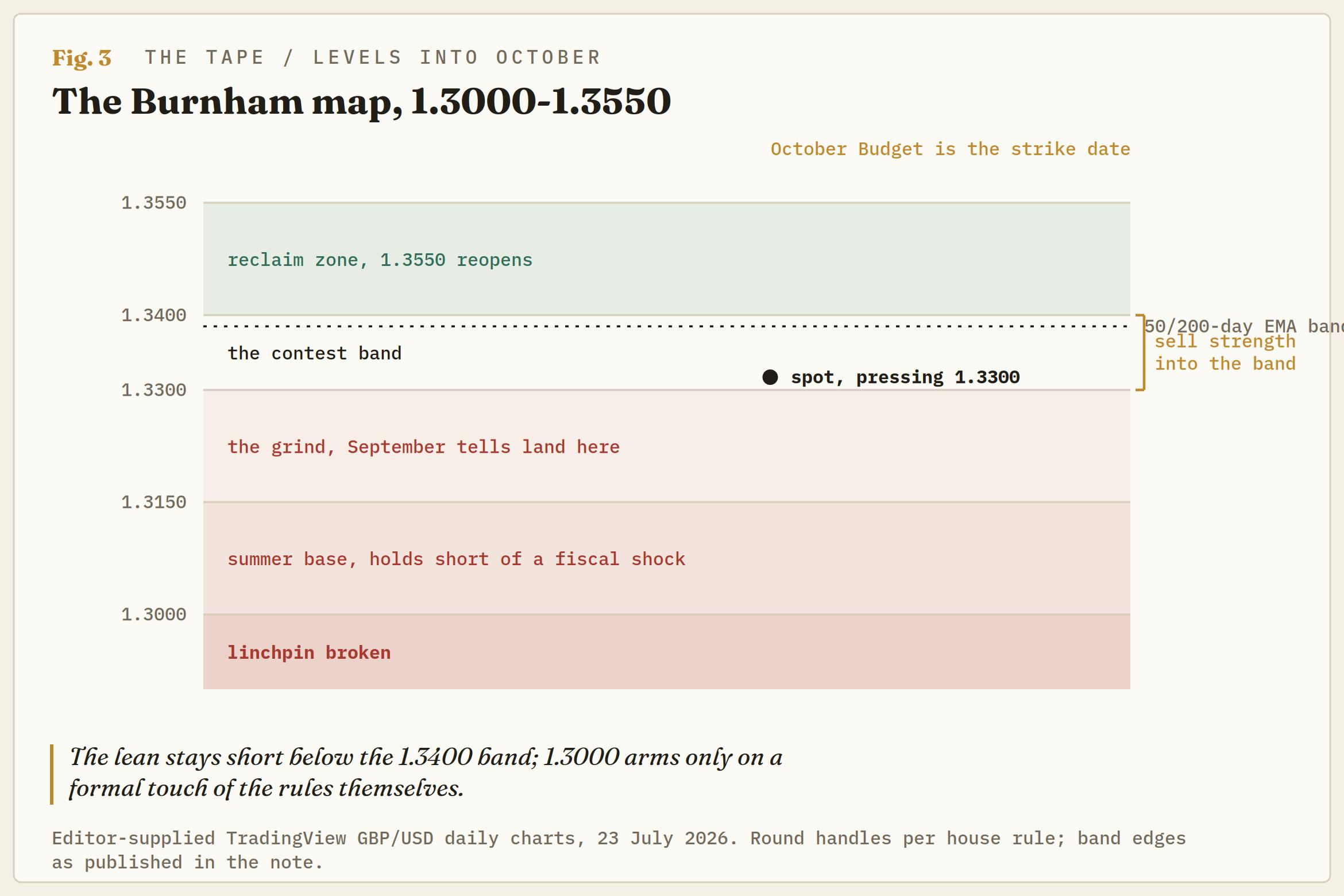
The chart says the market is not waiting for October to lean. The mid-July squeeze to 1.3550 has fully unwound. The pair failed at the moving-average band just under 1.3400, where the 50-day and 200-day Exponential Moving Averages (EMAs) have converged into a single ceiling, and both now sit overhead.
The Pound trades near 1.3300, down roughly 0.4% on the day, roughly 4% below the February peak. The daily Stochastic is rolling down through the middle of its range, so momentum sits with the bears without being stretched: there is room below before anything looks washed out.
The map is the June framework with fresher paint. First support is 1.3300, in test as this files. Beneath it sits the summer base at 1.3150, the floor the pair built in late June and the level that should hold anything short of a genuine fiscal shock. Then 1.3000, the linchpin this column promoted in June as the regime threshold, the level where the market stops extending the benefit of the doubt on fiscal credibility and starts charging for it. Topside, nothing changes the lean until the pair puts in daily closes back above 1.3400. Do that and the band flips back to floor, 1.3550 reopens, and the Burnham premium starts deflating.
The Burnham trade
Into October the desk view is a fade, built on five lines.
- The base case: the premium builds while the budget is unwritten. Strength into the 1.3400 band is for selling, and rallies need a catalyst the calendar does not currently offer.
- The tells: four budget-adjacent decisions will pick which Burnham shows up. The Energy Profits Levy’s (EPL) treatment. The compensation mechanics on any water or energy transfer into public hands. How the off-balance-sheet investment vehicles are classified. Whether the Defence carve-out is formalised. Each one resolved the September way is a leg toward 1.3150.
- The linchpin: 1.3000 arms only on a formal touch of the rules themselves. Anything less and the summer base at 1.3150 should hold. A rewrite, a redefinition, or a carve-out dressed as a technicality puts the big figure in play, and the 2022 playbook says the move would not be orderly.
- The invalidation: daily closes back above 1.3400. The route there is a budget that keeps the lock, banks the CPI cover, and outsources restraint to the Treasury veteran. That route exists, which is exactly why the tells matter more than the speeches.
- The calendar: the BoE on July 30, one day behind the Fed, is the first scheduled test, a hold priced with the residual hike pushed toward autumn and a fresh forecast round attached. The pattern to watch from here to October is Gilt yields and the Pound falling together. That combination has one name in this market, and it’s the one every Chancellor since 2022 has organised his life around avoiding.
Two men share one name and one address. The October budget decides which of them the market has been pricing since Monday.
Author

Joshua Gibson
FXStreet
Joshua joins the FXStreet team as an Economics and Finance double major from Vancouver Island University with twelve years' experience as an independent trader focusing on technical analysis.

















