Gold Price Forecast: A XAU/USD rebound appears in the offing
- Gold price consolidates a three-day correction but defends $3,000 early Tuesday.
- The US Dollar turns south with US Treasury yields as tariff anxiety returns ahead of data and Fed speak.
- Gold price finds buyers again at $3,000; a move back toward $3,050 likely?

Gold price is licking its wounds early Tuesday, consolidating the three-day correction while defending the $3,000 mark. Further downside in the Gold price appears elusive as investors remain wary amid mixed news on US President Donald Trump’s tariffs, awaiting the outcome of Monday’s US-Russia talks on the Ukraine ceasefire deal.
Gold price looks to US tariffs and Ukraine updates
Additionally, the US Conference Board (CB) Consumer Confidence data will also be closely watched alongside speeches from two US Federal Reserve (Fed) permanent voting members, Governor Adriana Kugler and New York President John Williams, for the next directional move in Gold price.
A lack of clarity on the likely US tariffs combined with the market’s nervousness on the prospects of a long-term Russia-Ukraine ceasefire revive the safe-haven demand for Gold price, pausing the US Dollar (USD) recovery momentum.
Asian stocks have turned lower after Chinese indices remain on the defensive due to the rising threat of US tariffs and worries over domestic growth.
On Monday, the US Dollar extended its recovery mode alongside a positive shift in risk sentiment, driven by increased expectations of narrower-than-feared Trump tariffs. Additionally, hawkish comments from Atlantic Fed President Raphael Bostic and strong US S&P Global preliminary business PMI aided the Greenback’s rebound, weighing negatively on the USD-denominated Gold price.
Bostic backed away from the idea of two rate cuts this year and said on Monday that he only sees one rate cut in 2025. Meanwhile, S&P Global flash US Composite PMI Output Index, which tracks the manufacturing and services sectors, jumped to 53.5 this month from 51.6 in February.
Gold price technical analysis: Daily chart
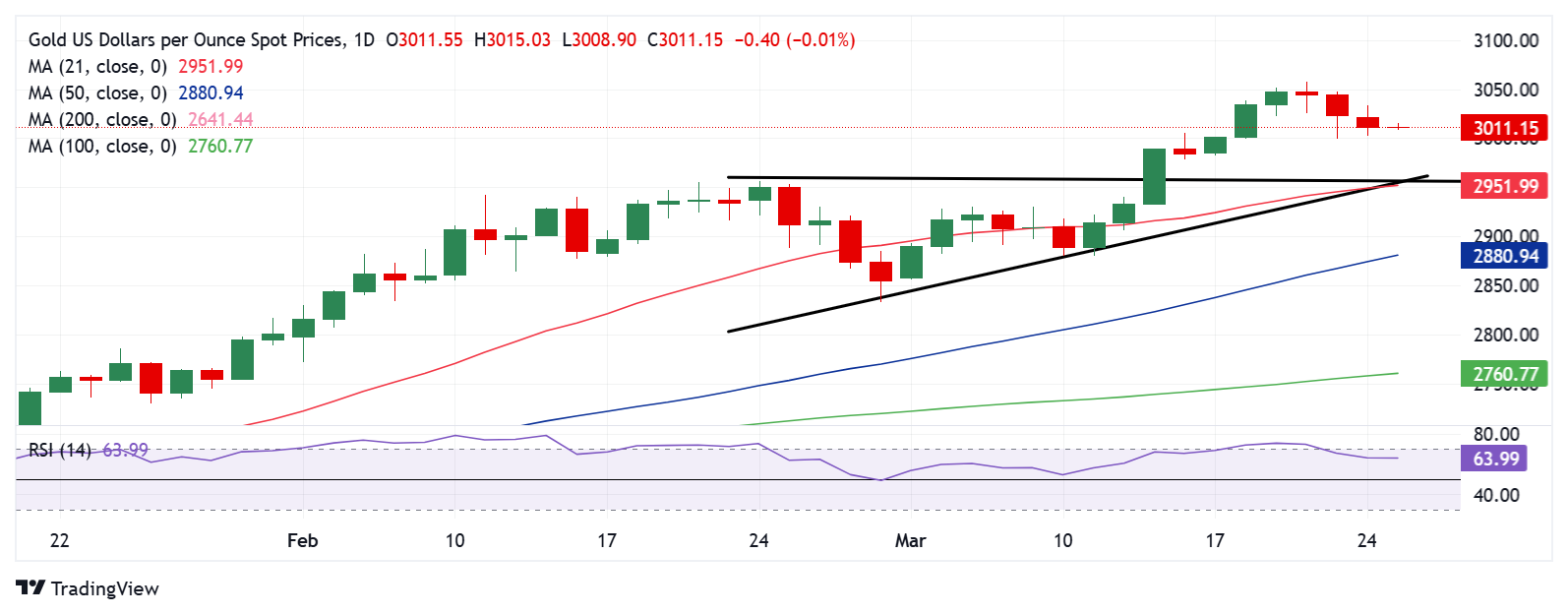
The short-term technical outlook for the Gold price remains unchanged, with a ‘buy-the-dips’ trading strategy likely to extend following the confirmed breakout from the ascending triangle earlier this month.
The 14-day Relative Strength Index (RSI) has paused its descent, currently near 64, suggesting that Gold price could resume its upward trajectory toward record highs.
If buyers jump back into the game, Gold price could retest the record high of $3,058. The door will then open to test the triangle target, which was measured at $3,080.
On the flip side, Gold price could test Friday’s low of $3,000 should the downside regain traction. The next support is aligned at the previous week’s low of $2,982.
Further south, the 21-day Simple Moving Average (SMA) and the triangle support confluence at $2,952 will be a tough nut to crack for sellers.
Gold FAQs
Gold has played a key role in human’s history as it has been widely used as a store of value and medium of exchange. Currently, apart from its shine and usage for jewelry, the precious metal is widely seen as a safe-haven asset, meaning that it is considered a good investment during turbulent times. Gold is also widely seen as a hedge against inflation and against depreciating currencies as it doesn’t rely on any specific issuer or government.
Central banks are the biggest Gold holders. In their aim to support their currencies in turbulent times, central banks tend to diversify their reserves and buy Gold to improve the perceived strength of the economy and the currency. High Gold reserves can be a source of trust for a country’s solvency. Central banks added 1,136 tonnes of Gold worth around $70 billion to their reserves in 2022, according to data from the World Gold Council. This is the highest yearly purchase since records began. Central banks from emerging economies such as China, India and Turkey are quickly increasing their Gold reserves.
Gold has an inverse correlation with the US Dollar and US Treasuries, which are both major reserve and safe-haven assets. When the Dollar depreciates, Gold tends to rise, enabling investors and central banks to diversify their assets in turbulent times. Gold is also inversely correlated with risk assets. A rally in the stock market tends to weaken Gold price, while sell-offs in riskier markets tend to favor the precious metal.
The price can move due to a wide range of factors. Geopolitical instability or fears of a deep recession can quickly make Gold price escalate due to its safe-haven status. As a yield-less asset, Gold tends to rise with lower interest rates, while higher cost of money usually weighs down on the yellow metal. Still, most moves depend on how the US Dollar (USD) behaves as the asset is priced in dollars (XAU/USD). A strong Dollar tends to keep the price of Gold controlled, whereas a weaker Dollar is likely to push Gold prices up.
Author

Dhwani Mehta
FXStreet
Residing in Mumbai (India), Dhwani is a Senior Analyst and Manager of the Asian session at FXStreet. She has over 10 years of experience in analyzing and covering the global financial markets, with specialization in Forex and commodities markets.