Gold Price Forecast: $1,935 holds the key for XAU/USD as King dollar reigns supreme
- Gold bulls give into the bearish pressures on hopes for diplomacy on the Ukraine crisis.
- The US dollar dominates amid hawkish Fed’s outlook and Ukraine, coronavirus-led risk-aversion.
- Gold price faces stiff resistance at 38.2% Fibo level while 23.6% Fibo support could cap the losses.

Dollar bulls regained ground on Friday, staging an impressive rebound and capping the further upside in gold price near $1,965. In the first half of the day, gold buyers remained in control, as the US dollar was sold off into USD/JPY’s freefall, led by higher Japanese inflation and verbal intervention. Dip buying trades and a lack of progress on the Russia-Ukraine war added to gold’s bullish potential. The course, however, changed in the second part after the Treasury yields extended their winning momentum, offering the much-needed impetus to the dollar bulls. Gold price retreated sharply to $1,943 lows, as hawkish Fed’s outlook continued to overwhelm the US bond buyers. Although the downside was quickly faded as markets reassessed the odds of the West blocking the Russian central bank’s financial transactions involving gold. Further, investors remained wary ahead of US President Joe Biden’s visit to Warsaw to meet the Ukrainian refugees.
Heading into a new week this Monday, gold price is back in the red zone, as the greenback reigns supreme amid increased safe-haven demand following the weekend’s comments from Biden and Ukrainian President Volodymyr Zelenskyy. Biden, in his Warsaw visit, lashed out at Russian President Vladimir Putin, which prompted French President Emmanuel Macron to warn against escalating the war. Biden called Putin a 'butcher' as he spoke to the media after his interaction with the refugees. Meanwhile, Zelenskyy said on Sunday, Ukraine is willing to become neutral and compromise over the status of the eastern Donbass region as part of a peace deal. In light of this, Ukrainian negotiator David Arakhamia announced that the next round of one-on-one talks between Kyiv and Moscow will take place in Turkey on March 28-30. Hopes for progress on another round of peace talks have also weighed on gold price. Additionally, surging coronavirus cases in Asia and Shanghai’s phased lockdown to curb the virus outbreak have boosted the dollar’s haven appeal at gold’s expense. Meanwhile, the Treasury yields continue to hold the higher ground, as aggressive Fed’s tightening bets remain in play ahead of Friday’s critical US Nonfarm Payrolls release.
In the meantime, incoming updates on the covid and Ukraine situation will continue to influence the market’s risk perception, eventually impacting the dollar as well as gold trades.
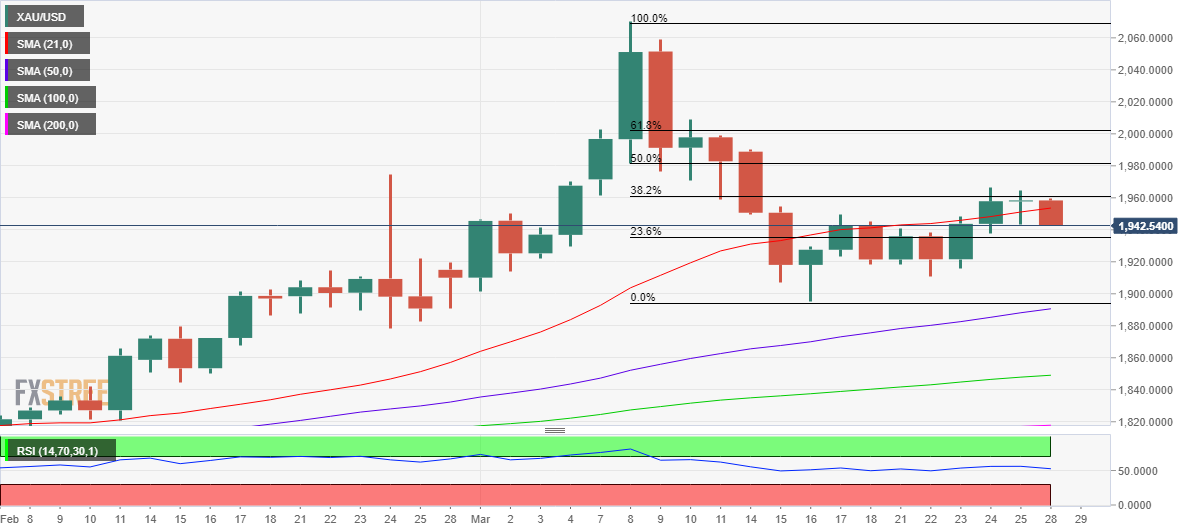
Gold: Daily chart
As observed on the daily chart, gold price failed to find acceptance above $1,961 on a daily closing basis. That level is the 38.2% Fibonacci Retracement (Fibo) level of the recent descent from 2022 highs of $2,070 to the March 16 lows of $1,895.
The rejection at higher levels prompted bears to take over complete control, extending gold’s pullback below the ascending 21-Daily Moving Average (DMA) at $1,954.
The next crucial support is seen at the 23.6% Fibo level of the same downtrend at $1,935. A firm break below the latter will open floors towards the previous week’s low of $1,910.
Further south, powerful support near $1,895 will challenge the bullish commitments. At that price zone, the upward-sloping 50-DMA and the March 16 lows coincide.
Alternatively, if bulls manage to find a strong foothold above the aforesaid resistance at $1,961, then a test of the previous week’s high at $1,966 will be inevitable.
Gold buyers will then target the $1,970 round level, above which the 50% Fibo level at $1,982 will be threatened.
Author

Dhwani Mehta
FXStreet
Residing in Mumbai (India), Dhwani is a Senior Analyst and Manager of the Asian session at FXStreet. She has over 10 years of experience in analyzing and covering the global financial markets, with specialization in Forex and commodities markets.